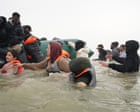
The British government just cut a check for £660 million to the French. Again. They call it a "partnership." They call it "strengthening borders." In any other sector, we’d call it a protection racketeer’s retainer.
If you’ve read the standard headlines, you’ve been fed a diet of lazy consensus: that the English Channel is a "problem" to be "solved" through friction, technology, and cross-border cooperation. This narrative suggests that if we just buy enough thermal cameras, pay for enough gendarmes, and build enough detention centers, the flow will stop. It’s a fairy tale.
Here is the truth the Home Office won't admit: The UK is paying France to fail. We are subsidizing a perpetual-motion machine of border theater that does nothing to address the mechanics of migration while burning taxpayer cash to maintain a political optics strategy that is fundamentally broken.
The Myth of the Deterrence Dividend
Politicians love the word "deterrent." It sounds muscular. It suggests a logical $x + y$ equation where increasing the cost of entry eventually makes the journey unattractive.
But migration doesn't follow the laws of supply and demand found in a freshman economics textbook. It follows the laws of desperate arbitrage. When you spend £660 million on "curbing" crossings, you aren't removing the demand; you are simply increasing the premium that smuggling gangs can charge.
I have watched policy cycles repeat this error for decades. In the private sector, if a strategy yielded a 0% success rate while costs ballooned, the CEO would be fired and the board would be dissolved. In the realm of UK border security, we just double the budget and hope the public doesn't notice the math.
The Math of Failure
Consider the actual distribution of these funds. We are paying for:
- Beach patrols that move the launch points 5 miles down the coast.
- Drones that watch boats leave, only to "hand over" the responsibility to the RNLI once they hit the halfway mark.
- Intelligence sharing that targets low-level "pilots" while the actual logistics hubs in Germany and Belgium remain untouched.
This isn't a security strategy. It’s an expensive game of Whac-A-Mole where the mole has a speedboat and the hammer is made of bureaucratic red tape.
France is Not Your Border Guard
The fundamental flaw in the UK’s approach is the assumption that France has a vested interest in stopping these boats. Why would they?
From a purely cold-blooded, geopolitical perspective, every boat that leaves a French beach is one less person for the French social security system to manage. France isn't "failing" to stop the boats; they are managing an exit strategy. By paying them £660 million, we aren't buying a solution. We are paying for the privilege of being France's complaining customer while they facilitate a transfer of people from their jurisdiction to ours.
If you want to stop a flow, you don't pay the guy upstream to stand there with a bucket. You change the reason why the water is flowing in the first place.
The Economic Reality of the Small Boat Market
Let’s talk about the smugglers. The media paints them as shadowy figures in trench coats. In reality, they are logistics professionals. They understand market dynamics better than the Home Office does.
When the UK spends hundreds of millions on "security," the smugglers don't quit. They innovate.
- Risk Premium: Increased patrols allow smugglers to hike prices. This attracts higher-tier criminal organizations with better resources.
- Safety Degradation: As high-quality RIBs are seized, gangs switch to cheaper, more dangerous inflatables. The death toll rises, but the volume remains constant.
- Displacement: Closing one route (like the Port of Calais) didn't stop the movement; it created the small boats crisis.
We are literally funding the evolution of the smuggling industry. By creating artificial scarcity in "safe" crossings, the British government has handed the entire market to organized crime on a silver platter.
The False Premise of "People Also Ask"
If you look at the common questions surrounding this issue, you’ll see the same flawed premises:
- "Why don't we just send them back to France?" Because there is no legal return agreement. You cannot force a sovereign nation to take people back without a treaty. Paying £660 million doesn't buy that treaty; it buys a "joint statement" and a few more police officers on a beach in Dunkirk.
- "Is the UK a magnet for migrants?" The UK is a magnet for people who speak English or have family here. No amount of barbed wire in Pas-de-Calais changes the fact that the English language is the world's most valuable asset.
A Brutal Alternative: The Infrastructure of Reality
If we actually wanted to dismantle the smuggling trade, we wouldn't spend £660 million on French patrols. We would spend it on processing centers in France and Belgium.
I know—the mere mention of "safe routes" or "offshore processing" makes hardliners break out in hives. But look at the data. Most of those crossing the Channel end up being granted asylum anyway. We are paying hundreds of millions to watch them cross a dangerous sea, only to bring them into the system once they arrive.
The current system is:
- Pay France to "stop" them (Failure).
- Pay the RNLI and Border Force to rescue them (Costly).
- Pay for hotels for years while the backlog grows (Inefficient).
A rational actor would bypass steps 1 and 2.
By setting up a legal processing hub in France, you kill the smugglers' business model overnight. Why pay a gang £5,000 for a 10% chance of drowning when you can submit a form and get a "Yes" or "No" in 48 hours?
The "No" would be enforceable. The "Yes" would be orderly. But we won't do it. Why? Because it’s "politically impossible." It’s easier to waste half a billion pounds of your money on the illusion of control than to exercise actual control that looks like a concession.
The Sunk Cost Trap
The UK government is currently suffering from the Sunk Cost Fallacy. They’ve spent billions over the last decade, and because the numbers of arrivals keep rising, their only solution is to spend more.
It’s the same logic used by failing tech startups: "We just need more runway." But the runway is made of taxpayer cash, and the plane doesn't have wings.
We are paying France to be our bouncer, but the bouncer is letting everyone in the back door while charging us for the VIP velvet rope at the front. It is a massive transfer of wealth from British citizens to the French state and, indirectly, to the criminal networks that thrive on the chaos we’ve funded.
Stop Buying the Theater
The £660 million isn't a security budget. It’s a marketing budget. It’s designed to make the evening news look like "action" is being taken.
If we were serious about border integrity, we would stop obsessing over the beach and start obsessing over the ledger. We would stop paying for patrols that don't patrol and start investing in a system that removes the profit motive from the Channel.
Until then, we are just the world’s biggest marks, paying for the privilege of watching a crisis we helped fund. Stop asking when the boats will stop. They will stop when the UK stops making it more profitable to cross illegally than to wait for a decision.
The check has been signed. The boats will keep coming. And in two years, we'll be told that we need to pay £800 million to "finally" finish the job.
Don't believe it. You're being sold a lemon, and the French are laughing all the way to the bank.


