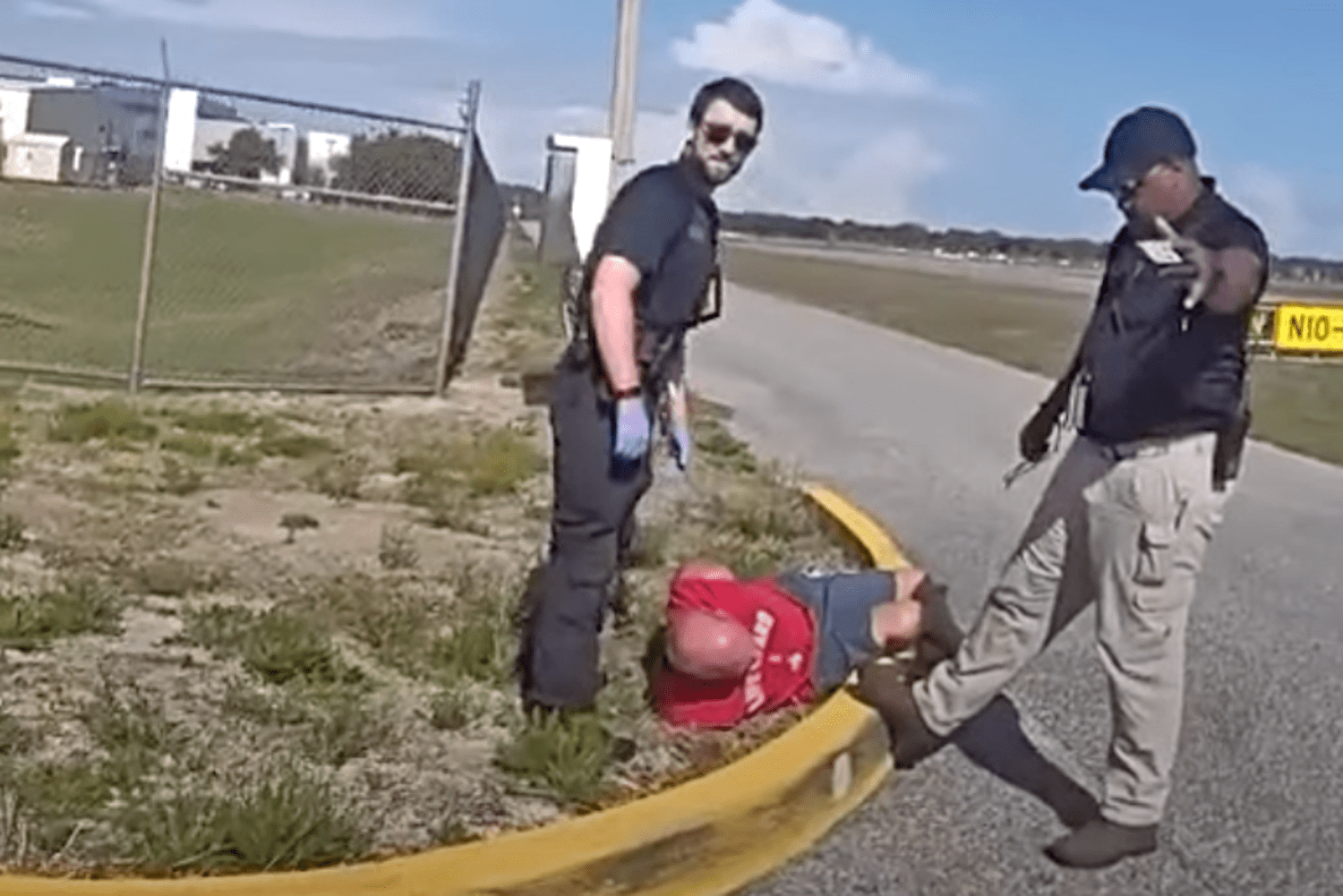
The headlines are predictable. They read like a script from a mid-market local news desk: "Drunken Driver Plows Car into Gate," "Chaos at Florida Airport," "Man Tries to Board Plane After High-Speed Chase." The media wants you to focus on the intoxication. They want you to cluck your tongue at the individual’s poor life choices and the "heroic" response of the police who eventually tackled him on the tarmac.
They are missing the only story that matters. Learn more on a connected topic: this related article.
This wasn’t a failure of one man’s sobriety. It was a total, systemic collapse of the billion-dollar security theater we have all agreed to participate in since 2001. If a drunk in a sedan can breach the perimeter, navigate a live airfield, and physically touch an aircraft before the "layers of security" stop him, then the perimeter doesn't actually exist.
We are spending billions on biometric scanners and making grandmas take off their shoes while the literal back door is held shut with a latch that a 2010 Toyota can defeat. Further analysis by National Geographic Travel highlights similar perspectives on the subject.
The Perimeter Fallacy
Airport security is designed to catch the person who follows the rules. It is built on the assumption of cooperation. You stand in the line, you show the ID, you walk through the metal detector. The industry calls this "compliance-based security."
The Florida incident—and dozens like it every year that don't make the national cycle—exposes the Perimeter Fallacy. This is the belief that because a fence exists, the area inside it is secure. In reality, airport "landside" security is often nothing more than a suggestion.
Most major US airports are sprawling municipalities. They have miles of fencing, hundreds of service gates, and various entry points for contractors, catering, and fuel. I have consulted on logistics for high-security zones, and the "battle scars" are always the same: we over-invest in the front door and leave the windows unlocked.
When a vehicle breeches a gate at a commercial airport like Sarasota-Bradenton or Orlando, the response time is measured in minutes. On a runway, minutes are an eternity. A plane taking off or landing at 150 mph doesn't have "minutes" to react to a rogue SUV in its path.
The Myth of the Hardened Gate
Why did the gate fail? Because we prioritize convenience over kinetic resistance.
True hardened barriers—the kind you see at military installations or embassies—are designed to stop a 15,000-pound truck traveling at 50 mph. They use deep-foundation bollards and massive steel plates.
Most airport perimeter gates are "safety-first" designs. They are built to break away or swing open to prevent injury to the driver or to allow emergency services easy access. We have traded actual physical security for liability reduction. We aren't building fortresses; we're building gated communities with better branding.
TSA is Not Who You Think They Are
The public often asks, "Where was the TSA?"
This question reveals a fundamental misunderstanding of American aviation law. The TSA (Transportation Security Administration) is responsible for screening passengers and baggage. They are not the police. They are not the perimeter guards. They are glorified clerks with x-ray machines.
The responsibility for the airfield falls on the local airport authority and local law enforcement. This creates a fragmented command structure. When a breach happens, there is a "dead zone" of communication between the guys watching the luggage and the guys watching the fences.
If you want to fix this, you have to stop treating the airport like a mall with a runway attached. It is a high-risk infrastructure hub.
The Drunk Driver as a Penetration Tester
In the cybersecurity world, we hire "Red Teams" to find holes in the network. They don't follow the rules. They try the "stupid" things that the architects assumed no one would ever do.
That drunk driver in Florida was an accidental Red Teamer.
He didn't use a sophisticated cyberattack to bypass the gate. He didn't use a fake ID. He used mass and velocity. He proved that for all the "cutting-edge" (excuse the term, let's call it "expensive") technology inside the terminal, the physical reality of the airfield is incredibly fragile.
If a man with a blood-alcohol level high enough to kill a horse can reach the stairs of a plane, a coordinated group with a plan could do significantly more damage before a single siren is heard.
Stop Fixing the Wrong Problems
The "lazy consensus" after these events is always the same:
- "We need more police patrols."
- "We need more sensors."
- "We need better mental health/substance abuse resources."
None of these address the mechanical reality of the breach.
More police won't help if they are two miles away when the gate gives way. Sensors only tell you that you’ve already been compromised—they don't stop the car. And while substance abuse is a societal issue, security must be "threat-agnostic." It shouldn't matter if the driver is drunk, a terrorist, or a confused elderly person; the barrier should stop the vehicle. Period.
The Unconventional Solution: Kinetic Parity
We need to stop pretending that airports are public parks.
- Active Denial Systems: We need retractable bollards at every vehicle entry point that are "normally closed." If a vehicle doesn't have a transponder and a cleared flight plan, the bollard stays up. If they hit it, the car stops. The driver might die. That is the price of securing a runway where 300 people are sitting in a tube of kerosene.
- Automated Drone Interdiction: The moment a perimeter sensor is tripped, an automated drone should be over the target in less than 20 seconds. Not to "observe and report," but to provide real-time telemetry to air traffic control to shut down the runways immediately.
- End the TSA Monopoly: We need to shift funding from passenger "theatrics" (taking off belts and shoes) to perimeter hardening. The ROI on catching a pocketknife is near zero. The ROI on preventing a vehicle-to-aircraft collision is infinite.
The Cost of the Truth
The downside to my approach? It’s expensive, and it’s "ugly."
People like the feeling of security they get from a smiling TSA agent. They hate the reality of security that involves concrete barriers, 10-foot reinforced walls, and the potential for lethal force against trespassers. We have built a system that prioritizes the "travel experience" over the "travel survival."
If we continue to treat these incidents as isolated "Florida Man" stories, we are inviting a catastrophe. The Florida driver didn't just break a gate; he shattered the illusion that we are in control of our most sensitive transport hubs.
Stop looking at the mugshot. Start looking at the fence.
The next person to drive through that gate might not be looking for a plane to board; they might be looking for a plane to hit.
Fix the fence or admit the whole thing is a farce.