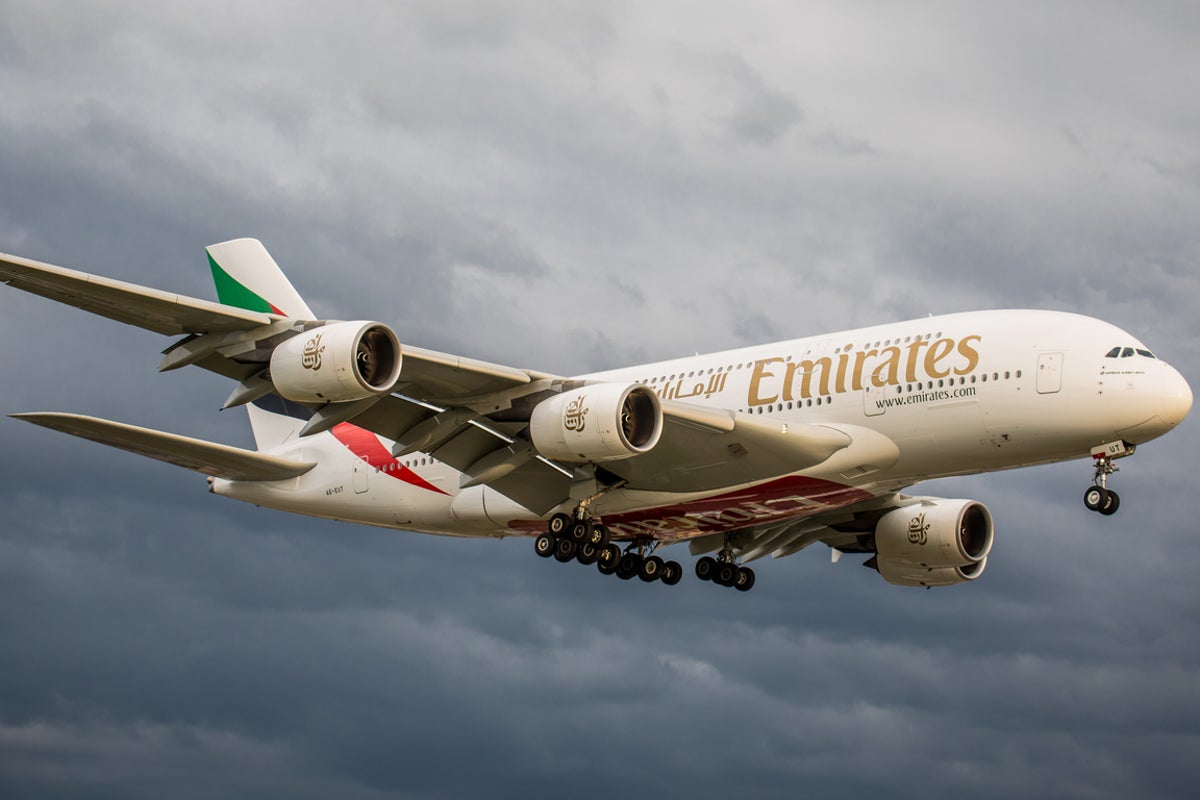
The captain stares at a digital map pulsating with crimson zones. Below the wings of the Airbus A380, the world is fractured. Airspace over parts of the Middle East has become a jagged jigsaw puzzle of "no-go" coordinates and sudden closures. For most, this is the stuff of terrifying news tickers. For the flight crew, it is a geometry problem. To fly from Dubai to London now means weaving through narrow corridors, hugging borders, and burning extra tons of kerosene to skirt the ghost of conflict.
One might expect a company operating out of a geopolitical tinderbox to be bracing for impact. Instead, Emirates just posted a record-breaking annual profit of $4.7 billion.
It is a number so large it feels abstract, like counting stars. But that profit wasn't born from luck. It was forged in a furnace of logistical obsession and a gamble on the human need to move, even when the world is trying to stand still. While the tremors of war in Gaza and regional tensions threatened to ground the industry, the airline didn't just survive. It thrived.
The Calculus of Chaos
When the sirens go off or the diplomatic cables turn cold, the aviation industry usually shudders. We saw it during the pandemic. We see it every time oil prices spike. War is the ultimate disruptor because it deletes the one thing airlines need most: predictability.
Yet, Emirates reported a 71% surge in profit over the last fiscal year. To understand how, you have to look past the gold-plated showers in First Class and into the windowless rooms where the dispatchers sit. These are the people who play a high-stakes game of Tetris with the globe. When a specific flight path over the Levant becomes untenable, they don't just cancel. They reroute.
Consider the "extra mile." During the height of regional disruptions, flights were forced into lengthy detours. This adds cost. It adds time. Normally, this would bleed a carrier dry. However, the demand for travel has become a tidal wave that refuses to break. People are no longer just "taking a trip." They are reclaiming years lost to lockdowns, and they are willing to pay a premium for a carrier that promises to get them there, regardless of the chaos on the ground.
The Ghost of the A380
There was a time, not long ago, when industry experts whispered that the era of the "Superjumbo" was dead. The four-engine giants were called gas-guzzlers. They were considered too big for a world moving toward smaller, point-to-point carbon-efficient jets.
Emirates ignored the eulogies.
They doubled down on the A380. Today, that decision looks like a stroke of genius. As airports across Europe and Asia struggle with capacity and slot constraints, the ability to move 500 people in a single takeoff is a massive competitive advantage. It is the difference between a crowded bus and a private train. While competitors waited for delayed orders of newer, smaller planes, Emirates sat on a massive, ready-to-fly fleet.
Revenue hit a staggering $33 billion. That is the sound of a gamble paying off. It is the sound of filling those massive double-decker cabins with passengers from Mumbai, New York, and Sydney, all funneling through a single hub in the desert.
The Invisible Stakes of the Hub
Dubai is not just a destination; it is a valve. If the valve fails, global trade and travel stutter. This is the invisible weight carried by the Group’s Chairman, Sheikh Ahmed bin Saeed Al Maktoum. He isn't just running a business; he is maintaining a vital organ of global infrastructure.
The record profit isn't merely a victory lap for the shareholders—though they are receiving a handsome dividend of $1.1 billion. It is a war chest. The airline recently announced a massive $52 billion investment in 95 new Boeing aircraft. They are buying the future because they know the present is fragile.
There is a specific kind of tension in being the "bridge" between East and West. You are subject to the whims of every dictator, every revolution, and every fluctuating currency. When the Iranian airspace becomes a point of contention, or when oil prices swing because of a tanker in the Strait of Hormuz, the airline feels the vibration first.
But there is a psychological layer to this success. We live in an era of profound fragmentation. We are told the world is de-globalizing. We are told that we are retreating into our own borders. Then you walk through Terminal 3 at 3:00 AM. You see a family from Manila meeting a cousin from Frankfurt. You see a tech consultant from San Francisco headed to Bangalore.
The record profits are a mathematical proof that, despite the headlines, our desire to connect remains stronger than the forces trying to pull us apart.
The Cost of the Climb
It would be a mistake to call this "easy money." The operational costs for the airline rose as well. Fuel remains the largest predator on the balance sheet, accounting for roughly a third of all spending. Labor costs are climbing. The world is getting more expensive, and the sky is no exception.
The airline also had to navigate the "wet-lease" reality—hiring other planes and crews to fill gaps left by Boeing’s delivery delays. It was a messy, expensive year behind the scenes. The polished image of a cabin crew member in a red hat is the result of a thousand small fires being put out in real-time.
There is also the matter of the environment. A $4.7 billion profit looks different when viewed through the lens of carbon emissions. The company is pumping millions into sustainable aviation fuel (SAF), but the technology is still in its infancy. They are flying record numbers of people while the planet records record temperatures. This is the paradox they must eventually solve. A profitable airline in a world that can no longer support flight is a hollow victory.
The View from 40,000 Feet
Imagine you are that passenger on the night flight over the Persian Gulf. You look out the window. Below, the world is dark, save for the occasional clusters of city lights or the orange flare of an oil rig. You are aware, in a distant way, that the geography you are traversing is fraught with history and heat.
But inside the cabin, there is a strange, pressurized peace. There is a movie playing. There is a warm meal. There is the steady, reassuring hum of engines that have been maintained with obsessive precision.
That peace is what people are buying. They aren't just buying a seat from point A to point B. They are buying a temporary exemption from the chaos of the world. Emirates’ record profit is the price the world is willing to pay for that exemption.
The airline has turned the desert into a crossroads and turned geopolitical disruption into a logistical footnote. They have bet on the idea that no matter how many borders are drawn or how many conflicts arise, the human impulse to see what is on the other side of the horizon will never be grounded.
The sun rises over the Hajar Mountains, hitting the polished silver bellies of a hundred planes lined up like soldiers on the tarmac. Each one represents a billion-dollar risk. Each one is a testament to the fact that in the business of the sky, the only way to survive the storm is to fly right through the center of it, higher and faster than anyone thought possible.