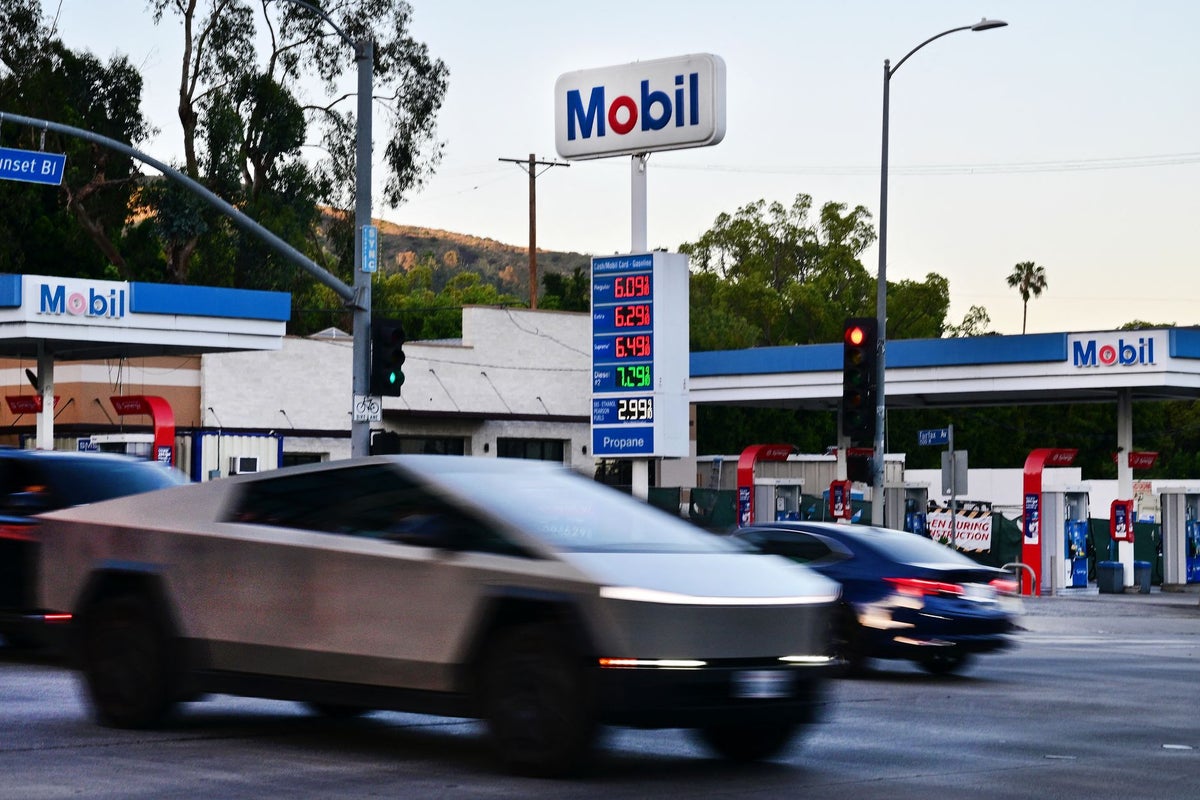
Mono County, California, represents the extreme upper bound of a domestic fuel cost function that most consumers interpret through the lens of political frustration rather than economic mechanics. To understand why a single county consistently benchmarks as the most expensive fuel market in the United States, one must move beyond the surface-level "skyrocketing prices" narrative and dissect the structural, fiscal, and logistical bottlenecks that create a localized pricing premium. The volatility in national averages is merely noise; the true signal lies in the convergence of California’s unique regulatory architecture and the specific isolation of the Eastern Sierra.
The Tri-Factor Model of Regional Fuel Disparity
Retail fuel pricing at the county level is not a monolith but a calculation of three distinct layers: the spot price of the underlying commodity, the state-level regulatory and fiscal overlay, and the local distribution friction.
1. The California Regulatory Premium
California functions as a "fuel island." Because the state requires a specific oxygenated blend to meet stringent air quality standards, it cannot easily import supply from neighboring states like Nevada or Arizona that use standard EPA blends. This creates a closed-loop supply chain. When a refinery in the state undergoes planned maintenance or an unplanned outage, supply drops precipitously with no immediate external relief valve.
2. The Tax and Carbon Intensity Burden
The fiscal stack in California is the highest in the nation. This includes the state excise tax, the federal excise tax, and local sales taxes. However, the hidden drivers are the Low Carbon Fuel Standard (LCFS) and the Cap-and-Trade program. These programs effectively internalize the environmental externalities of carbon combustion at the pump. In a high-price environment, these costs are passed directly to the consumer, adding a significant floor to the price that cannot be undercut regardless of global crude fluctuations.
3. Logistical Isolation and the Last-Mile Penalty
Mono County sits on the eastern side of the Sierra Nevada mountains. Most of California’s refining capacity is concentrated in the Bay Area or the Los Angeles Basin. To reach stations in Bridgeport or Mammoth Lakes, fuel must be trucked over high-altitude mountain passes or brought in from Nevada terminals that have already paid an import premium. The energy required to transport the fuel—ironically, consumed by the trucks themselves—becomes a non-negligible percentage of the final retail price.
Identifying the Outlier: The Case for Mono County
While national headlines focus on the $5.00 or $6.00 thresholds, Mono County often operates in a $7.00+ reality. This is not the result of simple corporate greed, but a manifestation of "low-volume, high-overhead" economics.
Infrastructure Amortization in Low-Density Areas
In high-traffic urban centers, a station can operate on razor-thin margins per gallon because the volume of transactions covers fixed operating costs (land, labor, electricity, insurance). In Mono County, the population density is approximately 4.5 people per square mile. Stations experience long periods of dormancy followed by seasonal spikes in tourism. To maintain a viable business, the margin per gallon must be significantly higher to cover the fixed costs of staying open year-round in a remote environment.
Competition Vacuums
The standard economic model suggests that competition drives prices toward the marginal cost. In rural Mono County, the nearest competing station may be 30 to 50 miles away. This geographical monopoly allows for pricing power that is unavailable to retailers in San Francisco or Sacramento. Consumers are not paying for the fuel alone; they are paying for the convenience of not being stranded in a wilderness area.
The Cost Function of Retail Gasoline
To quantify why prices vary so wildly, we must look at the specific breakdown of a single gallon of gasoline at the pump in a high-cost county.
$$Price = (Crude_{Spot} + Refining_{Margin}) + (Distribution + Marketing) + (Taxes + Regulatory_{Fees})$$
The "Crude Spot" component is globally set, but the other three variables are hyper-local. In Mono County, the Distribution and Regulatory Fees components are maximized.
- Refining Margin Volatility: California's refineries operate at high capacity. Any disruption causes a vertical spike in the refining margin because there is no "spare" capacity for the California-grade blend.
- Environmental Surcharges: These are often indexed. As the price of carbon credits fluctuates in the California market, the price at the pump adjusts. This is a mechanism many consumers fail to recognize as a variable cost.
- Retailer Risk Premium: Operating in an area prone to extreme weather (heavy snowfall) and wildfire risk increases insurance premiums for fuel stations, which is another cost passed through to the consumer.
Structural Failures in Price Reporting
Common media reporting on "most expensive counties" relies on daily averages that often lag behind the actual wholesale (rack) price changes. This creates a perception of "sticky prices" where prices go up instantly but fall slowly. In reality, small-town retailers in places like Mono County buy fuel in smaller batches. If they bought a load of fuel when the wholesale price was at its peak, they cannot lower their retail price until that inventory is depleted without taking a direct loss on the capital invested in the product.
The Inventory Cycle Effect
Large stations in Los Angeles may turn over their underground tanks every 24 to 48 hours. A station in a remote part of Mono County might take a week or more to sell through a single delivery. This creates a significant time lag in pricing. When national prices start to trend downward, these remote counties appear even more expensive by comparison because they are still selling "expensive" inventory purchased ten days prior.
The Strategic Reality of Fuel Procurement
For residents and commercial operators in high-cost corridors, the solution is not waiting for federal intervention or a shift in global crude supply. The pricing in Mono County is structural, not temporal.
- Geographical Arbitrage: Commercial fleets often utilize "wet-hosing" or private fueling stations located in neighboring jurisdictions (like Washoe County, Nevada) where the tax structure is more favorable, though California's "use tax" laws technically aim to capture this.
- Fuel Hedging: Large-scale consumers in the region must move toward fixed-price contracts or bulk storage to bypass the volatility of the retail pump.
- Decoupling from Liquid Fuels: The extreme cost of fuel in the Eastern Sierra serves as a natural economic accelerator for vehicle electrification. When the "payback period" for an electric vehicle is calculated against $7.00/gallon gasoline versus $4.00/gallon gasoline, the transition to EV or hybrid fleets becomes a matter of fiscal necessity rather than environmental preference.
The persistence of Mono County at the top of the price charts is a permanent feature of its geography and the state's legislative priorities. It serves as a laboratory for understanding the true cost of fuel when logistics are pushed to the limit and carbon is priced into the transaction. Any strategy centered on a "return to normal" for these prices ignores the fundamental cost function of the region.
The Forecast for Regional Fuel Markets
Short-term relief is unlikely given the current refinery footprint in the Western United States. No new refineries have been built in California in decades, and existing facilities are increasingly being converted to renewable diesel plants, which further tightens the supply of traditional CARBOB (California Reformulated Gasoline).
Expect the "spread" between national averages and Mono County to widen. As the regulatory environment in California continues to tighten through the 2030s, the fixed costs of maintaining gasoline infrastructure will be distributed across a shrinking pool of internal combustion engine (ICE) users. This will create a "death spiral" for rural fuel pricing: lower volume leads to higher per-gallon margins required for survival, which further incentivizes the abandonment of the fuel type.
Strategic stakeholders should view the current pricing not as a temporary spike, but as the new baseline for isolated, high-regulation markets. Optimization of supply chains and the aggressive transition to alternative energy carriers are the only viable hedges against this localized inflation.