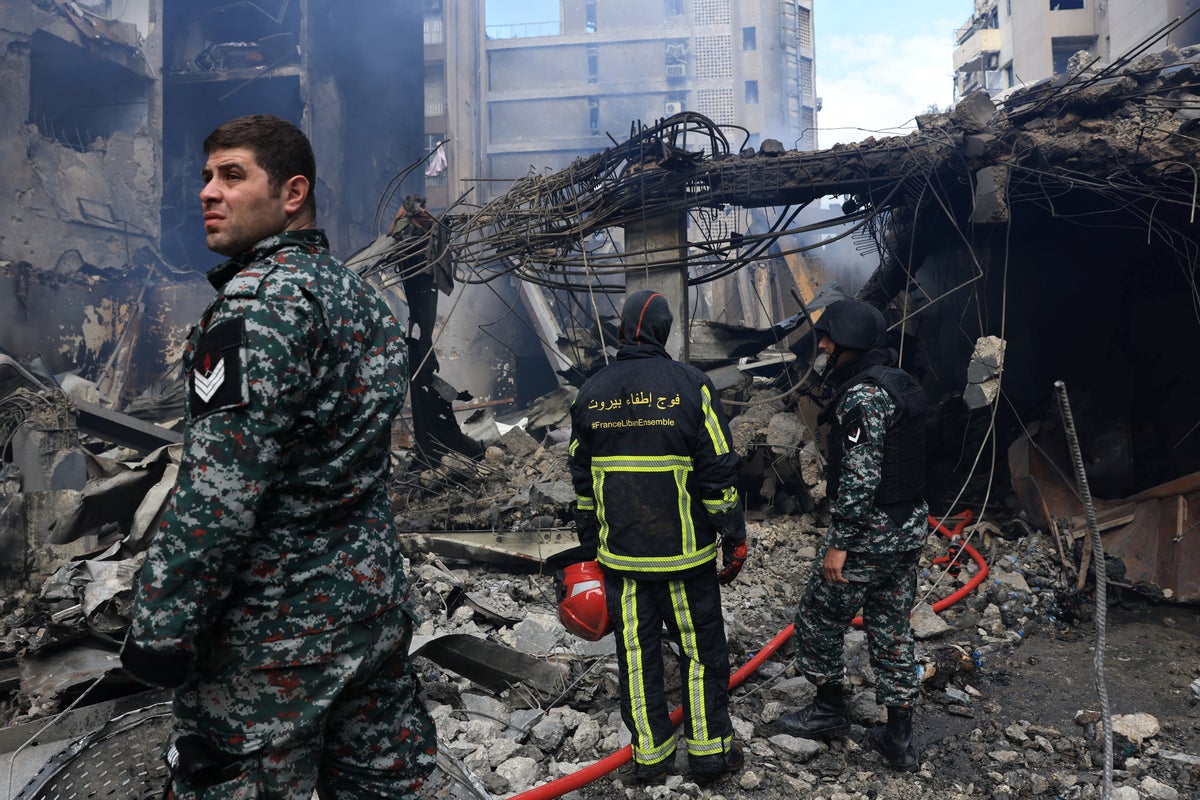
The air in Beirut does not just smell of smoke. It smells of pulverized concrete, ancient dust, and the metallic, cloying scent of blood that has nowhere to go. Inside the operating theaters of the city, the silence is more deafening than the explosions. It is a heavy, pressurized silence, broken only by the rhythmic hiss of ventilators and the wet slap of surgical gloves.
Dr. Ghassan Abu-Sittah knows this silence intimately. He has spent a lifetime chasing it, trying to reclaim it from the cacophony of war. A British-Palestinian surgeon with a face that carries the weary geography of a dozen conflict zones, he does not look like a man who scares easily. But as he stands over a jagged remains of what was once a human limb, the scale of the horror in Lebanon has shifted something fundamental in his understanding of trauma.
He calls it an absolute massacre. He does not use the word for effect. He uses it as a clinical diagnosis.
The Weight of the Incoming
When the strikes hit the southern suburbs, the hospitals do not just fill up. They overflow like a dam bursting. It begins with a low vibration in the floorboards—the herald of an ambulance fleet. Then comes the red.
Consider the logistics of a single blast. In a standard medical setting, a trauma team might mobilize for a car accident involving three people. In Beirut, the "accident" involves an entire apartment block. The patients arrive not in ones or twos, but in waves. They are coated in a grey, ghostly soot that makes them look like statues until they begin to scream.
Dr. Abu-Sittah describes a reality where the sheer volume of the wounded strips away the luxury of traditional medicine. This is "war surgery" in its most primal form. You are no longer just a doctor; you are a sorter of souls. You look at a father holding a child and you have to decide, in the space of a heartbeat, who has the best chance of seeing the sunrise.
The injuries are not clean. Modern munitions are designed to shred. They create complex, multi-system traumas—burns that reach the bone, shrapnel that migrates through the bloodstream, and blast injuries that turn internal organs into something resembling jelly. To witness this is to see the limits of the human frame. We are remarkably resilient until we are suddenly, violently, not.
The Ghost of Gaza in Beirut
For Abu-Sittah, this is a hauntingly familiar script. He spent weeks in Gaza’s Al-Shifa hospital before it was reduced to a shell, and the parallels he draws are not merely political—they are biological. He sees the same patterns of destruction, the same "massacre" signature written in the flesh of his patients.
The invisible stakes here are not just about who survives the night. It is about the collapse of a healthcare system that was already gasping for air. Lebanon’s economy has been in a freefall for years; its doctors have emigrated in droves, and its medicine cabinets are often bare. When the bombs fall, they fall on a system that is held together by little more than the stubbornness of its nurses.
Imagine a hypothetical nurse named Maya. She hasn’t been paid a full salary in eighteen months. Her own home was rattled by the blast, her windows blown inward. But she is here, in the dim light of a hallway, holding a flashlight so a surgeon can stitch a wound because the generator is flickering. Maya is the human element that statistics ignore. She represents the thousands of Lebanese citizens who are absorbing the shockwaves of a regional war they did not ask for.
The strikes target "infrastructure," but in the emergency room, infrastructure has a name. It is the five-year-old boy with third-degree burns. It is the grandmother who was sitting in her kitchen when the ceiling became the floor.
The Ethics of the Impossible
There is a specific kind of psychological toll that comes from practicing medicine under these conditions. It is called moral injury. It happens when a healer is forced to provide sub-standard care because the world has failed to provide the tools.
Dr. Abu-Sittah speaks of the "scorched earth" approach to urban warfare. When you strike a densely populated area, the distinction between a combatant and a civilian becomes a semantic game played by people in air-conditioned rooms. In the operating theater, there are no combatants. There are only bodies. There is only the frantic effort to stop the bleeding.
The surgeon notes that the types of wounds he is seeing suggest the use of high-explosive weapons in residential sectors. This isn't just about the immediate death toll. It’s about the "living dead"—those who survive with permanent disabilities, those who lose their sight, their limbs, or their minds to the sheer pressure of the blast. A single strike can create a generation of dependents in a country that has no social safety net to catch them.
A City on the Edge
Beirut has always been a city of echoes. It remembers the civil war, the 1982 invasion, and the catastrophic port explosion of 2020. The current strikes are not happening in a vacuum; they are being layered on top of a collective PTSD that is so thick you can almost touch it.
People walk the streets with a strange, jagged energy. They look at the sky more than they look at each other. They listen for the characteristic hum of drones, a sound that has become the soundtrack to their daily lives. It is a low-frequency anxiety that never quite leaves the back of the throat.
The "absolute massacre" described by Abu-Sittah isn't just the blood on the floor. It is the systematic destruction of the feeling of safety. When a hospital is no longer a sanctuary, and a home is no longer a shelter, the social contract dissolves.
The Finality of the Wound
As the night drags on, the rhythm of the hospital shifts. The frantic energy of the initial influx gives way to a grim, plodding exhaustion. The floors are slippery. The supply of morphine is dwindling.
Dr. Abu-Sittah moves from one table to the next. His hands are steady, a stark contrast to the world outside the hospital walls. He is a man trying to hold back a tide with a needle and thread. He knows that for every life he saves, the machinery of war is manufacturing a hundred more tragedies just a few miles away.
He speaks to the media not out of a desire for fame, but because he is a witness. In the hierarchy of war, the witness is the most dangerous person in the room. He tells the truth that the polished briefings try to obscure: that there is no such thing as a "surgical" strike in a city. There is only the tearing of flesh and the breaking of bones.
The scale of the carnage in Beirut is a reminder of our shared fragility. We like to believe in the permanence of our lives, our buildings, and our peace. But the surgeon sees the truth. He sees how quickly a human being can be reduced to a "case," and how easily a city can be turned into a graveyard.
He steps out of the theater for a moment of air. The sun is beginning to rise over the Mediterranean, casting a deceptive, golden glow over the ruins. For a second, if you squint, the city looks whole. Then the next ambulance siren cuts through the dawn, and the silence is gone again.
There are no more beds. There are only more people. And the surgeon goes back inside, because in the face of a massacre, the only thing left to do is to try, one stitch at a time, to prove that life still has a price.