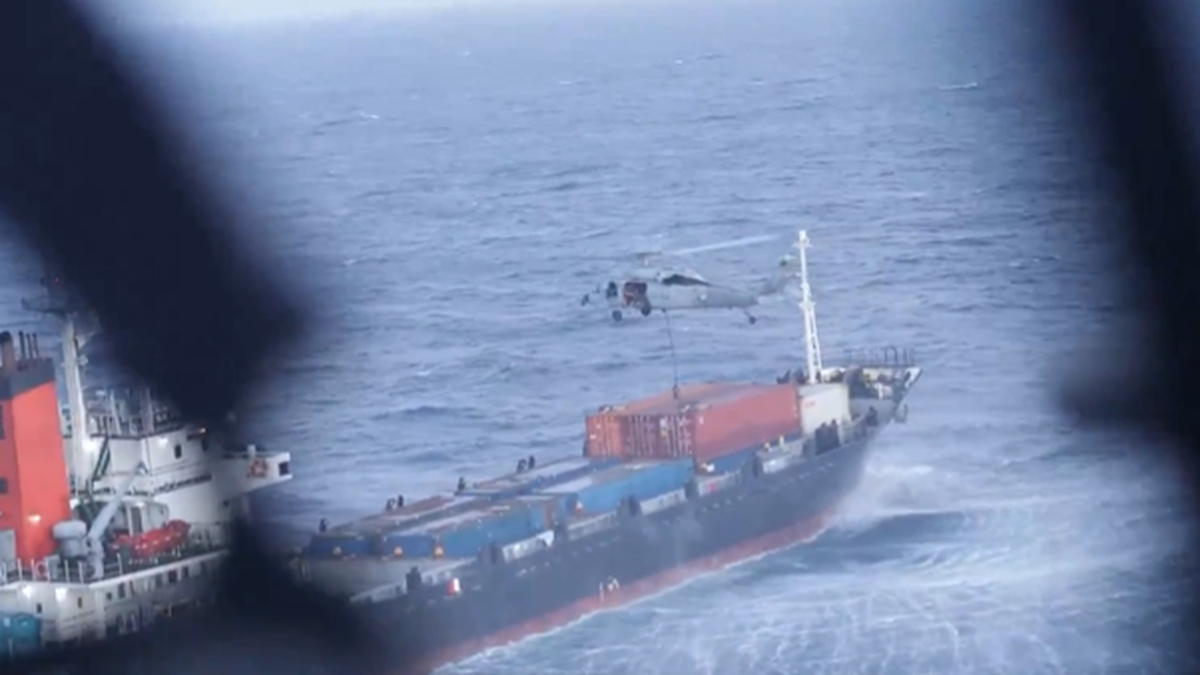
The standard reporting on the U.S. Marines boarding a merchant vessel in the Arabian Sea reads like a script from a 1990s action flick. The narrative is predictable: brave service members fast-rope onto a rusted hull, intercepting "illicit" cargo bound for Iran, effectively "securing" the region. It is a comforting tale of order versus chaos.
It is also a complete misunderstanding of modern maritime power dynamics.
If you think these boardings are about stopping a few crates of drone parts or small arms, you are missing the forest for the barnacles. These operations are not tactical victories; they are loud, expensive signals of a dying strategy. We are watching the world’s most sophisticated military play a game of Whack-A-Mole against an opponent that has already moved the game to a different table.
The Logistics of Futility
Let’s look at the math. The Arabian Sea covers roughly 1.49 million square miles. At any given moment, thousands of vessels transit these waters. To believe that boarding one "suspected" ship changes the regional security equation is like trying to drain the ocean with a thimble.
In my time analyzing naval logistics and maritime choke points, I’ve seen the sheer scale of the failure. The "lazy consensus" suggests that every seizure is a blow to the Iranian supply chain. In reality, it is a minor accounting error for the IRGC (Islamic Revolutionary Guard Corps).
The Iranians do not rely on a single "death star" cargo ship. They use a distributed, resilient network of dhows, "ghost" tankers, and third-party intermediaries that make traditional interdiction look archaic. When the Marines board a ship, they aren’t dismantling a network; they are validating the adversary’s need for more decentralized smuggling routes.
The Intelligence Trap
Most news outlets report these boardings as "intelligence-led." This sounds impressive until you realize how intelligence actually works in the 5th Fleet’s area of responsibility.
The U.S. isn't finding these ships because of some omniscient satellite net. They find them because of human intelligence, signals, and often, tips from rivals. But here is the nuance the press misses: The adversary knows we know.
By the time a VBSS (Visit, Board, Search, and Seizure) team hits the deck, the most sensitive cargo is often long gone, or the ship itself is a "sacrificial lamb." If you can lose one ship to ensure ten others pass through undetected while the Americans are busy processing paperwork and posing for "hero shots," you’ve won the economic war.
We are trading millions of dollars in flight hours, fuel, and personnel risk for a cargo manifest that wouldn't fill a single warehouse in Tehran.
The Myth of "Headed to Iran"
The headline always claims the ship was "headed to Iran" or "coming from Iran." This framing is a relic of the Cold War. In today’s globalized grey market, "destination" is a fluid concept.
Ships change their AIS (Automatic Identification System) data mid-voyage. They conduct ship-to-ship transfers in the dead of night. They use flags of convenience from countries that couldn't find the Persian Gulf on a map.
When we label a ship as "Iran-bound," we simplify a complex web of global trade to fit a political narrative. This isn't about geography; it's about the flow of capital. If the U.S. wanted to stop the flow of goods, they wouldn't be boarding ships in the Arabian Sea; they’d be seizing bank accounts in Dubai, Singapore, and Geneva. But that’s "too messy" for a press release. Boarding a ship is cinematic. Auditing a shell company is boring.
The Technology Gap Nobody Wants to Admit
We love to talk about our "cutting-edge" (excuse me, our advanced) sensor suites. We have the MQ-4C Triton. We have the P-8 Poseidon. We have integrated AI-driven tracking.
But here is the brutal truth: the more tech we throw at the problem, the easier we make it for the adversary to spoof us.
I’ve seen how easy it is to overwhelm a surveillance grid with "noise." If you send out fifty low-tech dhows with identical radar signatures, the multi-billion dollar sensor suite struggles to prioritize. The Iranians have mastered the art of the "low-tech swarm." They are using 19th-century maritime tactics to defeat 21st-century sensors.
By forcing the Marines to board physical ships, the adversary is dictating the tempo. They are making us use our most expensive assets to counter their cheapest ones. That is the definition of losing an asymmetric war.
The Human Cost of PR Stunts
Let’s talk about the VBSS teams. These are some of the most highly trained individuals on the planet. Putting them on a slippery deck in the middle of the night to search for some rusted AK-47s is a grotesque misuse of talent.
Every time a team boards a vessel, there is a risk of a mishap, a fire, or an ambush. We are risking Tier 1 and Tier 2 operators for the sake of a Pentagon briefing.
If the goal is truly to stop the shipment, use a drone to disable the rudder and let the ship drift. Why put boots on the deck? Because a drone strike on a "civilian" merchant ship looks bad on the 6 o'clock news. A boarding party looks like leadership. We are prioritizing optics over operational efficiency, and that is a recipe for a future catastrophe.
Dismantling the "Security" Premise
People often ask: "If we don't board these ships, won't the region become even more unstable?"
This question assumes that the current strategy is actually providing stability. It isn't. It's providing a false sense of security while the underlying tensions continue to boil.
The presence of the U.S. Navy in these waters is a constant friction point. It justifies the IRGC’s budget and gives them a "Great Satan" to point at whenever they need to rally their base. Our "policing" of the Arabian Sea is the primary oxygen for their flame.
The unconventional truth? A temporary withdrawal of these specific interdiction operations would likely force regional players—Saudi Arabia, the UAE, and even India—to take more ownership of their own backyard. As long as the U.S. is willing to play the world’s most expensive coast guard for free, no one else has an incentive to step up.
The Economic Reality
We are spending billions to protect shipping lanes for oil that is increasingly destined for China and India. Think about that irony. The U.S. taxpayer is subsidizing the security of energy routes for our primary economic rivals.
If a ship headed to Iran is seized, does it lower the price of gas in Ohio? No. Does it stop the Houthi rebels from firing missiles? Clearly not. Does it change Iran's nuclear ambitions? Not in the slightest.
It is a theatrical performance of "Doing Something."
How to Actually "Win" (If That’s Still the Goal)
If you want to disrupt the Iranian influence in the Arabian Sea, you have to stop thinking about ships and start thinking about networks.
- Total Transparency of Ownership: Force the IMO (International Maritime Organization) to end the practice of "flags of convenience." If we can't see who owns the ship, the ship doesn't sail.
- Aggressive Financial Interdiction: Follow the insurance money. Every one of these "illicit" ships has insurance, often through Western-linked syndicates or reinsurers. You don't need a boarding party to cancel a policy.
- Regional Burden Sharing: If the Gulf states want a secure sea, they need to man the boats. The U.S. should provide the "eyes" (satellite data), but the "hands" (the boarding teams) should be regional.
The current "U.S. Marines Board Ship" headline is a sugar high. It feels good for an hour, but it leaves the body weaker in the long run. We are exhausted by our own tactical successes that lead to strategic failures.
The next time you see a photo of a Marine standing over a pile of seized rifles on a merchant deck, don't feel "secure." Feel concerned that we are still using a 20th-century hammer to hit a 21st-century ghost.
We aren't winning the Arabian Sea. We are just paying to keep the lights on for a show that should have been canceled years ago.
Stop applauding the boarding. Start questioning the mission.