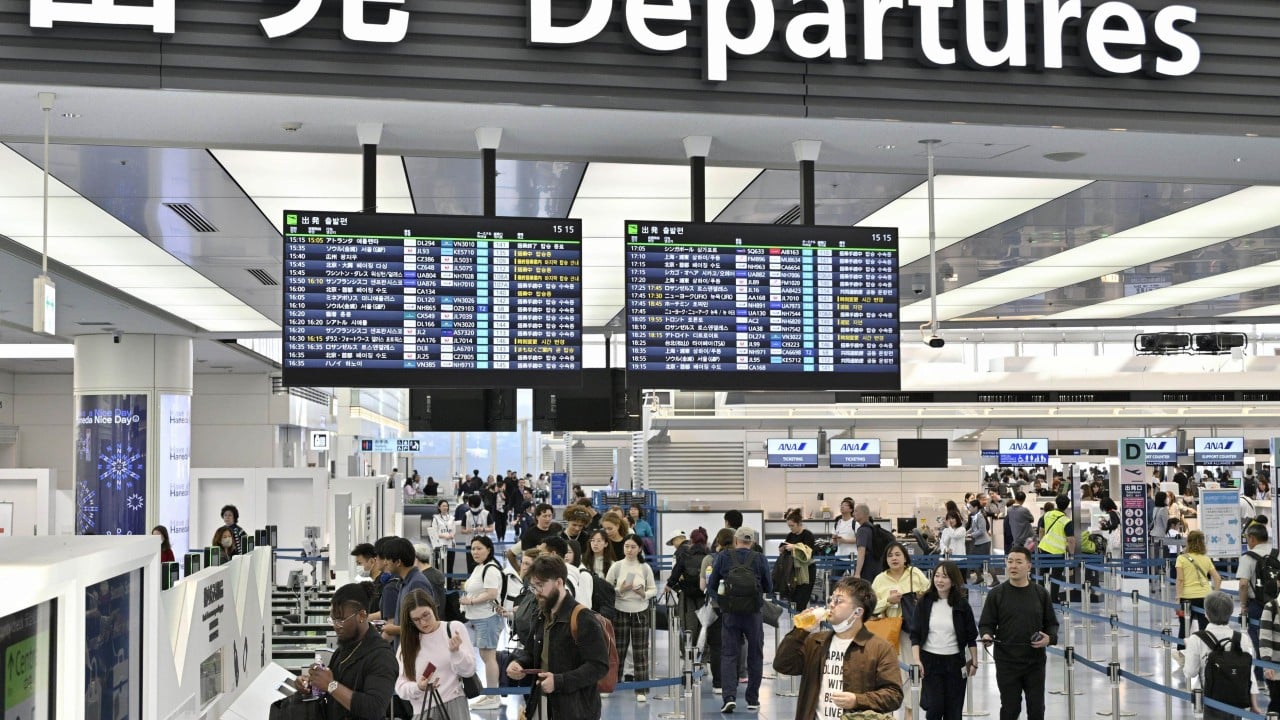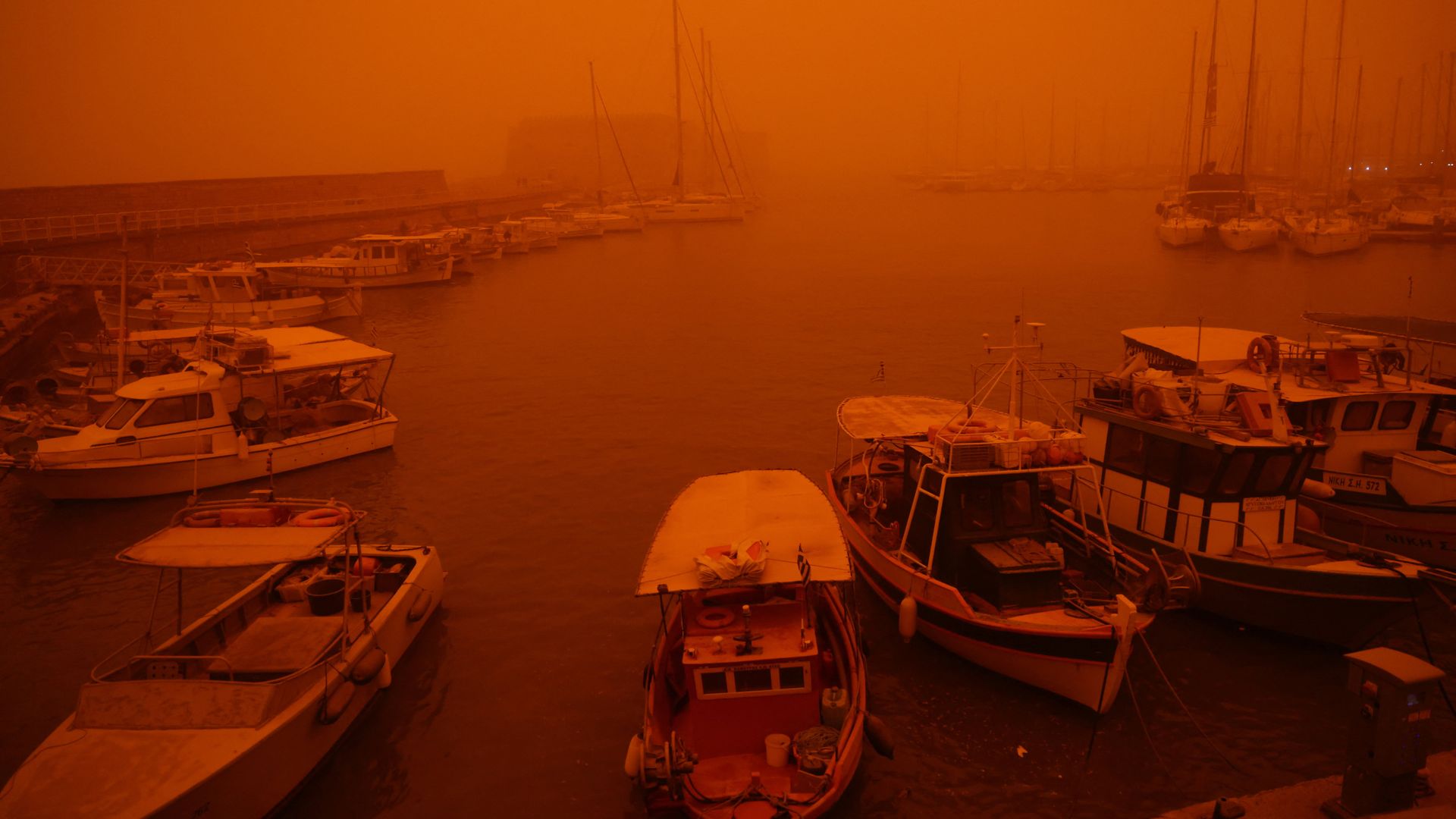
The visual transformation of the Canary Islands during a severe Saharan air layer (SAL) intrusion—characterized by a chromatic shift toward the deep red spectrum—is the aesthetic byproduct of a specific meteorological mechanism known as the Calima. While media reports focus on the "blood red" optics, the underlying reality is a high-density suspension of mineral dust that disrupts regional logistics, public health, and thermal equilibrium. Understanding the Calima requires moving past the spectacle to analyze the physics of aerosol transport and the operational friction it creates for the Macaronesian archipelago.
The Mechanics of Long-Range Mineral Transport
The Saharan air layer is an elevated mass of very dry, dust-laden air that forms over the Sahara Desert from late spring to early autumn, though winter intrusions are increasingly potent. The process follows a three-stage mechanical sequence:
- Aeolian Erosion and Uplift: Intense solar heating over the African continent creates thermal instability. Strong surface winds, often associated with the Harmattan or localized convective cells, lift fine mineral particles (clays, silts, and quartz) into the troposphere.
- The Convection-Advection Bridge: These particles are pushed upward to altitudes between 1,500 and 6,000 meters. A temperature inversion layer acts as a physical lid, trapping the dust-laden air.
- The Pressure Gradient Force: A high-pressure system over the Sahara, coupled with low pressure to the west, creates a conveyor belt. The dust mass is advected westward over the Atlantic.
When this layer descends or intersects with the lower-level trade winds, the Canary Islands experience a "Calima." The red hue frequently cited in news reports is the result of Mie scattering. Unlike Rayleigh scattering, which makes the sky blue by scattering shorter wavelengths, the larger mineral particles in a Calima scatter all visible wavelengths, but with a heavy bias toward longer red and orange wavelengths as the dust concentration ($PM_{10}$ levels) exceeds specific thresholds.
The Triad of Operational Impact
The arrival of a major dust storm introduces immediate systemic shocks across three primary sectors. These are not isolated incidents but rather a cascading series of failures dictated by the density of the particulate matter.
1. Aviation and Logistical Paralysis
Visibility is the primary KPI for island connectivity. During a severe Calima, horizontal visibility can drop below 400 meters, effectively hitting the operational minimums for many regional airports.
- Engine Attrition: Mineral dust is abrasive. Turbine engines ingesting high concentrations of silicates face accelerated wear on compressor blades and potential glassification if particles melt in the combustion chamber.
- Network Disruption: Because the Canary Islands serve as a hub for European winter tourism, a 24-hour closure of Gran Canaria (LPA) or Tenerife South (TFS) creates a multi-day backlog, as the islands lack the redundant high-speed rail infrastructure found on mainland Europe.
2. The Respiratory Load Function
Public health impact is quantified by the concentration of Particulate Matter (PM). In a standard environment, $PM_{10}$ (particles under 10 micrometers) is the baseline. During an intense Saharan storm, these levels can spike from a "healthy" 20 $\mu g/m^3$ to well over 500 $\mu g/m^3$.
- Physical Barrier Inefficiency: Human upper respiratory systems are optimized to filter larger debris, but $PM_{10}$ and $PM_{2.5}$ bypass these defenses, entering the bronchioles and gas-exchange regions of the lungs.
- Pathogen Hitchhiking: Research indicates that Saharan dust acts as a substrate for bacteria and fungi, potentially introducing foreign biological stressors into the local ecosystem and human population.
3. Thermal Inversion and Energy Demand
The Calima is often accompanied by a significant temperature spike. The dust layer absorbs incoming solar radiation, but more importantly, the dry air mass prevents the usual cooling effect of the maritime trade winds.
- The Heat Trap: Temperatures can jump 10°C within hours. This creates an immediate surge in HVAC (Heating, Ventilation, and Air Conditioning) load, stressing the islands' localized, isolated power grids.
- Solar Yield Degradation: For an economy attempting to pivot toward renewables, the Calima presents a paradox. While the sun is "out," the aerosol optical depth (AOD) is so high that photovoltaic output can drop by 30% to 80% due to light scattering and physical dust accumulation on panels.
Quantifying the Event: Visibility vs. Particulate Density
The "blood red" sky is a qualitative observation; the quantitative reality is measured through the relationship between extinction coefficients and mass concentration. The opacity of the atmosphere is a function of the total number of particles and their size distribution.
In a low-intensity event, the sky appears "milky" or hazy. The red shift occurs when the optical depth is so high that only the longest wavelengths can penetrate the particulate curtain. For travelers and residents, the transition from "haze" to "emergency" is marked by the smell of sulfur or dry earth and a palpable increase in static electricity, caused by the extreme lack of humidity (often dropping below 10%).
The Economic Friction of "Adventure Travel" Narratives
The competitor narrative frames these events as a dramatic backdrop for a holiday. This is a fundamental misunderstanding of the travel economy's risk profile. A "blood red sky" event is not a localized curiosity; it is a force majeure event that triggers:
- Insurance Liability: Large-scale cancellations under "Acts of God" clauses.
- Health System Strain: Increased ER admissions for asthma and cardiovascular distress.
- Agriculture Loss: The abrasive nature of the wind and the high salt content often found in Saharan deposits can "burn" crops, particularly the sensitive banana plantations of La Palma and Tenerife.
Structural Mitigation and Tactical Response
Managing the impact of a Saharan dust storm requires a shift from reactive observation to predictive modeling. The following framework outlines the necessary response hierarchy for stakeholders in the region.
Infrastructure Hardening
- Air Filtration Standards: Transitioning commercial and public buildings to HEPA-grade filtration systems capable of stripping $PM_{2.5}$ particles.
- Grid Redundancy: Developing battery storage to offset the simultaneous loss of solar yield and the spike in cooling demand.
Algorithmic Forecasting
The use of the Copernicus Atmosphere Monitoring Service (CAMS) allows for a 48-to-72-hour lead time. Strategic planning must integrate these forecasts into:
- Port Authorities: Adjusting vessel schedules before visibility drops to critical levels to avoid offshore holding patterns.
- Health Alerts: Issuing automated "Shelter in Place" orders for vulnerable demographics based on real-time $PM_{10}$ sensor data.
The Geopolitical and Climatic Variable
The frequency and intensity of Saharan dust events are linked to the desertification of the Sahel and the behavior of the North Atlantic Oscillation (NAO). A "negative" NAO phase often correlates with more frequent dust transport toward the islands. As desert boundaries shift and global wind patterns face disruption from thermal anomalies in the Atlantic, the "blood red" sky will likely transition from a seasonal anomaly to a frequent operational constraint.
The strategic imperative for the Canary Islands is to decouple their tourism and logistical stability from the unpredictability of the African air mass. This involves a transition toward high-resiliency infrastructure and a move away from marketing the islands as a purely "sun and sea" destination, instead highlighting their capacity for high-tech, resilient living in an increasingly volatile climate.
The immediate tactical move for any entity operating within this geography is the implementation of a Dust Response Protocol (DRP). This protocol should trigger automated shutdowns of non-essential outdoor labor when $PM_{10}$ exceeds 150 $\mu g/m^3$ and initiate pre-emptive cleaning cycles for all renewable energy infrastructure. The "blood red" sky is not a photo opportunity; it is a signal of environmental loading that demands a sophisticated, data-driven defense.