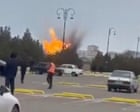
Calling every drone strike "terrorism" is the lazy man’s geopolitics. When a state-aligned actor hits a strategic infrastructure point like the Heydar Aliyev International Airport, labeling it a "terrorist attack" isn’t an analysis—it’s a press release. Azerbaijan’s immediate finger-pointing at Iran following the recent drone incident that injured four people is a masterclass in narrative control, but it ignores the cold, mechanical reality of modern electronic warfare and regional signaling.
This wasn't a random act of chaos designed to frighten the masses. It was a calibrated stress test of a specific defense architecture. If you want to understand what actually happened in Baku, you have to stop looking at the casualty count and start looking at the radar signatures.
The Myth of the Unprovoked Attack
The mainstream media loves the "unprovoked" trope. It builds a clean hero-villain arc. But in the South Caucasus, nothing is unprovoked. Azerbaijan has spent the last three years aggressively integrating Israeli-made defense systems and Turkish Bayraktar tech into a seamless "sensor-to-shooter" network. To Iran, that isn't just a neighbor upgrading their security; it’s a forward-operating base for their greatest regional rivals.
When a drone hits an airport in this context, it is a diagnostic tool.
I have spent years watching defense contractors pitch "impenetrable" bubbles to energy-rich nations. These systems are often sold on the premise that they can intercept low-RCS (Radar Cross Section) targets with 99% efficiency. But a drone strike on a high-security hub like Baku's airport proves that the bubble has a leak. Whether it was an Iranian Shahed variant or a deniable proxy "suicide" drone, the mission wasn't to kill four people. It was to see which frequency the Azerbaijani jammers were using and how fast the Iron Dome—or its local equivalent—could hand off the target from tracking to engagement.
Stop Asking Who and Start Asking How
The standard "People Also Ask" queries focus on the wrong things.
- "Will this lead to war between Iran and Azerbaijan?"
- "How safe are flights to Baku?"
These questions assume this is an emotional escalation. It isn't. It’s a data-gathering exercise. If Iran did this, they didn't do it to start a war; they did it to prevent one by proving they can bypass the very tech Azerbaijan relies on for its sense of invincibility.
Let's talk about the hardware. The "terrorist" label falls apart when you look at the precision. If a state actor wanted to cause mass casualties at a civilian airport, the death toll would be in the hundreds, not four injuries. A low-payload loitering munition hitting a specific sector of the tarmac or a peripheral hangar is a "shot across the bow." It’s a physical manifestation of a "404 Error" sent to the Azerbaijani Ministry of Defense.
The Irony of the Israeli Connection
Azerbaijan is the largest buyer of Israeli loitering munitions in the region. They pioneered the use of the Harop "suicide drone" to dismantle Armenian S-300 systems in 2020. For Baku to now cry "terrorism" when the same tactics are used against them is the height of strategic hypocrisy.
You cannot normalize drone warfare as a tool of "liberation" and then act shocked when those same tools are used to check your own expansion. The "status quo" here is a permanent state of gray-zone conflict. In this zone, there are no terrorists—only actors with varying degrees of deniability.
The real failure here isn't a lapse in counter-terrorism. It’s a failure of the "Maginot Line" mentality. Azerbaijan has invested billions in hardware, but hardware is static. Software and signals are fluid. If a $20,000 drone can injure people at your most protected civilian-military hub, your billion-dollar defense contract is a paperweight.
Why Diplomacy is a Distraction
The international community will call for "restraint." They will tell Iran to respect sovereignty and tell Azerbaijan not to retaliate. This is useless advice.
In the defense industry, we see this cycle constantly:
- The Breach: A vulnerability is exploited.
- The Outcry: The victim uses moral language (terrorism, cowardice) to hide technical embarrassment.
- The Patch: The victim buys more expensive hardware to fix the specific hole used in the breach.
- The Evolution: The aggressor develops a way around the new patch.
Azerbaijan isn't looking for an apology. They are looking for a bigger budget from their energy exports to buy the next generation of jamming tech. Iran isn't looking for a fight. They are looking to remind Baku that while Israeli satellites might see everything, they can't stop a low-flying lawnmower with a pound of C4 from touching their crown jewel.
The Hard Truth About "Civilian" Infrastructure
In the 21st century, there is no such thing as a "purely civilian" airport in a strategic corridor. Baku’s airport is a logistics hub. It’s a refueling point. It’s a signal intelligence node. Labeling an attack on it as "terrorism" is a clever way to bypass the fact that the airport is a legitimate military-adjacent target in any shadow war.
The injuries are a tragedy for the individuals, but for the states involved, those four people are rounding errors in a much larger calculation of regional dominance. If you are waiting for "peace" to return to the Baku-Tehran relationship, you are waiting for a reality that never existed. This isn't a breakdown of order. This is the new order.
Stop buying the narrative that this is an isolated incident of "terror." This is the opening bell for a decade of electronic and kinetic testing that will redefine the borders of the South Caucasus.
Go look at the flight paths. Watch which airlines cancel and which stay. The ones who stay know exactly what this was: a technical demonstration, not a declaration of war. If you want to survive the next decade of "news," you need to stop listening to the politicians and start reading the spec sheets of the drones falling from the sky.
Fix your sensors. The moral outrage won't stop the next one.