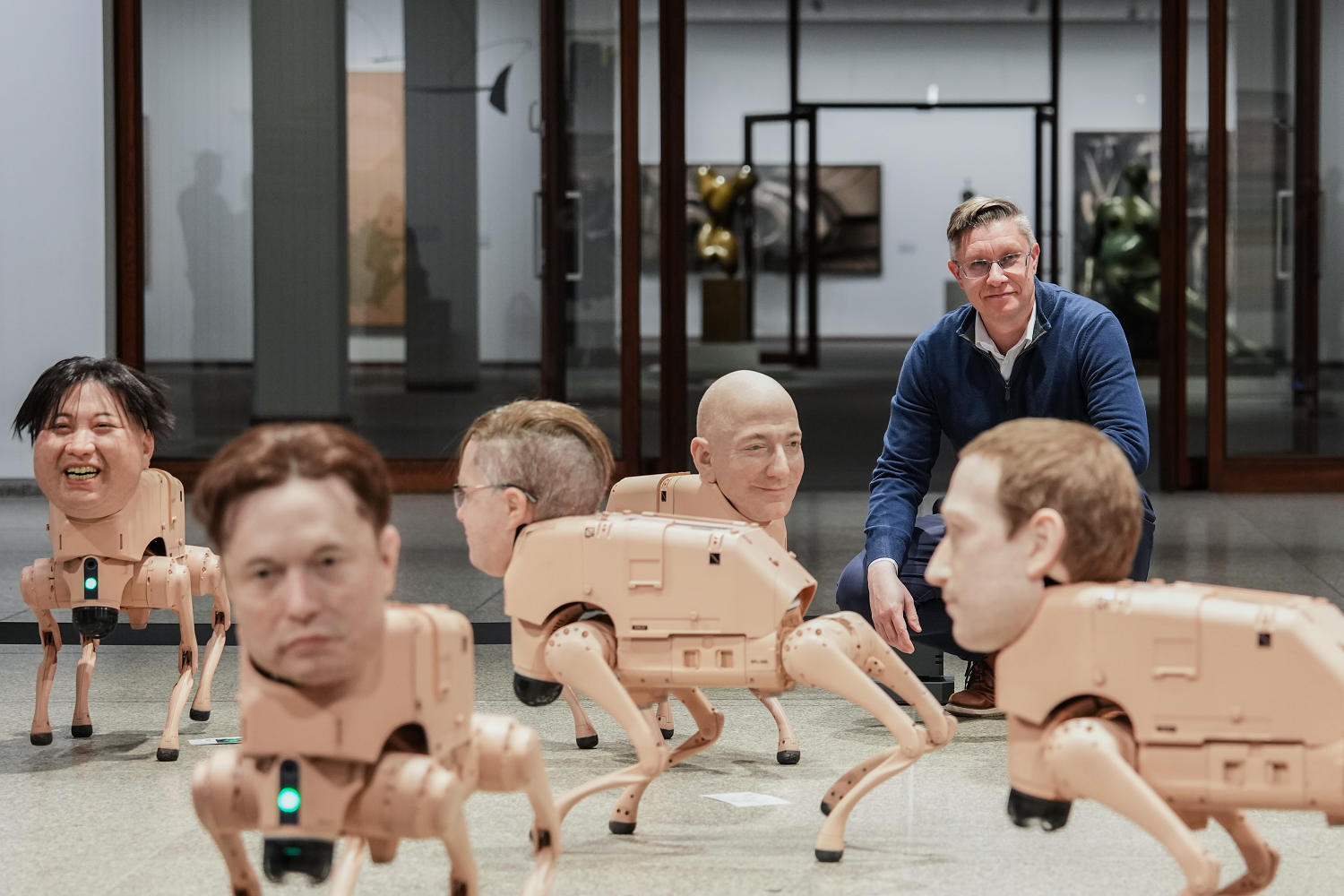
Walk into the Mall of Berlin right now and you'll run into something that looks like a fever dream born in a Silicon Valley basement. Two four-legged machines, mechanical joints whirring, are pacing around with oversized, hyper-realistic heads of Elon Musk and Mark Zuckerberg. It’s creepy. It’s intentional.
The exhibit, titled The Silicon Valley Trail, is the work of Italian artist Filippo Lorenzin. While most people are just stopping to take selfies for the "gram," there’s a much sharper critique happening here. It’s not just about two billionaires who want to cage-fight each other. It’s about how these men have turned themselves into the very hardware of our daily lives. Meanwhile, you can read other developments here: Elon Musk and the OpenAI Litigation Myth Why This Trial is About Marketing Not Ethics.
Why the choice of robot dogs actually matters
You’ve probably seen the Boston Dynamics videos. The ones where the yellow Spot robots dance to Motown or get kicked by engineers to show off their balance. We’ve been conditioned to find them cute, or at least impressive. But by slapping the faces of the world's most powerful tech moguls on them, Lorenzin strips away that friendly "good boy" vibe.
The choice of the robot dog—specifically the Unitree Go2 model used here—is a deliberate nod to surveillance and automation. These aren't pets. They're tools of data collection. Musk’s head on a frame that represents the pinnacle of AI-driven mobility isn't just a joke about Tesla’s Optimus project. It’s a literal representation of his desire to be the "operating system" for the physical world. To see the full picture, we recommend the recent report by The Verge.
Zuckerberg’s presence is equally biting. Since the Meta rebrand, he’s been trying to convince us that his version of reality is the one we should inhabit. Seeing his face on a mechanical beast that follows a pre-programmed path through a shopping center highlights the lack of agency we often feel in his digital ecosystems. We think we're browsing; really, we're being herded.
The setting is the message
Hosting this in a museum that sits inside a massive shopping mall—the Mall of Berlin—is a stroke of genius. Most high-brow art stays tucked away in quiet galleries where people whisper. This exhibit lives where the people are. It lives where the commerce happens.
It forces you to confront these figures while you’re literally in the middle of consuming. You’re holding a shopping bag, maybe checking an X (formerly Twitter) notification or scrolling through an Instagram Reel, and there they are. The physical embodiments of the platforms you’re currently using are walking at your heels.
Berlin has a long, complicated history with surveillance and state control. Putting autonomous robots with the faces of American oligarchs in this city creates a tension you won’t find in San Francisco or London. Berliners don't trust tech by default. They’ve seen what happens when "big data" becomes "big brother," even if the current version comes with a "move fast and break things" sticker on the side.
Technical specs of the mechanical moguls
If you look past the silicon masks, the tech running these dogs is actually quite sophisticated. They aren't just remote-controlled toys. The Unitree Go2 Pro models used in the exhibit feature:
- Ultra-wide 4D LiDAR: This allows them to map the museum floor in real-time, avoiding tourists and toddlers.
- AI-driven gait: They handle the smooth mall tiles and the carpeted museum sections without tripping.
- Point-of-view cameras: While the "eyes" of the masks don't see, the sensors in the chest do.
The irony? These robots are affordable. You can buy one for a few thousand dollars. It’s "democratized" tech used to parody the men who want to monopolize it. Lorenzin has basically hijacked the tools of the future to mock the architects of that future.
Moving beyond the meme
It’s easy to dismiss this as a meme brought to life. Social media is already full of clips of the "Zuck-dog" sniffing a corner or the "Musk-bot" staring down a passerby. But if that’s all you see, you’re missing the point.
We’re currently in a period where these two men are competing for the "Alpha" spot in the AI race. Whether it’s Grok vs. Llama or Starlink vs. the Metaverse, their egos are shaping the infrastructure of the 21st century. The exhibit turns them into pack animals. It suggests that despite their billions, they’re still just machines following a script—one written by the demands of late-stage capitalism and the need for infinite growth.
I’ve watched people interact with them. Some laugh. Others look genuinely disturbed. That visceral "uncanny valley" reaction is the most honest thing about the whole display. We aren't supposed to feel comfortable with our tech leaders being this integrated into our physical space.
What this says about our relationship with AI
We talk about AI as if it’s this invisible cloud of logic. Lorenzin makes it heavy. He makes it clunky and noisy. By giving AI the faces we recognize, he reminds us that "the algorithm" isn't some neutral force of nature. It’s a reflection of the people who fund it.
When the Musk-dog pivots to follow a group of teenagers, it’s a parody of his own erratic social media presence—always desperate for the next engagement hit. When the Zuckerberg-dog maintains a steady, eerie pace, it mirrors the relentless, quiet data harvesting of Meta’s platforms. It’s a physical manifestation of the attention economy.
Don't just watch the video online
If you're in Berlin, go see it. Don't just watch a TikTok of it. There is a specific sound these things make—a high-pitched whine of electric motors—that doesn't translate well to phone speakers. It’s the sound of a future that’s already here, even if it’s currently wearing a rubber mask of a billionaire.
The exhibit doesn't offer a "solution." It doesn't tell you to delete your accounts or throw your phone in the Spree. It just asks you to notice who’s leading the pack.
The next time you’re about to click "Accept All" on a set of terms and conditions, think about a robot dog with a billionaire’s head pacing around a mall. That’s the reality of our digital contract. We aren't the customers; we’re just the obstacles the sensors are programmed to navigate around.
Stop by the museum, take your photo, but pay attention to how the machine moves. It doesn't care if you're there or not. It’s just following the code. If you want to understand the power dynamics of 2026, you could read a dozen white papers on AI ethics, or you could just spend ten minutes watching a mechanical Mark Zuckerberg try to figure out how to walk over a doorframe.