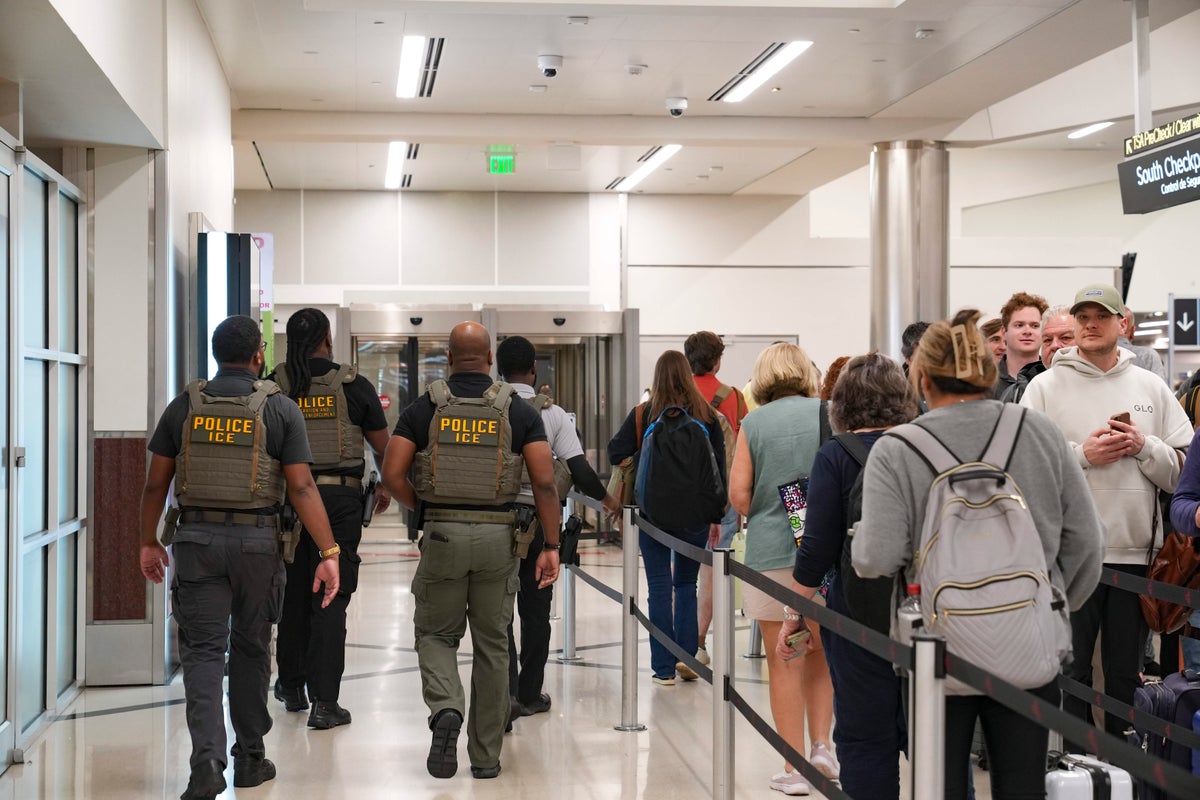
The air in Terminal 4 of JFK doesn't just circulate; it stagnates. It carries the sharp tang of recycled espresso, the heavy musk of damp winter coats, and the low-frequency hum of a thousand private anxieties. For most of us, this is a transitory purgatory. We check our watches, we grumble about the Wi-Fi, and we wait for the metal tube that will whisk us away to somewhere better.
But for the men and women in the crisp navy uniforms, this isn't a transition. It is the destination.
Consider a woman we will call Elena. She is a real person in every sense that matters, even if her name is a shield for her privacy. Elena has stood at the mouth of a metal detector for nine hours. Her lower back is a dull roar of localized pain. She has been barked at by a businessman who forgot he had a liter of Fiji water in his carry-on and sobbed at by a mother whose toddler just had a meltdown over a confiscated toy. Elena isn't just a security officer; she is the human friction point between national safety and public convenience.
And for weeks, she has been doing it for free.
The "Travel Frustrations" mentioned in the headlines are usually measured in minutes—the length of a line, the delay of a flight. But the real frustration, the kind that settles into your marrow, is measured in missed rent payments and empty pantries. When the federal government hits a stalemate, the Transportation Security Administration becomes a ghost fleet. The ships are still sailing, the crews are still at their posts, but the fuel—the actual compensation for their labor—has been cut off.
Donald Trump’s recent announcement that he will sign an executive order to ensure these agents are paid is not merely a bureaucratic adjustment. It is a desperate patch on a hull that has been taking on water for a long time.
The Calculus of a paycheck
To understand why this matters, you have to look past the political theater and into the bank account of a GS-5 federal employee. This isn't the "deep state" of spy novels. This is a workforce that often starts at an hourly wage comparable to a high-end fast-food manager, yet bears the weight of preventing the unthinkable.
When the paychecks stop, the math of survival becomes brutal. Do you put gas in the car to drive to the airport for a job that isn't paying you? Or do you save those last twenty dollars for a gallon of milk and a box of cereal?
Imagine the mental state of the person checking your boarding pass when they are wondering if their electricity will be shut off by the time they get home. Security is a game of patterns and anomalies. It requires 100% of a human’s cognitive load. Every ounce of brainpower spent worrying about a looming eviction is an ounce of brainpower not spent looking for the one thing that shouldn't be in that suitcase.
The stakes are invisible until they aren't. We treat airport security like a chore, a ritual of removing shoes and belts that feels more like a performance than a shield. But the shield is only as strong as the person holding it.
The Tipping Point of the Terminal
Travelers felt the shift long before the executive order was drafted. It started with the "call-outs."
In major hubs like Miami and LaGuardia, the absenteeism rate began to climb. It wasn't a strike. It wasn't a coordinated rebellion. It was a mathematical inevitability. If you cannot afford the commute, you cannot do the job. The result was a cascading failure of efficiency. Lines that usually took twenty minutes stretched into two hours. Concourses became congested bottlenecks of simmering rage.
The "frustration" the news reports on is often framed as a consumer issue—as if a delayed flight to Cancun is the ultimate tragedy. But the true tragedy was the erosion of a social contract. The government asks these individuals to stand on the front lines of the war on terror, to endure verbal abuse, and to maintain a level of vigilance that is exhausting. In exchange, the contract promises a steady check and a path to the middle class.
When one side of that contract vanishes, the dignity of the work vanishes with it.
The executive order is an admission that the system cannot sustain this kind of neglect. By bypassing the traditional legislative gridlock to funnel money to the TSA, the administration is acknowledging that the "blue wall" of security was beginning to crumble. It is a move born of necessity, fueled by the realization that a grounded airline industry is a catastrophic blow to the national economy.
A Temporary Peace
There is a specific kind of silence that follows a chaotic day at an airport. It’s the sound of the last janitorial cart clicking over the floor tiles at 2:00 AM.
For Elena, the news of the executive order brings a sense of relief that is almost painful. It is the feeling of a held breath finally being released. But the relief is shadowed by a new, cynical understanding. She now knows how quickly her livelihood can be used as a bargaining chip in a game played by people who never have to take their shoes off for a stranger.
The money will arrive. The back pay will be processed. The lines at JFK will, for a moment, move a little faster as morale receives its artificial resuscitation.
But the memory of the empty weeks remains. It sits in the back of the mind of every agent standing behind the plexiglass. They are the guardians of the sky, the watchers at the gate, and the people we try our best not to look in the eye as we rush toward our gates.
We see the uniform. We see the badge. We see the delay. We rarely see the human being who is just trying to make it to Friday.
As the pen hits the paper on that order, the immediate crisis recedes. The planes will keep flying. The scanners will keep humming. But the true cost of this uncertainty isn't found in a budget report or a travel advisory. It is found in the eyes of the person at the end of the line, wondering if they are still part of the country they are sworn to protect.
The line is moving again. Step forward. Laptops out. Shoes off. The machine is back in motion, but the gears still carry the grit of the weeks they spent standing still.