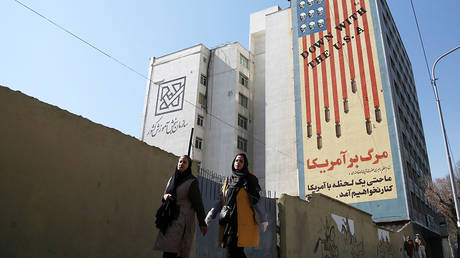
The air in the Middle East has a specific weight right now. It is heavy, static, and tastes of dust and high-octane fuel. When you stand on the edge of a precipice, you don’t hear the wind; you hear the silence of everyone holding their breath at once.
In the mahogany-lined halls of Washington and the sun-scorched command centers of the Levant, a gamble is being played with millions of lives as the stakes. An Iran-backed armed group recently issued a warning that wasn't just a headline. It was a promise of a "long war" if the United States dared to strike Tehran directly. To the casual observer scrolling through a news feed, this looks like another cycle of rhetoric. To those on the ground, it is the sound of a tripwire being pulled taut.
Imagine, for a moment, a young father in Baghdad or a shopkeeper in Haifa. These are not hypothetical casualties of a spreadsheet; they are the people who wake up every morning wondering if the sky will remain blue or turn the color of cordite. For them, the "long war" isn't a strategic term. It is a generational haunting.
The Architecture of the Ultimatum
The threat didn't emerge from a vacuum. It is the culmination of decades of a "gray zone" conflict—a shadow play where no one wears a uniform but everyone carries a grudge. When these groups speak of a long war, they are referencing an asymmetrical nightmare. They aren't planning to win a traditional tank battle against the world's most advanced military. They are planning to outlast the American political will.
They are betting on the "forever war" fatigue that has settled into the marrow of the Western psyche.
Consider the mechanics of this threat. If the U.S. strikes the heart of the Iranian state, the response won't be a singular counter-punch. It will be a thousand stinging needles. We are talking about the closure of the Strait of Hormuz, where 20% of the world’s petroleum flows. We are talking about sleeper cells and drone swarms that cost less than a used car but can blind a billion-dollar satellite system.
The logic is brutal: If we burn, you will at least be forced to smell the smoke for a decade.
The Invisible Strings
To understand the weight of this warning, you have to look at the map not as a collection of borders, but as a nervous system. Tehran is the brain, but the "Resistance Axis" acts as the limbs. From Yemen’s rugged coastlines to the sophisticated bunkers of Southern Lebanon, the infrastructure for this "long war" is already built. It is dug into the limestone and hidden in the basements of apartment blocks.
When a militia spokesperson issues a televised warning, they aren't just talking to the Pentagon. They are talking to the global markets. They are telling every CEO and every family sitting at a kitchen table in Ohio or Manchester that their gas prices, their supply chains, and their sense of security are tethered to a desert thousands of miles away.
This is the leverage of the weak against the strong. It is the realization that in a globalized world, there is no such thing as a "contained" strike.
I remember talking to a veteran who spent three tours in the region. He didn't talk about the heat or the sand. He talked about the eyes. He said you could always tell when a storm was coming because the street markets would go quiet. The locals knew before the intelligence briefings ever reached the Green Zone. Right now, that quiet is deafening.
The Math of Human Misery
Let's look at the cold reality of what a "long war" actually entails. It isn't just a series of explosions. It is the slow, grinding erosion of a civilization's foundation.
- Economic Paralysis: A direct conflict with Iran would likely send oil prices into a vertical climb, potentially hitting $150 or $200 a barrel. This isn't just about the cost of a commute; it’s about the cost of shipping grain to nations on the brink of famine.
- The Refugee Surge: We have seen what localized civil wars do to the borders of Europe and neighboring states. A regional conflagration involving Iran would create a human exodus that would make previous crises look like a rehearsal.
- The Radicalization Cycle: Violence is the best recruiter. Every "surgical strike" that misses its mark by fifty yards creates a new generation of believers who have nothing left to lose but their lives.
These groups know this math. They use it as a shield. They are telling the West: Our pain tolerance is higher than your patience.
The Echo Chamber of Power
In Washington, the debate often feels like a chess match played by people who will never have to move the pieces. There are those who argue that "decapitation" strikes or targeted hits on Iranian infrastructure are the only way to restore "deterrence." It’s a clean word, isn't it? Deterrence. It sounds like a thermostat setting.
But deterrence is a psychological state, not a military one. If your opponent believes that their very existence is at stake, they cannot be deterred. They can only be provoked.
The Iranian-backed groups are signaling that they have moved past the point of fear. They are operating on a different timeline—one that doesn't care about the next election cycle or the quarterly earnings report. They are thinking in decades. They are thinking in martyrs.
The Human Cost of Miscalculation
The tragedy of the "long war" warning is that it leaves no room for the middle ground. It forces everyone into a binary: total submission or total escalation.
Think about the sailors on the destroyers in the Red Sea. They are twenty-year-olds from small towns, staring at radar screens, waiting for a blip that moves too fast to be a bird. They are the front line of a policy they didn't write. On the other side, there is a kid in a dusty trench in the Levant, convinced that the Great Satan is at his doorstep.
Both are victims of a narrative that says peace is a sign of weakness.
We often mistake silence for peace. We assume that because the missiles aren't flying today, the situation is under control. But tension has a memory. It builds up in the soil, in the politics, and in the hearts of the people who have to live through the "gray zone" every single day.
Beyond the Rhetoric
The warning of a "long war" is a mirror held up to the world's face. It asks us if we are truly prepared for the consequences of our posturing. It challenges the notion that technology can solve ideological problems. You can't "smart-bomb" a grievance. You can't use a drone to kill an idea that has been nurtured by forty years of sanctions and proxy battles.
If the strike happens, and if the "long war" begins, it won't look like the movies. There will be no triumphant music. There will only be the slow, agonizing realization that we have entered a tunnel with no exit.
The shops will close. The electricity will flicker and die. The internet will go dark. And in that darkness, the only thing left will be the very thing the armed groups promised: a struggle that outlives the men who started it.
There is a moment, just before a thunderstorm breaks, when the birds stop singing and the light turns a bruised purple. That is where we are standing. The warning has been issued. The pieces are on the board. The only thing left is to see if anyone has the courage to walk away from the table before the first shot makes the "long war" an irreversible reality.
A child in Tehran is finishing his homework by a window. A pilot in a carrier deck is checking his flight gear. They are connected by a thread so thin it's invisible, yet so strong it could pull them both into the abyss. That thread is vibrating. It is humming with the tension of a thousand "what ifs."
The long war is not a prediction. It is a choice that is being made every second that we refuse to find a different language for power.
We are waiting for the spark. We are praying for the rain. But the horizon is staying stubbornly, terrifyingly dry.