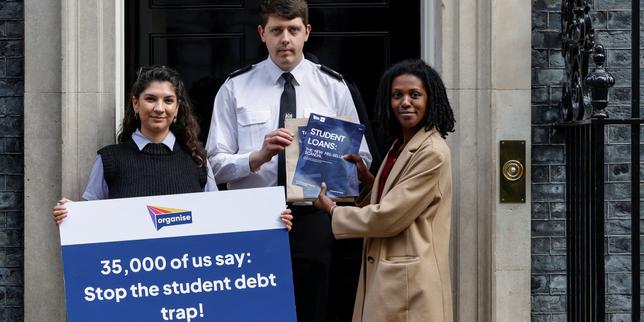
The British higher education system has quietly transformed from a ladder of opportunity into a sophisticated wealth extraction mechanism. For decades, the promise was simple. You study hard, you take on a manageable amount of debt, and your increased earnings potential pays it back while leaving you significantly better off. That social contract has been torn up. Today, millions of graduates in the United Kingdom are waking up to the reality that they have signed onto a financial burden that behaves less like a loan and more like a lifelong tax on aspiration.
This isn't just about young people complaining about bills. It is a fundamental shift in the economic structure of the country. We are seeing a generation where the median graduate will never actually pay off their debt. Instead, they will watch the balance balloon through compound interest for thirty or forty years until the government finally wipes the slate clean. In the interim, that debt siphons off disposable income, kills the ability to save for a home deposit, and alters the very career choices that keep the economy moving.
The Mathematical Mirage of Plan 2 and Plan 5
To understand why this is a crisis, you have to look at the mechanics of the interest rates. For those who started university between 2012 and 2023, known as Plan 2 students, the interest rates were pegged to the Retail Price Index (RPI) plus up to 3%. When inflation spiked recently, students saw their balances jump by thousands of pounds in a single year without even stepping foot in a classroom.
Consider a typical graduate entering the workforce with £50,000 in debt. If they land a decent job starting at £30,000, their mandatory repayments don't even cover the interest being added to the pile. They are running on a treadmill that is moving faster than they can sprint. Every month, they pay a portion of their salary toward the loan, yet every year, the total amount they owe increases. It is a psychological weight that the previous generation of policymakers, who often enjoyed free tuition and maintenance grants, seem fundamentally unable to grasp.
The introduction of Plan 5 for new students has "fixed" the interest rate by capping it at RPI, but it has simultaneously lowered the repayment threshold and extended the term of the loan to 40 years. This means graduates start paying back sooner and stay in the system for nearly their entire working lives. It is a permanent 9% marginal tax rate on everything earned above a relatively low threshold.
Why the System is Design to Fail
The government’s accounting of these loans is a masterclass in creative bookkeeping. By treating these loans as assets on the national balance sheet, the state can pretend the money will be paid back, even though their own forecasts suggest a massive percentage of the debt will eventually be written off. It is a giant game of "kick the can" where the ultimate cost is deferred to future taxpayers, while the immediate pain is felt by the workforce.
Universities, meanwhile, have become bloated. When the tuition fee cap was raised to £9,000 and later £9,250, it didn't necessarily lead to a golden age of teaching. Instead, it triggered an arms race in marketing, administrative expansion, and prestige real estate projects. The student became a consumer, but a consumer with no bargaining power and a blank check provided by the Student Loans Company.
The Impact on the Housing Market
The connection between student debt and the UK's housing crisis is direct and devastating. When a mortgage lender assesses an applicant, they look at debt-to-income ratios and monthly outgoings. A graduate losing hundreds of pounds a month to student loan repayments is a graduate who cannot save for a deposit and who qualifies for a smaller loan.
The result is a delayed adulthood. We see people in their 30s still living in shared accommodation or with parents, not because they are "lazy" or spending too much on avocado toast, but because the math of their lives no longer adds up. They are paying a "graduate tax" that their older managers never had to face, while trying to buy houses that have tripled in price relative to earnings.
The Myth of the Graduate Premium
For years, the justification for high fees was the "graduate premium"—the idea that a degree adds so much to your lifetime earnings that the debt is a bargain. In certain fields like medicine, law, or high-end engineering, that remains true. But for a vast swathe of the population, the premium is shrinking or has vanished entirely.
As the labor market becomes saturated with degrees, the credential itself loses value. It becomes a baseline requirement for entry-level roles that used to require only a high school education. When you combine stagnant UK wages over the last decade with high inflation and high student loan interest, the "premium" becomes a net negative for many. They are paying for a seat at a table where the meal is no longer being served.
The Psychological Toll of Perpetual Debt
There is an overlooked factor in this investigative trail: the mental health of a workforce that feels it can never win. Debt is traditionally viewed as something you take on to acquire an asset, like a house or a business. But student debt is an "unsecured" shadow that follows you regardless of your success or failure.
Young professionals describe a feeling of "debt fatigue." When the balance on your statement increases despite you making every payment on time for five years, you stop viewing it as a loan. You view it as a punishment for trying to better yourself. This breeds a deep-seated resentment toward the institutions that sold the dream of higher education as a risk-free investment.
Moving Toward a Realistic Solution
The current model is unsustainable for the individual and the state. If the government continues to treat higher education as a private commodity rather than a public good, the economic drag will eventually stifle national growth.
A hard-hitting reform would require a three-pronged attack. First, the interest rates must be decoupled from the volatility of RPI; charging students "profit" on their education is ethically dubious and economically counterproductive. Second, we must address the "degree inflation" that forces people into debt for jobs that don't require university-level skills. This means a massive reinvestment in vocational training and apprenticeships that offer a path to a middle-class life without the £50,000 entry fee. Finally, the universities themselves must be held accountable for the "value-add" of their courses. If a degree consistently fails to provide the earnings potential to cover its own cost, the institution, not just the student, should share the financial risk.
The UK is currently conducting a massive, decades-long experiment on its own youth. We are testing how much debt a generation can carry before it stops consuming, stops starting families, and stops believing in the fairness of the economy. The early data is in, and the results are harrowing. Without a radical pivot in how we fund the development of human capital, the "best decision" many young people make—going to university—will continue to be their worst financial mistake.
Check your own student loan statement today and look at the interest added over the last twelve months versus your total repayments.