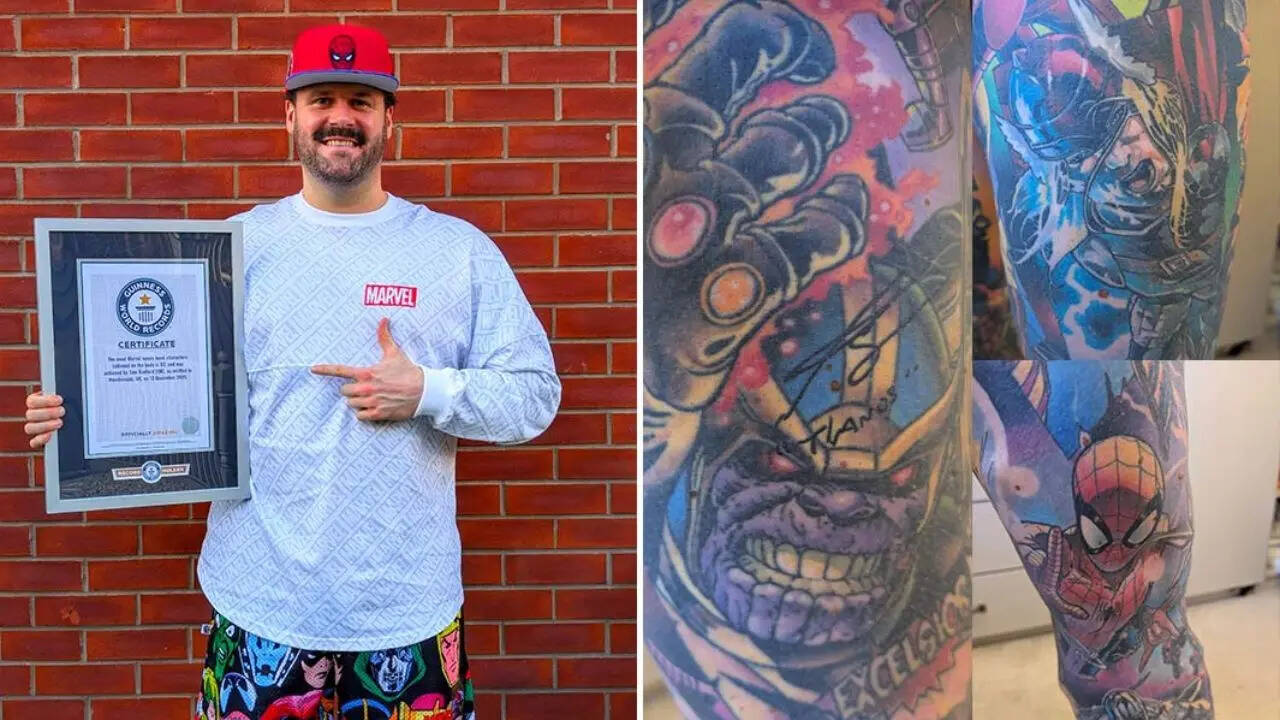
Rick Scolamiero did not just buy a ticket to the Marvel Cinematic Universe. He moved in, remodeled the interior, and let the neighbors know he was never leaving. With more than 30 Marvel characters etched permanently into his skin, the Canadian man—often confused with similar record-holders in the UK—turned his body into a living storyboard. While the headlines focus on the glossy finish of a Guinness World Record, the reality of this kind of extreme anatomical branding is a grueling marathon of physical pain, financial depletion, and a psychological commitment that most fans cannot fathom. This is not about being a "super-fan." It is about the intersection of obsessive collecting and permanent body modification.
The sheer scale of these projects defies the casual logic of fandom. We are talking about hundreds of hours under the needle. When a collector decides to cover their limbs in Captain America, Black Widow, and the Hulk, they aren't just paying for art. They are undergoing a systematic transformation that alters how the world perceives them and how they perceive their own aging process. If you found value in this post, you should look at: this related article.
The Physical Toll of a Living Canvas
Most people think of a tattoo as a singular event. You go in, you bleed a little, you walk out with a souvenir. For the record-breaking Marvel enthusiast, the process is closer to a medical procedure. The skin is an organ, and treating it like a sticker book carries consequences that no comic book movie ever addresses.
Trauma and Recovery Cycles
The human body reacts to a tattoo as a wound. When you scale that up to 60 or more large-scale pieces, you are putting the immune system under constant stress. Frequent, long sessions trigger a persistent inflammatory response. The lymph nodes work overtime to process the heavy metals and pigments found in the ink. Artists often report that after the 20-hour mark on a single limb, the skin begins to "reject" the work, swelling to a point where the needle can no longer deposit pigment accurately. For another perspective on this development, check out the recent coverage from Glamour.
The Pain Threshold Myth
There is a romantic notion that these collectors have a superhuman tolerance for pain. The truth is more clinical. It is about endurance and the management of "tattoo flu"—the systemic exhaustion that hits 24 hours after a massive session. For those chasing world records, the pain is not a badge of honor so much as a recurring tax. They deal with the white-hot sear of the inner bicep and the bone-shaking vibration of the spine, all to ensure that Spider-Man’s webbing is anatomically correct across their shoulder blades.
The Economics of Permanent Fandom
Let’s talk about the money. A high-end tattoo artist charges anywhere from $150 to $300 per hour. A full-color, realistic Marvel portrait can easily take eight to twelve hours to perfect. Multiply that by sixty characters. We are looking at a total investment that rivals a down payment on a house in most metropolitan areas.
Investment Without Resale Value
In the world of comic book collecting, a rare Amazing Fantasy #15 is an asset. It appreciates. You can sell it when the market peaks. A body full of Marvel tattoos is a sunk cost. You cannot liquidate your forearm to pay the mortgage. This creates a unique psychological profile for the collector: they are spending tens of thousands of dollars on a collection that will literally rot with them. It is the ultimate expression of "keep-it-in-the-box" mentality, except the box is their own skin.
The Artist Dependency
Securing a Guinness World Record requires consistency. You cannot have ten different artists with ten different styles if you want a cohesive masterpiece. These collectors often become "linked" to a single studio for years. This creates a power dynamic where the fan is at the mercy of the artist’s schedule, pricing, and health. If your lead artist moves across the country or retires, your record-breaking journey hits a wall.
The Corporate Ownership of the Self
There is a deeper, more unsettling layer to this trend that many analysts ignore. When you cover your body in Marvel characters, you are effectively turning yourself into a walking billboard for a multi-billion dollar corporation. Disney owns those silhouettes. They own those color palettes.
Branding in the Literal Sense
Historically, branding was something done to cattle to show ownership. In the modern era, we do it to ourselves voluntarily. These collectors are so deeply integrated with the intellectual property of a studio that their identity becomes inseparable from the brand. If Marvel makes a creative turn the fan hates, or if a lead actor is embroiled in a scandal, the fan is stuck with the permanent fallout on their skin. They have surrendered their aesthetic autonomy to a corporate entity that doesn't know they exist.
The Permanence of Trends
Marvel is the titan of the box office today, but cultural tides shift. In thirty years, will these hyper-realistic portraits of Robert Downey Jr. and Chris Evans carry the same weight? Or will they look like the "Looney Tunes" tattoos of the 1990s—dated relics of a specific pop-culture fever dream? The risk of "fandom regret" is rarely discussed in the glow of a Guinness certificate, but it is the shadow that follows every collector.
The Psychology of the Record Hunter
Why do it? Why go through the pain, the cost, and the social scrutiny? The answer usually lies in the pursuit of the "ultimate" status. Being a fan is common. Being the most fan is a rare air that provides a sense of purpose and distinction.
The Dopamine Loop of the Needle
Tattooing releases endorphins and adrenaline. For some, the pursuit of the record becomes an addiction to the process itself. The "empty space" on the body becomes an itch that must be scratched. It isn't just about having the tattoos; it's about the next session, the next character, and the next social media update. The Guinness World Record is simply the finish line that justifies the obsession to the outside world.
Identity Fusion
Psychologists refer to "identity fusion" when a person’s individual identity becomes blurred with a group or a concept. For the Marvel record-holder, there is no "Me" without "The Avengers." This fusion provides a community and a shield against the mundane. When you are the "Marvel Tattoo Guy," you never have to worry about being boring at a party. You have a built-in narrative, even if that narrative was written by a room of screenwriters in Burbank.
The Technical Challenge of High-Detail Realism
To understand why these pieces stun the world, you have to understand the evolution of tattoo technology. We are no longer in the era of "bold will hold" traditional anchors. The Marvel record-holders favor "photo-realism," a style that pushes the limits of what human skin can support.
Pigment Density and Longevity
The human eye perceives color differently as it ages. Small details in a 1:1 scale portrait of Iron Man's mask will inevitably blur over decades as the ink particles migrate through the dermis. Maintaining a record-breaking collection requires a lifetime of "touch-ups." It is a maintenance project that never ends. If the collector stops caring for the skin—neglecting sunscreen or gaining/losing significant weight—the "masterpiece" distorts into an unrecognizable smudge.
The Canvas Limits
There is only so much "prime real estate" on a human body. Once the back, chest, and sleeves are full, the collector has to move to more painful or less visible areas. The shins, the tops of the feet, and the armpits. These are high-friction areas where ink is notoriously difficult to set. The jump from 30 tattoos to 60 is not a linear progression; it is a battle for space against the body's own geometry.
The Social Cost of the Superhero Suit
Living with a body suit of comic book characters changes how you move through the world. It dictates what you wear and how people approach you.
The Spectacle of the Self
These individuals are never truly off the clock. In a grocery store, at a funeral, or on a first date, their "obsession" is the first thing people see. This creates a perpetual state of being "on display." While some thrive on the attention, others find that the record title becomes a cage. They are expected to be the joyful ambassador of Marvel at all times, regardless of their actual mood.
The Judgment of the "Pure" Art World
Within the tattoo community, there is often a divide between those who appreciate "fine art" tattoos and those who get "pop culture" work. The record-holders are sometimes dismissed by purists as mere collectors of commercial logos. This internal friction highlights a broader cultural question: Is it still art if the subject matter is a product designed to sell action figures?
Looking at the Aging Superhero
The most significant overlooked factor is the biological reality of time. A tattoo record is a snapshot of a moment. As the skin loses elasticity and the "comic masterpieces" begin to sag, the collector faces a unique form of body dysmorphia. The vibrant, neon-colored heroes of their youth will eventually become faded ghosts of a former self.
Maintaining the integrity of 60+ tattoos into one's 60s and 70s requires a level of dermatological discipline that few people possess. It involves a strict regimen of hydration, UV protection, and likely, further painful interventions to keep the colors from turning muddy. The record isn't just won; it must be defended against the natural decay of the human frame.
The End of the Journey
When the final patch of skin is covered, and the Guinness adjudicator signs the paper, a strange vacuum often opens up. The quest is over. The "Marvel Tattoo Guy" has reached the summit, but he still has to live in the body he built. The tattoos don't grant the powers of the characters they depict; they don't provide invulnerability or flight. They provide a narrative of endurance and a permanent map of a man's devotion to a modern mythos.
The true story isn't the number of tattoos or the record itself. It is the quiet, daily reality of a man who looked at a blank canvas and decided that his life's work would be the celebration of someone else’s imagination, etched in ink and blood, until the very end.
Careful consideration of the lifestyle impacts is the only way to understand this phenomenon. If you're planning on starting your own journey toward a record, remember that the ink is the easy part. Living with it is the real work.