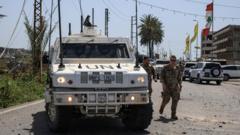
The death of a French peacekeeper in southern Lebanon serves as a grim reminder that the United Nations Interim Force in Lebanon (UNIFIL) is operating in a theater where its presence is increasingly symbolic and dangerously exposed. While official statements often focus on the immediate circumstances of such tragedies, the reality is that the peacekeeping mission has become a static target in a rapidly shifting conflict. The incident underscores a fundamental breakdown in the security guarantees that were supposed to protect international monitors under UN Resolution 1701.
The Myth of Buffer Zones
Resolution 1701 was designed to create a zone between the Blue Line and the Litani River free of any armed personnel, assets, and weapons other than those of the Lebanese government and UNIFIL. That vision has not materialized. Instead, the region has transformed into one of the most heavily fortified corridors in the Middle East. For a French soldier on the ground, the mission involves navigating a maze of local hostility, intelligence surveillance, and the constant threat of being caught in the crossfire of a high-intensity proxy war. Meanwhile, you can explore related events here: Why the attack on Indian ships in the Strait of Hormuz changes everything for maritime security.
Peacekeepers are currently trapped in a strategic paradox. They are mandated to observe and report, yet they lack the enforcement power to stop the very activities they are meant to prevent. This creates a vacuum where local actors view the UN presence not as a neutral arbiter, but as an obstacle or, worse, a shield for their adversaries. When a patrol is struck, it is rarely a simple accident of war. It is often the result of a total collapse in the deconfliction mechanisms that are supposed to keep international troops safe.
Strategic Erosion and the French Dilemma
France has historically viewed its participation in UNIFIL as a pillar of its Mediterranean policy. By maintaining a significant troop presence, Paris exerts influence in a former mandate territory and positions itself as a key mediator. However, the cost of this influence is rising. The death of personnel forces the French government to justify a mission that many military analysts now view as a relic of a previous era of warfare. To explore the bigger picture, we recommend the recent analysis by TIME.
The current conflict is not the low-level insurgency of the early 2000s. It is a sophisticated, multi-domain engagement involving precision-guided munitions, advanced drone swarms, and electronic warfare. UNIFIL’s white SUVs and fixed observation posts are vestigial organs in this environment. They offer no protection against modern kinetic strikes and serve primarily to provide coordinates for the very combatants they are meant to separate.
- Observation Posts: Fixed positions that have become liabilities rather than assets.
- Patrol Routes: Predictable paths that are easily monitored by local intelligence networks.
- Rules of Engagement: Restrictive protocols that prevent proactive defense in high-threat scenarios.
The Intelligence Failure in the South
Every time an international soldier is killed in southern Lebanon, a frantic search for accountability follows. But the accountability rarely reaches the higher echelons of command. There is a persistent failure to acknowledge that the intelligence environment in the south is compromised. Local populations, often under the direct influence of dominant political and military factions, have become increasingly bold in obstructing UN movements.
This obstruction is not organic. It is a coordinated effort to blind the international community. When a French patrol is blocked by "angry civilians" or targeted by "unidentified fire," it is a message. The message is that the UN operates only with the permission of the local powers. When that permission is withdrawn or ignored, the risk of a fatality becomes a mathematical certainty.
The Futility of Reporting
The primary function of UNIFIL is the generation of reports. Thousands of pages are sent to New York every year detailing violations of the Blue Line. These reports are meticulously filed and then largely ignored by the UN Security Council, where geopolitical interests ensure that no meaningful action is taken. This cycle of toothless monitoring creates a dangerous complacency.
Soldiers on the ground know their reports go nowhere. This realization impacts morale and operational focus. If the mission's output has no impact on the strategic reality, the risks taken to gather that information become harder to justify. A French soldier dying for a report that will never be acted upon is a tragedy of bureaucracy as much as it is a tragedy of war.
Logistics of a War Zone
Supply lines for UNIFIL are now under constant threat. Moving fuel, food, and medical supplies through southern Lebanon requires navigating a gauntlet of checkpoints and potential ambush sites. The logistical burden of maintaining a force of over 10,000 troops in a hostile environment is immense, and as the regional conflict escalates, these lines become even more fragile.
The death of a peacekeeper often occurs during these routine movements. It is rarely a grand battle; it is a roadside explosion, a sniper round, or a "miscommunication" at a checkpoint. These "small" events are what hollow out a mission from the inside. They turn a peacekeeping operation into a survival exercise.
Reevaluating the Mandate
There is a growing chorus within military circles calling for a complete overhaul of how UNIFIL operates. The current model of "presence as deterrence" is failing. Deterrence requires the credible threat of force, which UNIFIL does not possess. Without a mandate that allows for active enforcement or a political environment that respects the Blue Line, the mission is simply waiting for the next casualty.
The international community must decide if it is willing to give these troops the tools they need to actually secure the border or if it is time to withdraw. Maintaining the status quo is a gamble with the lives of young men and women from France, Italy, Spain, and other contributing nations. The current policy is one of managed decline, where the human cost is accepted as the price of maintaining a diplomatic fiction.
The reality on the ground has outpaced the diplomats in New York. While committees debate the wording of renewals, soldiers are dealing with the kinetic reality of a border that has ceased to exist in any functional sense. The death of a French soldier should not be treated as an isolated incident of bad luck. It is the logical outcome of a mission that has been stripped of its purpose but kept in place for lack of a better alternative.
The Shadow of 2006
The ghost of the 2006 war hangs over every decision made in the region today. Back then, UNIFIL was expanded with the hope that a larger force would prevent another catastrophic escalation. For nearly two decades, that hope held, not because of the UN’s strength, but because both sides found the stalemate useful. That period of managed tension has ended. The region is now in a state of active, rolling conflict where the old rules no longer apply.
Modern military technology has made the traditional "buffer zone" obsolete. When missiles can travel hundreds of miles with meter-level accuracy, a 20-kilometer strip of land monitored by soldiers in blue helmets offers no security. The tactical value of UNIFIL has been eroded by the very nature of contemporary warfare.
Concrete Risks for the Future
- Accidental Escalation: The death of UN personnel can trigger diplomatic crises that neither side actually wants, yet the proximity of peacekeepers to combatants makes these accidents inevitable.
- Mission Creep: Without clear objectives, UNIFIL risks being pulled into local governance issues for which it is not equipped.
- Hostage Situations: Individual peacekeepers or small patrols are increasingly vulnerable to being used as political leverage.
France and other contributing nations must confront the fact that their troops are now functioning as high-value targets in a war they are not allowed to fight. The diplomatic shield that once protected the blue helmet has shattered.
Every day that the mandate remains unchanged is a day that the risk of another death increases. The mission requires more than just "robust" language in a resolution; it requires a fundamental shift in how the international community engages with the reality of southern Lebanon. If the Lebanese Armed Forces cannot or will not take control of the south, UNIFIL remains a target in a shooting gallery.
The time for symbolic presence has passed. Either the mission is empowered to clear the zone of illegal weapons, or it should be reduced to a skeleton crew of observers who do not require the massive, vulnerable footprint of a multi-national brigade. Peacekeeping in a war zone is an oxymoron that usually ends in a flag-draped coffin arriving at an airbase in Paris.
Stop treating southern Lebanon like a peacekeeping mission and start treating it like the active combat zone it has become.