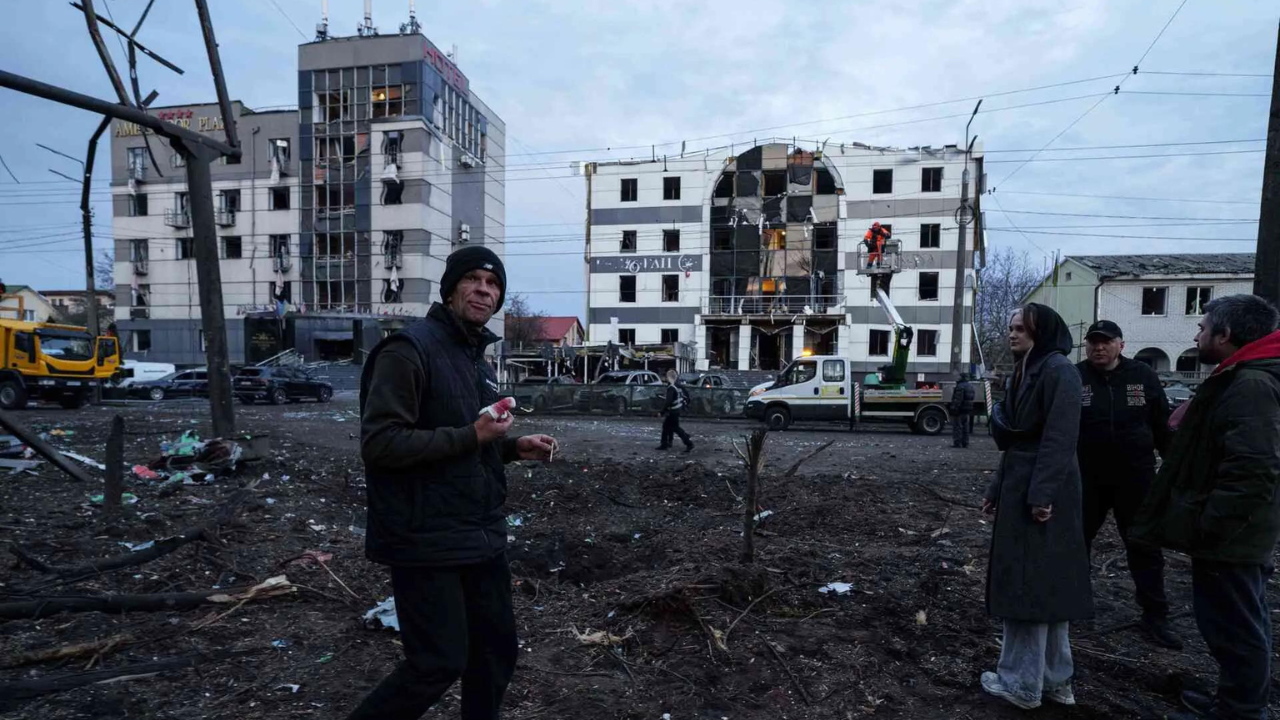
The latest bombardment of Ukrainian cities reveals a terrifying shift in the mechanics of modern attrition. While headlines focus on the immediate tragedy of 14 dead and the charred remains of civilian infrastructure, the underlying reality is a calculated expansion of aerial pressure. Russia launched a coordinated strike involving 31 missiles and a staggering 636 drones, a volume of fire intended to do more than just destroy physical targets. This is a deliberate attempt to bankrup the Ukrainian air defense system through sheer numerical exhaustion.
Russia has moved past the era of sporadic missile strikes into a phase of sustained, high-volume saturation. By flooding the skies with cheap, long-range loitering munitions, Moscow forces Kyiv to make an impossible choice every single night. They must decide whether to use a million-dollar interceptor to down a drone that costs less than a used car, or let the drone hit a power station, a residential block, or a grain silo. The math of this war is becoming increasingly lopsided, favoring the side that can produce the most mass at the lowest cost.
The Strategy of Saturation
Western observers often mistake the high shoot-down rate reported by the Ukrainian Air Force for a total victory. When 90 percent of incoming threats are neutralized, it looks like a success on paper. However, the 10 percent that get through are increasingly hitting critical nodes in the energy grid. More importantly, the 90 percent that are destroyed still achieve a primary Russian objective: the depletion of Ukraine’s finite stockpile of interceptor missiles.
This isn't just about the missiles themselves. It’s about the radars, the mobile fire teams, and the personnel who are being pushed to the breaking point. The sheer frequency of these 600-plus drone waves creates a "noise" in the airspace that makes it easier for the 31 missiles—the high-value assets—to find gaps in the defense. While the drones act as the frontline infantry of the sky, soaking up fire and revealing battery locations, the cruise and ballistic missiles act as the precision scalpels.
The Drone Production Pipeline
The transition from dozens to hundreds of drones per strike is the result of a massive industrial pivot. Russia has successfully localized the production of the Geran-2, the domestic version of the Iranian Shahed. Factories in regions like Tatarstan have scaled up to a degree that suggests a permanent shift in the intensity of the conflict. They are no longer relying on intermittent shipments; they have built a conveyor belt of destruction.
This industrialization of aerial terror means that "quiet" nights are becoming a rarity. The psychological impact on the civilian population is profound, but the strategic impact on logistics is where the real danger lies. Every hour spent in a basement is an hour of lost economic productivity. Every fire at a substation requires parts that are becoming harder to source.
The Air Defense Dilemma
Ukraine is currently operating a patchwork of systems, ranging from Soviet-era S-300s to modern Western tech like IRIS-T, NASAMS, and the Patriot. Each system has its own specific utility and its own specific cost.
- High-End Interceptors: Patriots are essential for stopping hypersonic missiles like the Kinzhal, but using them against drones is a strategic disaster.
- Medium-Range Systems: These are the workhorses, but their magazines are constantly under threat of running dry.
- Mobile Fire Teams: Pick-up trucks equipped with machine guns and searchlights are the most cost-effective way to kill drones, but they require perfect intelligence and positioning to be effective across a country as large as Ukraine.
The current bombardment proves that the "iron dome" approach is difficult to maintain over a landmass of this size. When Russia spreads 636 drones across multiple oblasts simultaneously, they are testing the reaction time and the movement of these mobile units. They are looking for the dark spots where the defense is thin.
The Infrastructure Toll
While the "shattered windows" of the headlines provide a visceral image of the war, the real damage is often invisible to the naked eye. The vibration from a nearby explosion can misalign precision machinery in a factory. The constant fluctuation in the power grid caused by emergency shutdowns wears out industrial transformers that were never meant to be cycled on and off daily.
Russia is targeting the long-term viability of Ukraine as a functioning state. By hitting residential areas, they ensure that the workforce is exhausted. By hitting the energy sector, they ensure that the cost of doing business remains prohibitively high. The 14 lives lost in this latest strike are a tragedy, but the millions of lives disrupted represent a calculated blow to the nation's heart.
Intelligence and the Electronic Frontier
Behind the physical explosions is a silent battle of electronic warfare. Many of the 636 drones launched are equipped with basic spoofing technology or are designed to fly paths that exploit the curvature of the earth and local terrain. Russia is learning from every downed unit. They analyze which flight paths were successful and which were intercepted, feeding that data back into the next night’s mission planning.
This is a dynamic, iterative process. Ukraine has responded by developing its own electronic "domes" to jam GPS signals, but the Russians have countered by adding optical navigation and anti-jamming CRPA antennas to their drones. It is a technological arms race happening at a pace that traditional defense procurement cycles cannot match.
The Role of Western Supplies
The bottleneck for Ukraine remains the supply of interceptors. The United States and European allies have provided significant numbers, but the consumption rate during a 600-drone wave is unsustainable without a massive increase in Western manufacturing. We are seeing a return to 20th-century industrial warfare, where the side that can keep its factories running longer and faster holds the ultimate advantage.
The 31 missiles used in this strike—likely a mix of Kh-101s and Kalibrs—represent a significant investment for Moscow, but they are also a sign of confidence. They are willing to expend these expensive assets because they believe the Ukrainian shield is thinning. They are betting that the West will eventually tire of the cost of replenishing that shield.
A Change in Tactics
Earlier in the war, Russian strikes were often criticized for being disjointed. That is no longer the case. The coordination between the drone swarms and the missile launches shows a refined command and control structure. The drones often arrive in waves, timed to hit just as the defenders are reloading or as the sun is setting, making visual tracking more difficult for the mobile fire teams.
This level of synchronization suggests a high degree of pre-mission planning based on real-time reconnaissance. It isn't just "raining missiles"; it is a choreographed assault.
The Civilian Cost of Modern Attrition
The deaths of 14 people in a single night of strikes is a grim reminder that there are no truly "safe" zones in Ukraine. The fragments of intercepted missiles and drones are often just as deadly as the weapons themselves when they fall over densely populated city centers. The debris from a 300-kilogram drone falling from the sky carries enough kinetic energy to crush a vehicle or penetrate the roof of a house.
In Kyiv, Dnipro, and Kharkiv, the sound of the air raid siren has become a background noise to daily life, but the threat remains existential. The psychological toll of living under a persistent threat of "loitering" death is a weapon in itself. It erodes the social fabric and creates a sense of helplessness that the Kremlin hopes will eventually lead to a demand for peace at any cost.
The Path Toward Escalation
As Russia increases the volume of its attacks, the pressure on Ukraine to strike back at the source increases. We are seeing more frequent Ukrainian drone strikes on Russian refineries and airfields. This "deep strike" capability is Ukraine's only way to change the math. If they cannot shoot down every drone, they must destroy the drones before they ever leave the ground.
However, this requires a level of long-range capability that remains a point of contention among Western allies. The fear of escalation has often limited the types of weapons provided to Kyiv, but the 636-drone reality makes those limitations increasingly difficult to justify from a purely military perspective. You cannot win a defensive war if the enemy has a sanctuary from which to launch an infinite number of cheap attacks.
The 31 missiles and 636 drones are a message. They are a statement of intent from a Russia that has fully committed its economy to the war effort. For Ukraine, the challenge is no longer just about bravery on the front lines; it is about the industrial and technological capacity to keep the lights on and the skies clear. The war has moved into a phase where the most important "soldiers" are the assembly line workers and the software engineers who must out-produce and out-code an adversary that has found its rhythm.
The international community must recognize that the current level of support is geared toward survival, not victory. To break the cycle of these nightly bombardments, the defensive strategy must evolve into a proactive one that addresses the production facilities and launch platforms directly. Without a shift in the strategic calculus, the "shattered windows" of today will become the permanent ruins of tomorrow. Ukraine is fighting a 21st-century war with a supply chain that is still trying to catch up to the reality of mass-produced aerial terror. The math of the conflict is clear: mass must be met with mass, or the shield will eventually break.