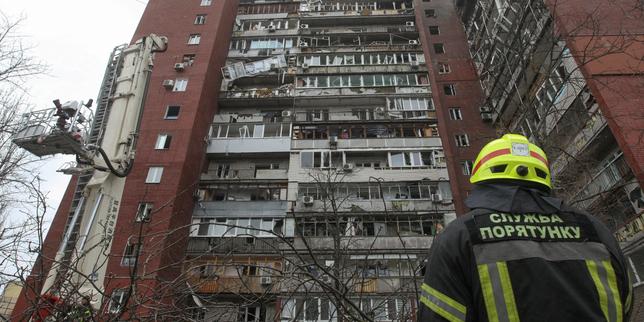
Russia has shifted its strategy from opportunistic strikes to a calculated, industrial-scale attrition of the Ukrainian power grid and civilian morale. The latest massive aerial assault, resulting in at least five deaths and widespread infrastructure damage, represents a dangerous evolution in Moscow’s long-range strike capabilities. This is no longer just about terrorizing the population. It is a systematic attempt to collapse the technical backbone of the country before the next winter cycle begins.
Western intelligence and field reports confirm that the barrage involved a sophisticated mix of Iranian-designed Shahed drones, Kh-101 cruise missiles, and the much-feared Kinzhal hypersonic projectiles. By launching these assets in synchronized waves, Russia is forcing Ukrainian air defense teams to make impossible choices. Do they deplete their dwindling supply of high-end Patriot missiles on cheap drones, or do they hold back and risk a cruise missile hitting a thermal power plant? On Tuesday, that gamble resulted in a breach of the shield.
The Strategy of Saturation
The primary objective of these massive raids is the total exhaustion of the interceptor stockpile. Every time a $20,000 drone flies toward a city, it threatens to trade itself for a $2 million missile. This is the grim arithmetic of modern siege warfare. Russia is betting that its domestic production, bolstered by North Korean shells and Iranian components, can outpace the Western world's willingness to ship expensive defense hardware.
When five people die in a single morning from falling debris or direct hits, the human cost is the headline. However, the structural cost is what keeps military planners awake. The targeting of distribution substations—the nodes that move electricity from plants to homes—is a specific, surgical effort. Repairing a turbine takes months. Repairing a specialized transformer can take a year, especially when the global supply chain for high-voltage equipment is already stretched thin.
Russia is not just aiming for the lights. They are aiming for the water pumps, the hospital generators, and the logistics hubs that keep the front lines supplied. By forcing Kyiv to pull air defense systems away from the trenches to protect the capital and major cities like Lviv or Kharkiv, the Russian Air Force creates "bubbles" of vulnerability on the battlefield. This allows their tactical aviation to use glide bombs against Ukrainian fortifications with relative impunity.
The Kinzhal Factor and the Hypersonic Myth
Moscow often touts the Kinzhal as an "invincible" weapon. While Ukraine has proven it can be shot down, the missile remains a significant problem because of its speed and the short reaction time it affords. When a MiG-31K takes off from an airbase deep inside Russia, air raid sirens trigger across every Ukrainian oblast instantly. The psychological wear and tear of these constant alerts is a weapon in itself.
The reality of the "massiveness" of these strikes lies in the sequencing. First come the drones to map out the radar positions. Then come the decoy missiles with no warheads, designed to trick the automated systems. Finally, the heavy hitters—the Kh-101s—arrive, often programmed with complex flight paths that hug the terrain or circle around a target to strike from the least defended angle. It is a high-tech game of cat and mouse played over a thousand kilometers of territory.
Domestic Production and the Sanctions Gap
There is a persistent narrative that Russia is running out of precision munitions. The evidence on the ground suggests otherwise. Despite heavy international sanctions, Russian factories have shifted to a 24-hour production cycle. They have successfully bypassed electronics bans by utilizing "dual-use" components found in household appliances or sourced through third-party intermediaries in Central Asia and the Middle East.
The debris found at recent strike sites shows missiles manufactured as recently as the previous quarter. This indicates a "hot" supply chain where weapons go from the factory floor to the bomber wing in weeks. Ukraine is facing a revived military-industrial complex that has successfully pivoted to a war footing, while much of the West is still debating budgetary allocations.
The Fragility of the Energy Shield
Energy workers in Ukraine have become a secondary military force. They work under the threat of "double-tap" strikes—where a second missile hits the same location thirty minutes after the first to kill the first responders and repair crews. This is a blatant violation of international law, yet it has become a standard tactic in the Russian playbook.
The grid is currently holding, but it is a patchwork of temporary fixes. Every strike removes a layer of redundancy. If the high-voltage backbone is severed, the country faces a "black start" scenario—a situation where the entire grid shuts down and requires a massive, coordinated effort to restart without causing further damage to the remaining generators. This is the ultimate goal of the current Russian campaign: to make Ukraine unlivable, forcing another massive wave of refugees into Europe and breaking the political will of Kyiv’s allies.
The Intelligence Failure of De-escalation
For months, the international community hoped that providing just enough defense would deter Moscow from these escalations. The latest attack proves that "controlled support" has not achieved its aim. Instead, it has given the Russian military time to refine its strike patterns and find the holes in the defensive net.
The debate over whether Ukraine should be allowed to strike the airfields inside Russia where these bombers originate is no longer an abstract policy discussion. It is a matter of immediate survival. As long as the Russian Long-Range Aviation fleet can operate from "sanctuaries" just across the border, the cycle of massive aerial assaults will continue. Air defense is a shield, but a shield eventually cracks under enough pressure.
Western Industrial Latency
The bottleneck is not just political; it is industrial. The United States and Europe are struggling to produce 155mm shells and air defense interceptors at the scale required for a high-intensity continental war. The "just-in-time" manufacturing model that works for a peaceful global economy is a liability in a prolonged conflict.
Ukraine's allies are now looking at "franken-sam" projects—integrating old Soviet launchers with modern Western missiles—as a stopgap. While innovative, these are not long-term solutions to a Russian military that is getting more efficient at mass-producing destruction. The disparity between the cost of the attack and the cost of the defense is the most significant strategic challenge facing the coalition.
The Psychological Front
Beyond the steel and the concrete, these attacks target the Ukrainian psyche. The deaths of civilians in their sleep are meant to broadcast a message of helplessness. If the state cannot protect its citizens in the middle of the capital, the reasoning goes, then the state is failing. However, historical precedent suggests that strategic bombing of civilian centers often has the opposite effect, hardening the resolve of the population.
What the Russian planners may be miscalculating is the "normalization" of the war. Ukrainians have developed an extraordinary level of resilience, but resilience is not exhaustion-proof. The constant lack of sleep, the loss of loved ones, and the economic instability caused by power outages create a cumulative trauma that will take generations to heal.
Immediate Requirements for Stability
To break this cycle, the defensive strategy must move from reactive to proactive. This involves three distinct pillars that the current international aid packages only partially address.
- Deep Strike Capability: Eliminating the Archer at the bow. Targeting the launch platforms and the storage depots on Russian soil is the only way to reduce the volume of incoming fire.
- Electronic Warfare (EW) Expansion: Modern drones rely on GPS and radio links. Flooding the skies with localized EW signals can neutralize the Shahed threat without firing a single expensive missile.
- Distributed Energy Generation: Shifting from massive, centralized Soviet-era power plants to a network of smaller, gas-fired or renewable nodes that are harder to target and easier to replace.
The current situation is a race against time. Russia is accelerating its production and refining its tactics. If the response from the West remains incremental, the cost of the next "massive attack" will not just be measured in five lives, but in the total collapse of the Ukrainian rear.
You can advocate for the immediate transfer of more medium-range systems like the NASAMS or IRIS-T, which are better suited for intercepting cruise missiles than the heavy-duty Patriot. These systems need to be deployed not just around Kyiv, but in the industrial heartlands of the East and South where the pressure is most acute. Use your influence to highlight the specific technical needs of the Ukrainian energy sector, particularly the requirement for high-capacity mobile transformers that can be hidden or armored.