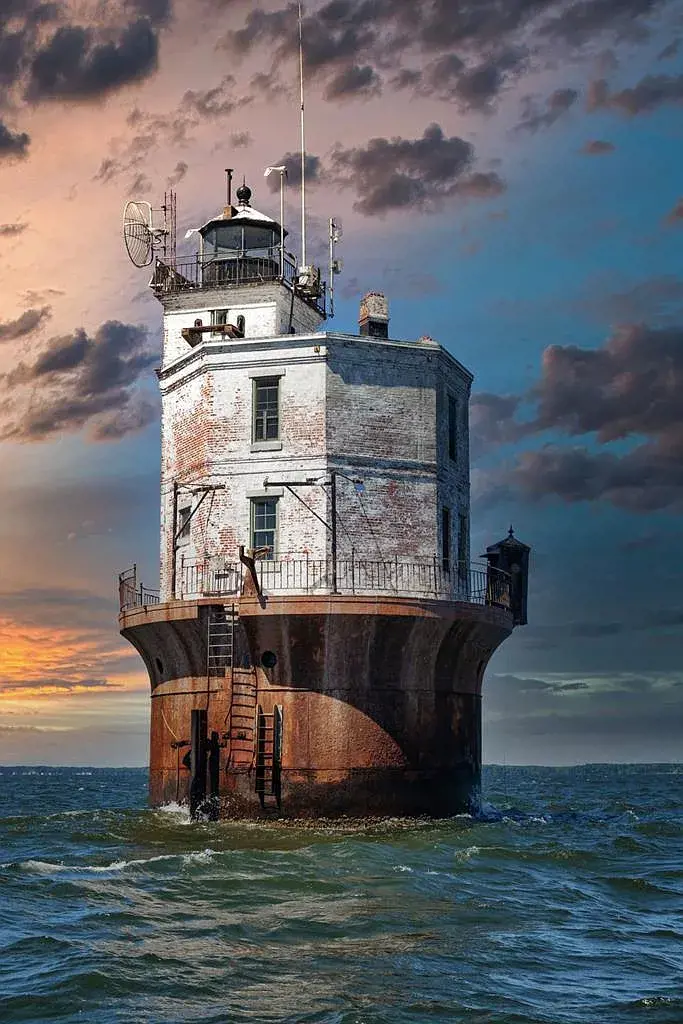
The romantic notion of owning a lighthouse 4km out at sea usually survives until the first winter storm hits or the first repair bill arrives. Recently, a century-old offshore sentinel hit the market, sparking the usual flurry of "escape the world" fantasies. But for the serious investor or the adventurous buyer, this is not a vacation home. It is a grueling, high-stakes battle against salt, isolation, and federal bureaucracy. Buying a lighthouse located miles from the coastline means acquiring a structure that was never designed for human comfort, but rather for mechanical endurance.
The Myth of the Secluded Sanctuary
Most people see a lighthouse and imagine sunset gin and tonics on the gallery. The reality is a relentless fight against corrosion. When a structure sits 4km offshore, it exists in a permanent shroud of salt spray. Salt is not just a nuisance; it is a chemical agent that actively seeks out and destroys rebar, iron fittings, and electrical systems.
Unlike a coastal cottage, you cannot simply drive a truck to the front door when the roof leaks. Every bag of concrete, every gallon of fresh water, and every technician must be transported by boat. If the sea state is above four feet, your "home" becomes an inaccessible fortress. You are at the mercy of the tides and the wind. This logistical nightmare turns a simple $500 plumbing fix into a $5,000 expedition.
The National Historic Lighthouse Preservation Act Trap
Potential buyers often find these properties through government auctions or specialized brokers, lured by surprisingly low starting bids. However, the price tag is the least expensive part of the transaction. Most of these structures fall under the National Historic Lighthouse Preservation Act (NHLPA).
When you buy a historic lighthouse, you aren't just a homeowner; you are a de facto curator for the government. The deed usually comes with stringent covenants. You are often required to maintain the structure according to the Secretary of the Interior’s Standards for the Treatment of Historic Properties.
- Original Materials: If a window pane breaks, you can't just pop in a modern double-pane vinyl replacement. You may be forced to source period-accurate glass and frames.
- Public Access: Some agreements require the owner to allow occasional public tours or inspections, stripping away the very privacy the buyer was seeking.
- The Light Stays: In many cases, the U.S. Coast Guard (or the relevant national authority) retains an easement to maintain the actual light and fog signal. They can show up at any time, and you cannot interfere with the aid to navigation.
Engineering a Life on the Waves
Modernizing a century-old tower for habitation requires an engineering overhaul that would make a skyscraper developer sweat. You are dealing with a vertical tube of stone or iron with zero existing infrastructure for 21st-century life.
Power Generation and Storage
You aren't hooked up to the grid. Solar arrays are the standard choice, but they face a unique challenge at sea: bird guano and salt crusting. Within days, a thin layer of salt can drop your energy efficiency by 30%. You need a massive battery bank—usually lithium iron phosphate—stored in a temperature-controlled environment, which is difficult to find in a damp basement that might take on water during a surge.
The Freshwater Problem
You cannot dig a well in the middle of the ocean. Most owners rely on a combination of rainwater catchment systems and high-end desalination units. Desalination, or reverse osmosis, is energy-intensive and finicky. If your membranes clog or your high-pressure pump fails, your stay at the lighthouse ends immediately. There is no backup.
Waste Management
This is the least talked about but most critical hurdle. You cannot simply pipe sewage into the ocean. Environmental regulations are draconian for offshore structures. Most owners have to install sophisticated composting toilets or "incinolet" systems that burn waste into ash. Otherwise, you are looking at hauling "black water" tanks back to the mainland by boat—a task that quickly sours the dream of island living.
The Architecture of Isolation
Lighthouses built in the late 19th and early 20th centuries were designed for "keepers"—men and women trained to live in Spartan conditions. The rooms are often circular, making standard furniture useless. Every piece of cabinetry must be custom-curved. The walls are thick, often several feet of masonry, which acts as a thermal mass. While this keeps the structure standing during a hurricane, it also makes the interior perpetually cold and damp.
Heating these spaces is a logistical nightmare. Traditional wood stoves are risky in confined towers, and hauling cordwood across 4km of open water is backbreaking work. Most modern conversions rely on diesel-fired heaters or heat pumps, but again, this brings us back to the fuel problem. You are constantly calculating your "burn rate."
Why the Market is Heating Up Despite the Risks
If the costs are so high and the labor so intensive, why is there a market for these towers at all? It comes down to scarcity and ego. There is a finite number of offshore lighthouses in existence. As the Coast Guard continues to decommission older stations in favor of solar-powered steel poles, these historic towers are becoming the ultimate trophy assets.
For a certain class of buyer, a penthouse in Manhattan or a villa in St. Barts is cliché. A lighthouse 4km out at sea is a statement of total independence. It is one of the few places on earth where you can truly control who enters your orbit.
The Hidden Costs of Insurance
Insurance companies loathe offshore lighthouses. Most standard carriers won't even provide a quote. You are forced into the "surplus lines" market, where premiums are astronomical and deductibles are even higher. You are insuring a property against "acts of God" in a location where God is frequently angry.
If a rogue wave smashes your lower gallery or a lightning strike fries your entire electrical system, the payout process is grueling. Adjusters often refuse to fly out to the site, requiring you to provide extensive drone footage and third-party engineering reports just to start a claim.
A Calculated Gamble
Prospective buyers must approach a lighthouse purchase with the mindset of a commercial ship owner, not a residential home buyer. You need a reliable vessel, a captain’s license or a trusted skipper, and a deep network of specialized contractors who don't mind getting seasick.
The "why" behind the sale of these 100-year-old structures is simple: the government can no longer afford the specialized labor required to keep them from crumbling into the sea. They are offloading the liability onto the private sector.
Before signing a contract for a lighthouse 4km offshore, you must ask yourself if you are prepared to spend 80% of your time there maintaining the building and only 20% enjoying the view. For the right person, that trade-off is acceptable. For everyone else, it is a maritime money pit that will swallow your savings as surely as the tide.
If you still want the keys, start by hiring a marine surveyor and a lead-paint abatement specialist. You'll need them both before the first boat leaves the dock.