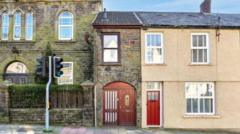
A derelict property in Rhyl, North Wales, recently changed hands for just £45,000, sending a ripple through the bargain-hunting corners of the internet. On the surface, the story looks like a quirky win for the underdog. A "super-slim" house, measuring barely seven feet wide in places, sold for the price of a mid-range SUV. But the fascination with this architectural oddity masks a much grimmer reality regarding the UK housing market, regional neglect, and the true cost of "cheap" real estate. This wasn't a lucky find. It was a symptom of a systemic failure in the property ladder.
The Economics of a Floor Plan Under Seven Feet Wide
To understand why a house sells for £45,000 in an era where the average UK home is nearing £300,000, you have to look past the novelty of its dimensions. This property, situated on Rhyl’s Aquarium Street, is a terraced slice of Victorian desperation. It is not a "tiny home" in the modern, curated sense of the word. It is a structural leftover.
The valuation of such a property is based purely on the risk-to-reward ratio of a full-scale renovation. At seven feet wide, the internal living space is restricted by more than just comfort; it is restricted by building regulations. To make a space like this habitable by 21st-century standards, an investor must navigate a labyrinth of fire safety codes, insulation requirements, and structural integrity issues that standard houses simply don’t face.
When a buyer drops £45,000 on a shell like this, they aren't buying a home. They are buying a high-stakes gamble. The cost of labor and materials in 2026 has remained stubbornly high. Fitting a kitchen, a bathroom, and heating systems into a space where you can touch both walls simultaneously requires bespoke solutions. Standard off-the-shelf units don't fit. Every centimeter lost to plasterboard or insulation is a significant percentage of the total living area. This is where the "bargain" starts to bleed money.
The Rhyl Factor and the Myth of Regeneration
Geography dictates price more than floorboards do. Rhyl was once the crown jewel of the North Wales coast, a Victorian seaside escape for the workers of Liverpool and Manchester. Today, it stands as a case study in post-industrial decline. The town has been the subject of numerous "masterplans" and regeneration schemes over the last two decades, yet it remains one of the most deprived areas in Wales.
The £45,000 price tag is a reflection of the local economy. If this exact same sliver of brickwork were located in London's Kensington or even Manchester’s Ancoats, it would be marketed as a "unique urban pied-à-terre" for ten times the price. In Rhyl, it is a liability.
Investors often flock to these low-entry-point auctions with visions of high rental yields. They see a low mortgage—or a cash purchase—and assume the local rental market will provide a steady return. What they often overlook is the churn rate. Areas with low property values often suffer from transient populations and high maintenance costs. When the roof leaks on a seven-foot-wide house, the repair costs the same as it does on a fifteen-foot-wide house. The margins are razor-thin.
Architecture as an Afterthought
The Victorian builders who squeezed these properties into every available gap weren't thinking about "lifestyle." They were maximizing density for a burgeoning working class. These "gap houses" were often built using inferior materials compared to the primary residences on the street.
Looking at the structural bones of the Aquarium Street property, one sees the inherent flaws of 19th-century "fill-in" construction.
- Shared Walls: In a house this narrow, you are essentially living in a corridor between two other people's lives. Noise complaints are a structural certainty.
- Thermal Efficiency: With so much surface area relative to the internal volume, these homes are notoriously difficult to heat.
- Vertical Living: With no width to expand, the only way is up. This creates a "ladder" lifestyle that is inaccessible to the elderly or those with mobility issues, further shrinking the pool of potential future buyers.
Why the Auction House Always Wins
The sale of the Welsh narrow house happened via a traditional auction, a format that thrives on the "gambler’s high." Auctions are where professional developers go to offload the problems they don't want to fix. By the time a property hits the auction catalog with a guide price of £35,000 or £40,000, it has likely been passed over by more conservative estate agents who recognize the difficulty of securing a traditional mortgage on a non-standard construction.
Most banks will not lend on a property that is less than a certain square footage or that lacks a functional kitchen and bathroom. This means the buyer pool is restricted to cash-rich investors or those using high-interest bridging loans. This is the hidden wall of the property market. It keeps the "cheap" houses in the hands of the wealthy, while the average first-time buyer is stuck paying rent that exceeds the monthly cost of a mortgage they are told they cannot afford.
The Psychological Trap of the Micro Home
There is a dangerous romanticization of small-scale living currently permeating our culture. We see sleek videos of "van life" or Japanese micro-apartments and think that a seven-foot-wide house in North Wales is part of that same aesthetic movement. It isn't.
Living in a space that narrow has a measurable impact on psychological well-being. The lack of "swing space"—the ability to move through a room without navigating obstacles—creates a perpetual state of low-level stress. We are witnessing the normalization of substandard housing under the guise of "quirky" or "minimalist" living. When we celebrate a house selling for £45,000 because it’s "slim," we are essentially celebrating the shrinking of human living standards.
The Ghost of Future Maintenance
Imagine the logistical nightmare of a full renovation on Aquarium Street. You cannot park a skip easily. You cannot have three tradespeople working in the same room. Delivery drivers struggle with bulky appliances. These "soft costs" add up.
A standard renovation might cost £1,500 per square meter. In a narrow house, that figure can easily double because every solution must be custom-engineered. By the time the new owner has made this house habitable, their total investment might sit closer to £100,000. In a street where the ceiling price for a full-sized terrace is only slightly higher, they have effectively "over-developed" the site. They are trapped in a property that is worth less than the sum of its parts.
The Regulatory Gap
Wales has different housing regulations than England, often more stringent regarding the "Fitness for Human Habitation" (FFHH) standards. The Renting Homes (Wales) Act 2016 shifted the burden heavily onto landlords to ensure properties are not just safe, but functional. For a house this small, meeting those standards is an uphill battle.
The buyer must ensure adequate ventilation in a space that is basically a chimney. They must ensure fire egress in a building where the staircase might take up 40% of the ground floor width. If the local authority decides the property doesn't meet the minimum "habitable space" requirements, the investor is left with a very expensive storage unit.
Beyond the Headline
The viral nature of the "£45k Welsh House" story is a distraction. It provides a brief moment of "what if" for people struggling with astronomical rents in Bristol, London, or Cardiff. They see the price and think, "I could buy that with my savings."
But the truth is that the UK housing market is not being "fixed" by these outliers. If anything, these sales highlight the widening gap between the habitable and the inhabitable. We are seeing a tier of "junk" property emerge—buildings that are bought and sold as financial instruments rather than places for humans to exist.
The real story isn't that a house sold for £45,000. The real story is that we live in a country where a seven-foot-wide ruin is considered a viable real estate opportunity. It is a testament to our collective desperation.
Investors should stop looking for the "next Rhyl" and start looking at the structural integrity of the towns they are buying into. A house is only worth its price if someone can actually live in it without losing their mind or their bank balance. The narrow house on Aquarium Street isn't a victory for the buyer; it’s a warning to everyone else.
If you are looking at a property that costs less than a deposit in a major city, ask yourself why. The answer is usually buried in the walls, the local crime statistics, and the impossibility of fitting a standard sofa through the front door.
Check the local council's long-term development plans before committing to a "bargain" area. If the town's main economic drivers are seasonal tourism and retail, your investment is at the mercy of the weather and the next recession. Avoid non-standard constructions unless you have a deep bench of specialized contractors. The "cheap" house is the most expensive one you will ever buy.