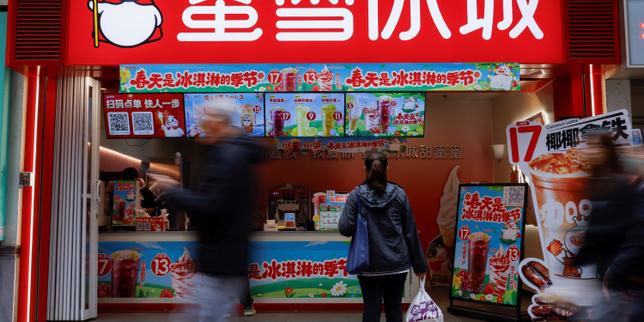
Pass by any of the 46,000 stores operating under the red-and-white banners of Mixue Group, and the scene looks like a retail miracle. Customers line up to buy ice cream cones for 3 yuan or massive cups of lemon tea for 7 yuan. To western observers or casual business journalists, it looks like a masterclass in low-cost consumer retail, a triumphant conquering of China's lower-tier cities through cheap treats.
But this is a fundamental misunderstanding of what Mixue actually is. Mixue is not a beverage company. It does not make its money by selling bubble tea to consumers.
The real engine behind this corporate giant, which pulled in RMB 33.56 billion in revenue in 2025, is a massive B2B logistics and manufacturing operation. Mixue makes its billions by selling plastic cups, straws, milk powder, and fruit concentrates to its own army of franchisees. The individual store owners take all the operational risk on the high street, while corporate headquarters collects predictable margins on the raw materials. It is a brilliant, hyper-scaled supply chain play disguised as a cheerful neighborhood tea shop.
The Franchise Extraction Machine
To understand why Mixue is so profitable while its products cost less than a bottled water at a high-end cafe, you have to look at its corporate financial structure. According to financial data from its public reporting, less than 2% of Mixue's total revenue comes from operating its own stores. The vast majority comes from the sale of goods and equipment to franchise owners.
The franchise fee itself is surprisingly low, often just a few thousand dollars a year. This is the bait. It lowers the barrier to entry for small investors, laid-off workers, and ambitious entrepreneurs in third- and fourth-tier Chinese cities.
Once an individual signs the contract, they enter a closed-loop system. The franchisee is contractually obligated to buy every gram of sugar, every slice of frozen lemon, and every single plastic straw directly from Mixue’s central warehouses.
Consider a hypothetical example. If a franchisee wants to run a promotion and discount a tea from 7 yuan to 5 yuan to fight off a local competitor, their retail margin shrinks to razor-thin levels. Yet, Mixue headquarters still sells the underlying syrup and cups to that franchisee at the exact same wholesale price. Corporate profit remains insulated from the brutal price wars happening on the ground.
A Factory With a Mascot
This setup only works because Mixue invested in upstream manufacturing infrastructure long before its competitors did. In 2012, when the modern bubble tea trend was still in its infancy, Mixue established its own central factories. Today, it runs massive production bases across China, including major hubs in Henan, Hainan, and Anhui.
By manufacturing its own ingredients, Mixue cuts out middleman costs completely.
- Lemons: The company sources directly from farms in Sichuan, processing them in proprietary facilities.
- Dairy: Mixue processes its own liquid milk and milk powders, bypassing traditional agricultural distributors.
- Logistics: A network of over 25 specialized warehouses across China ensures that inventory reaches stores without reliance on expensive third-party cold-chain providers.
This scale creates a profound cost advantage. Mixue can acquire raw materials at prices up to 20% below the industry average. It is this corporate infrastructure that allows a cup of tea to be sold for pennies, not some magical retail formula. The ubiquitous snowman mascot, the "Snow King," is simply the friendly public face of a highly optimized industrial processor.
The Saturation Point and the Franchisee Squeeze
The fundamental vulnerability of this model is its reliance on constant store expansion to drive revenue growth. Because corporate profits are tied to the volume of ingredients shipped, the system demands more stores opening every single month.
This has led to severe geographic saturation. In many Chinese cities, you can stand on a street corner and see three different Mixue locations within a five-minute walk. They are actively cannibalizing each other's customer base.
While the Mixue Group celebrated a net profit surge to RMB 5.92 million in 2025, individual store owners are feeling the squeeze. When three stores open in an area that can only support one, the daily transaction volume per store plummets. But because the corporate office makes money on total volume shipped across the whole network, the financial pain is borne entirely by the local franchisees.
The corporate entity maintains a remarkably low store closure rate of under 3.5%, but this metric masks the churn of human capital. When an independent operator runs out of savings and shuts down, a new hopeful entrepreneur is often waiting to take over the lease, buy a fresh set of Mixue-branded equipment, and restart the cycle.
Replicating the Playbook Overseas
With the domestic Chinese market reaching a clear saturation point, Mixue is aggressively exporting its industrial model to Southeast Asia and western markets. It has opened thousands of locations in Vietnam, Indonesia, Thailand, and even experimental outposts in major global metropolises like New York.
The playbook remains identical. Lower the cost of entry, deploy a hyper-aggressive local marketing campaign centered around their viral jingles, and capture the low-end market before premium competitors even realize there is a fight.
Yet, international expansion introduces structural frictions that a domestic supply chain cannot easily solve. Shipping heavy liquid syrups, milk powders, and plastic packaging across international borders subjects Mixue to import tariffs, localized food safety regulations, and fluctuating shipping costs. If a container of ingredients gets stuck in port customs for three weeks, the local cost advantage vanishes instantly. The company has attempted to mitigate this by opening localized warehouses in four countries, but replicating the deep industrial integration it enjoys inside China is an incredibly capital-intensive endeavor.
The Cooling of the Sugar High
The business model faces a broader cultural headwind. Consumer preferences are shifting rapidly toward health and wellness. High-fructose corn syrup, non-dairy creamers, and artificial flavorings—the exact low-cost ingredients that form the foundation of Mixue’s pricing structure—are losing favor among middle-class consumers who increasingly demand fresh milk, real tea leaves, and organic fruit.
Mixue is highly aware of this vulnerability. The recent acquisition of FULU Fresh Beer, which added over 1,300 franchised locations to its portfolio, is a clear attempt to diversify away from pure sugar-water dependency. They are also trying to capture the coffee market through their sister brand, Lucky Cup.
When Nvidia CEO Jensen Huang visited Beijing and ordered a 7-yuan Peach Spring Tea from a Mixue cart, the company’s marketing team immediately turned it into a viral campaign labeled "The Big Shot's Signature." Sales of that specific drink jumped 140% overnight. It was a brilliant piece of opportunistic marketing, but guerrilla marketing tactics cannot permanently outrun macro-economic realities. You can only optimize a supply chain so far before hitting the floor of commodity pricing. If inflation drives up the baseline cost of plastic, sugar, and diesel, the 7-yuan price point becomes untenable.
Mixue has built an undeniably impressive corporate machine, but its future relies on a delicate balancing act. It must continue to recruit fresh franchise capital and find new international territories to absorb its massive industrial output, all while keeping a restless, low-margin workforce from revolting against the corporate center.