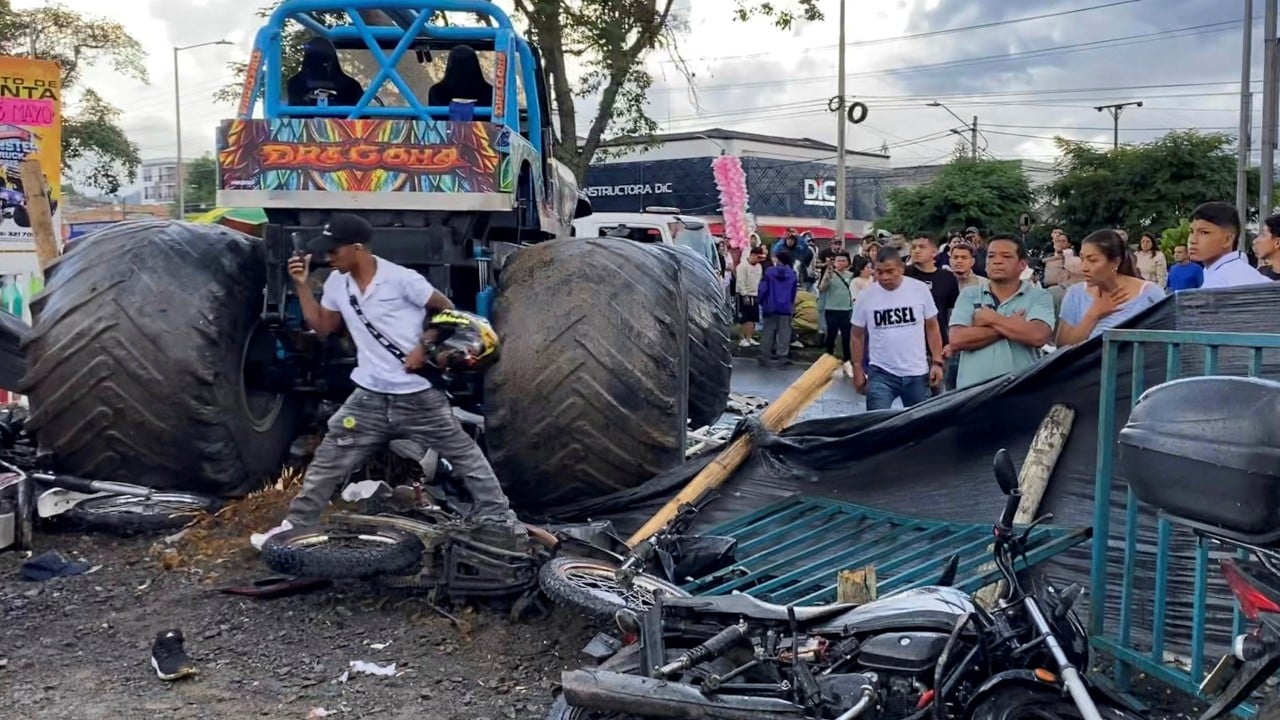
The death of a 10-year-old girl during her birthday celebration in Huila, Colombia, was not a freak accident. It was a predictable failure of oversight. When a modified "monster truck" lost control and plowed into a crowd of spectators, it claimed three lives and left a community shattered. While local headlines focused on the tragedy of the young victim, the deeper investigation reveals a systemic disregard for safety barriers and mechanical standards that turns these high-octane exhibitions into death traps. This was a disaster born of negligence, where the thrill of the show was prioritized over the basic physics of kinetic energy and crowd control.
Blood and Dust in Huila
The event in the municipality of San Agustín was supposed to be the highlight of a local festival. Instead, it became a crime scene. Witnesses describe a scene of total chaos as the massive vehicle, characterized by oversized tires and a raised suspension, suddenly veered off its intended path. There was no reinforced fencing. There were no concrete k-rails. There was only a thin line of tape and the misplaced trust of families standing just feet away from several tons of moving steel.
Among the dead was the young girl whose birthday had served as the reason for the family's outing. Two adults also perished. The mechanical failure—suspected to be a steering or brake malfunction—was the immediate trigger, but the true culprit is the lack of a standardized safety distance. In professional motorsports, the "kill zone" is calculated with mathematical precision. In the rural circuits of South America, it is often guessed at by promoters looking to maximize the number of paying eyes on the track.
The Illusion of Control
A monster truck is an engineering contradiction. It is built to be top-heavy, designed for violent impact, and often steered by hydraulic systems that can fail under extreme pressure. When you put a 10,000-pound machine in a confined space, the margin for error disappears.
The driver in the Huila incident reportedly lost the ability to redirect the vehicle after a jump or a sharp maneuver. At that point, the truck became a projectile. Physics does not care about local permits or festive atmospheres. The momentum of a vehicle that size, even at low speeds, carries enough force to crush through makeshift barriers like they are made of paper.
Why the Barriers Failed
In high-end racing environments, barriers are designed to absorb energy or deflect it away from human beings. In many regional exhibitions across Colombia and neighboring nations, "barriers" are often nothing more than:
- Plastic mesh fencing intended for construction sites.
- Single-tier metal barricades that tip over upon contact.
- The proximity of the crowd itself, acting as a human shock absorber.
This isn't just a Colombian problem, but the lack of a national regulatory body for "stunt" entertainment in the region means that every promoter is essentially writing their own safety manual. If the promoter wants the crowd to feel the roar of the engine, they move them closer. If they move them closer, people die when the steering rack snaps.
The Economics of Negligence
Investigating the "why" requires looking at the ledger, not just the wreckage. These events are lucrative. They draw massive crowds from surrounding rural areas, bringing in significant revenue for local municipalities and private organizers. However, the cost of proper safety infrastructure—portable concrete barriers, professional flaggers, and rigorous vehicle inspections—eats into those margins.
There is a recurring pattern in these tragedies. A small town wants to put itself on the map. They hire a freelance troupe of drivers. The local authorities, lacking the technical expertise to inspect a modified racing engine or a hydraulic steering system, sign off on the permits. It is a "don't ask, don't tell" policy that works perfectly until the moment a tire loses grip.
A History of Warnings Ignored
This is not the first time a monster truck has turned into a weapon in the region. The 2013 disaster in Chihuahua, Mexico, where eight people were killed and dozens injured under similar circumstances, should have been the definitive wake-up call for the entire Latin American exhibition industry. In that instance, the driver had been drinking and the safety measures were nonexistent.
The Huila crash shows that the lessons of Chihuahua were never codified into law. We see the same flaws:
- Inadequate setback distances: Spectators were standing within the "arc of failure" for the vehicle.
- Mechanical opacity: No evidence has emerged that the truck underwent a third-party safety certification before the show.
- Emergency response lag: In rural settings, the "golden hour" for trauma surgery is often lost due to poor access roads and lack of on-site medical staff.
The Myth of the Freak Accident
We need to stop calling these events "accidents." An accident is an unavoidable stroke of bad luck. A monster truck crashing into a crowd because there was no wall between them is a certainty given enough time. It is a statistical inevitability.
The industry likes to use the term "unforeseen circumstances" to shield itself from liability. But when you operate a vehicle that weighs as much as an African elephant and travels at 40 miles per hour, a mechanical failure is entirely foreseeable. In fact, it should be the baseline for your safety planning. You don't plan for the truck to stay on the track; you plan for what happens when it leaves it.
The Path Forward is Built of Concrete
If these exhibitions are to continue, the era of the "unregulated stunt show" must end. There is a clear blueprint for how to handle high-risk motor entertainment, but it requires a shift in how local governments view their responsibility.
The first step is a mandatory Safety Buffer Zone. This isn't a suggestion. It is a requirement that the front row of the audience be elevated or separated by a distance that accounts for the full length and weight of the vehicle in motion. If the venue isn't big enough to allow for that buffer, the show doesn't happen.
The second is Mechanical Accountability. Every vehicle entering a public arena needs a logbook of maintenance, specifically focusing on the fatigue of the chassis and the integrity of the hydraulic lines. These trucks endure massive stress. Steel weakens. Bolts shear. Without a rigorous inspection protocol, the driver is just a passenger in a ticking time bomb.
A Birthday That Never Ended
The image of a 10-year-old girl celebrating her life moments before it was extinguished by a machine is a stain on the organizers of the San Agustín event. It is a reminder that "entertainment" carries a heavy price when it is managed by amateurs. The grieving families in Huila aren't looking for excuses about mechanical failure. They are looking for why their children were allowed to stand in the path of a monster.
The investigation into the driver and the organizers must go beyond simple negligence. It must look at the permits. It must look at the kickbacks. It must look at why, in 2026, we are still allowing heavy machinery to be operated in the middle of a crowd without a single piece of reinforced concrete in sight.
Stop treating these shows as harmless local fun. They are high-risk industrial operations. Until they are regulated with the same severity as a construction site or an airport, the dust in Colombia will continue to be stained red. The girl in Huila didn't die because of a truck; she died because of a system that valued the spectacle more than her life. Demand the barriers be built, or don't go to the show.