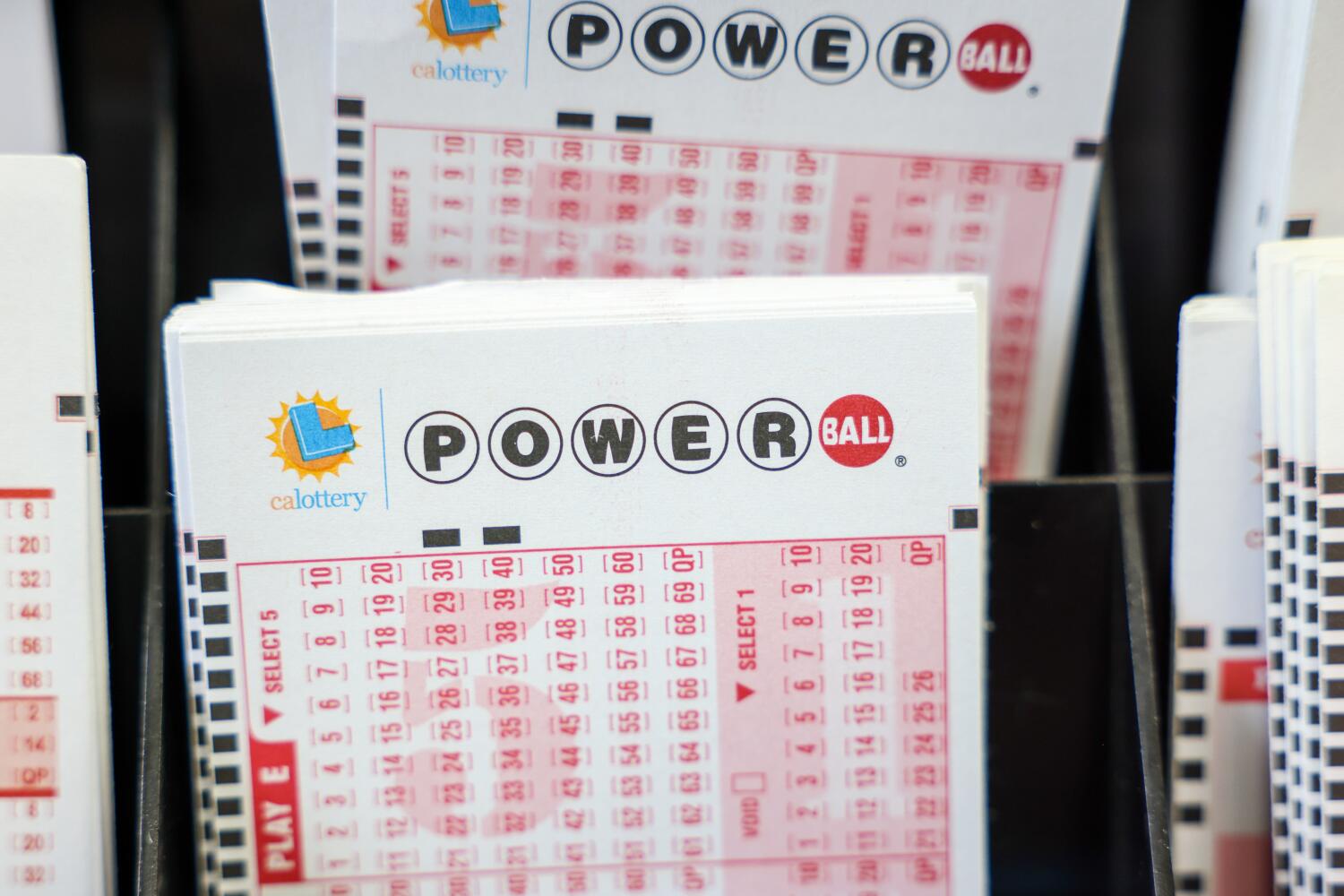
A single slip of paper sold at a Mobil station on Las Virgenes Road in Calabasas just turned a $2 investment into a $2.24 million windfall. While the headlines scream about "Ka-ching" moments and overnight millionaires, the reality of the California Lottery’s latest Powerball draw is a cold lesson in probability, taxation, and the desperate mechanics of the American dream. This wasn't a jackpot win—the big prize remained untouched—but rather a "Match 5" result that highlights the massive gap between life-changing luck and the statistical impossibility of the grand prize.
The winning ticket matched five numbers—19, 30, 37, 44, and 46—missing only the Powerball number 5. Under California law, which mandates that all non-jackpot prizes be parimutuel, the payout is determined by actual ticket sales rather than fixed amounts. This makes California the only state where a "Match 5" can fluctuate wildly, often yielding significantly more than the $1 million standard prize seen in other jurisdictions. On this occasion, the high volume of play pushed the reward past the $2 million mark, creating a localized frenzy in one of the state's wealthiest enclaves.
The Mobil Station Economy
There is a certain irony in a multi-million dollar lottery ticket being sold in Calabasas. This is an area defined by gated communities and inherited wealth, yet the gas station at 23841 Las Virgenes Road serves as a crossing point for the service workers, commuters, and laborers who keep the hills running. The lottery thrives on these intersections. For the person who held that ticket, the money represents an exit ramp from the daily grind.
But for the state of California, the lottery is a calculated revenue engine. While the winner celebrates, we must look at the sheer volume of losing capital required to fund that $2.24 million payout. In the 2022-2023 fiscal year alone, the California State Lottery generated over $9.2 billion in sales. Of that, roughly $2 billion went to public education. It sounds noble. However, critics have long argued that lottery funds often "supplant" rather than "supplement" general fund education spending. When lottery money flows in, legislators frequently redirect the money that would have otherwise gone to schools toward other projects. The result is a net neutral gain for the classroom, funded largely by those who can least afford to play.
The Tax Man Cometh
Before the winner even thinks about a new house or a diversified portfolio, they have to face the fiscal reality of a sudden windfall. While California is one of the few states that does not tax lottery winnings at the state level, the federal government is not so generous.
The IRS considers lottery winnings ordinary income. For a $2.24 million win, the top federal tax bracket of 37% looms large. The winner will likely see an immediate 24% federal withholding, but the remaining 13% will be due at tax time. After the dust settles, that $2.24 million is closer to $1.4 million. In a market like Los Angeles, $1.4 million buys a nice three-bedroom home in a decent neighborhood—it does not buy a lifetime of leisure. The "wealth" provided by a secondary Powerball prize is often a temporary buffer rather than a permanent status shift.
The Parimutuel Trap
Most players don't understand how the prize pool actually works. In most states, if you match five numbers, you get $1 million. Period. California’s parimutuel system is a double-edged sword. It means that when sales are high, the prize swells, as we saw in Calabasas. But when sales are sluggish or too many people pick the same numbers, the prize can crater.
This system reflects a broader economic trend: the shift from guaranteed outcomes to performance-based volatility. We see it in the gig economy and in the stock market. Even in our luck, we are tied to the collective behavior of the crowd. The Calabasas winner benefited from a surge in ticket sales driven by a jackpot that was creeping toward the billion-dollar mark. They rode the wave of other people’s failed dreams.
The Psychology of the Near Miss
Matching five numbers but missing the Powerball is a specific type of psychological torture. You were one digit away from $800 million or $1 billion. You were in the room, but you weren't at the table.
Sociologists often point to the "near-miss effect" as a primary driver of gambling addiction. When a player gets close, the brain processes the event not as a loss, but as a "quasi-win." It reinforces the belief that the system is winnable and that the player is "due" for the big one. The Calabasas win will undoubtedly spur a localized spike in sales at that specific Mobil station, as people flock to what they perceive as a "lucky" location.
Statistics, of course, tell us that the location of a previous win has zero impact on future draws. The machine does not have a memory. The paper does not know where it was printed. Yet, we are wired to find patterns in the chaos. We want to believe that there is a secret to the madness, a way to tilt the $1$ in $292.2$ million odds in our favor.
Wealth Disparity in the Hills
The location of this win adds a layer of social commentary that can't be ignored. Calabasas is synonymous with the Kardashian-era brand of extreme wealth. To a resident of Hidden Hills, $2 million is a rounding error or the cost of a backyard renovation. To the person likely buying a ticket at a Mobil station, it is a total restructuring of their existence.
This highlights the "two-tier" nature of modern American wealth. We have the ultra-wealthy, for whom money is an abstract tool of influence, and we have the working class, for whom money is a survival mechanism. The lottery is the only bridge between these two worlds that doesn't require a degree from Stanford or a seed round from a venture capital firm. It is the "Hail Mary" of the proletariat.
Why the Jackpot Keeps Growing
You may have noticed that Powerball and Mega Millions jackpots are reaching $1 billion with increasing frequency. This isn't an accident. In 2015, the Powerball operators changed the rules, increasing the pool of white balls and decreasing the pool of red Powerballs.
The goal was simple: make the grand prize harder to win. By lengthening the odds, the jackpot is allowed to roll over for weeks or months, creating the massive, headline-grabbing numbers that drive "casual" players to the kiosks. The $2.24 million win in Calabasas is a byproduct of this "Jackpot Fatigue." The industry knows that a $100 million prize no longer moves the needle. They need the "B-word"—Billion—to trigger the FOMO (fear of missing out) that leads to lines out the door at gas stations.
The Hidden Cost of the Win
History is littered with the stories of lottery winners who ended up bankrupt, estranged from their families, or worse. The "lottery curse" is often attributed to a lack of financial literacy, but the root cause is more complex. Sudden wealth destroys the social structures that keep an individual grounded.
When you win $2 million, every relationship you have is instantly recalibrated. Cousins you haven't spoken to in a decade appear with "business opportunities." Friends expect you to pick up every tab. The winner in Calabasas is currently entering a period of extreme vulnerability. Without a team of lawyers and fee-only financial advisors, that $1.4 million (after-tax) can vanish in thirty-six months.
Managing the Windfall
The first step for any winner—including our Calabasas mystery person—is to remain anonymous for as long as possible. In California, the winner's name is public record, but they can take time before claiming the prize.
- Secure the ticket: A $2 million piece of paper is a liability. It should go into a bank safe deposit box immediately.
- Build the "Wall": Hire a tax attorney and a certified financial planner. They act as the "bad guys" who say no to the inevitable requests for money.
- Avoid the "Lifestyle Creep": The temptation to buy a Ferrari and move into a mansion is high. But $1.4 million does not fund a mansion lifestyle. It funds a comfortable, middle-class existence if managed with extreme discipline.
The Mathematical Reality
Let's talk about the numbers. The odds of matching five white balls are $1$ in $11,688,053$. To put that in perspective:
- You are more likely to be struck by lightning in your lifetime ($1$ in $15,300$).
- You are more likely to be bitten by a shark ($1$ in $3.7$ million).
- You are more likely to have identical quadruplets ($1$ in $729,000$).
The Calabasas winner beat the odds, but they didn't beat the house. The house—in this case, the State of California—always wins because it takes its cut off the top. The lottery is essentially a voluntary tax on those who struggle with math or those who are desperate enough to view an $11$ million-to-one shot as their best bet for a better life.
The Mobil Station’s Cut
It’s not just the player who won. The Mobil station at 23841 Las Virgenes Road will receive a retailer bonus for selling the winning ticket. Typically, this is a small percentage of the win, capped at a certain amount (often $1$ million for the jackpot, but much smaller for secondary prizes). For a "Match 5" win of this size, the retailer bonus is a welcome infusion of cash for a small business owner. It covers the rent, the payroll, and the rising costs of insurance. In the ecosystem of the lottery, the retailers are the only ones with a guaranteed win rate, as they earn a commission on every ticket sold, regardless of whether it’s a winner or trash.
The End of the Dream
As the Powerball jackpot continues to climb, the Calabasas win will soon be forgotten by the public. It will be replaced by the next "lucky" store and the next set of numbers. But for the individual involved, the journey is just beginning.
They have been handed a rare opportunity to bypass the traditional hurdles of the American economy. Yet, they remain a statistical anomaly in a system designed to extract wealth from the many to enrich the few (and the state). The $2.24 million payout is a glittering distraction from a sobering truth: the middle class is increasingly being pushed toward the margins, where a random draw at a gas station is the only remaining path to financial security.
Don't go looking for the winner. Don't wait by the pumps at the Mobil station expecting lightning to strike twice. The balls will spin, the numbers will drop, and the machine will continue its work. If you want to change your life, the odds say you’re better off investing in a low-cost index fund or learning a new trade. But we all know the allure of the ticket. It’s the two-dollar permission to dream for forty-eight hours.
Take the money and run. That is the only real strategy when you find yourself on the right side of an eleven-million-to-one calculation. Anything else is just noise.