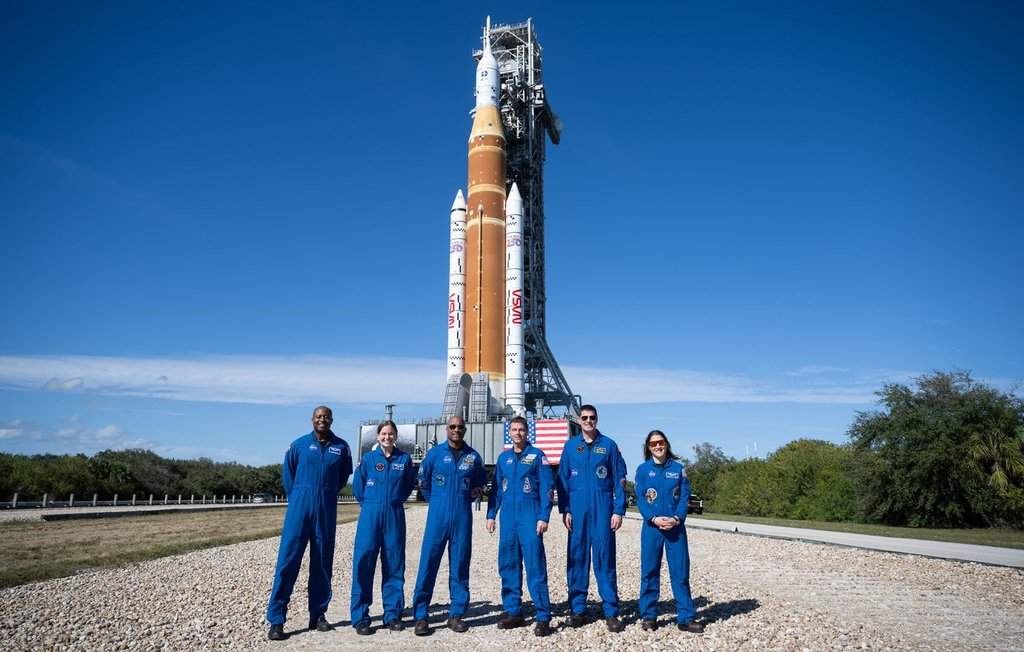
When the four astronauts of the Artemis II mission arc around the far side of the lunar surface, they will be farther from home than any human being in half a century. In that vacuum, silence is the enemy. The tether keeping them connected to Earth isn't just a radio frequency; it is a specific human voice stationed at Mission Control in Houston. That voice belongs to Canadian Space Agency (CSA) astronaut Jenni Gibbons. While the public focuses on the hardware and the heat shields, the success of the first crewed lunar mission since 1972 rests on the shoulders of the Capcom—the Capsule Communicator.
Gibbons has been named the primary backup and lead communicator for this historic flight. Her role is the narrow bottleneck through which every critical instruction, every emergency procedure, and every piece of morale-boosting banter must pass. It is a position defined by high-stakes translation. She must take the chaotic, multi-layered data from hundreds of flight controllers and distill it into clear, calm directives that a pilot can execute while vibrating at three times the force of gravity.
The Architecture of Lunar Communication
The technical reality of Artemis II is vastly different from the Apollo era. We are no longer dealing with simple analog relays and grainier-than-life television feeds. The Orion spacecraft utilizes the Deep Space Network (DSN), a massive global array of radio antennas. However, the complexity of modern telemetry creates a new kind of risk: information overload.
A Capcom serves as the essential human filter. During the mission, the flight director manages the "trench"—the room full of specialists monitoring everything from CO2 scrubbers to orbital mechanics. These specialists do not talk to the crew. If they did, the cockpit would be a cacophony of competing priorities. Instead, they talk to Gibbons. She sits at the nexus of the operation, deciding what the crew needs to know instantly and what can wait for a quieter moment in the flight plan.
Training for the Unthinkable
The Artemis II trajectory is a "free-return" profile. The spacecraft will use the Moon's gravity to whip itself back toward Earth without needing a massive engine burn to come home. It sounds elegant, but it leaves very little room for error. If a life support system fails or the communication link jitters during a critical manual maneuver, the Capcom is the only person who can talk the crew through a manual override.
Gibbons hasn't just been reading manuals. She has spent thousands of hours in high-fidelity simulators, replicating the "worst day" scenarios that NASA engineers dream up to break their astronauts. These simulations aren't just about technical proficiency. They are about psychological synchronization. To be an effective Capcom, you have to know how Commander Reid Wiseman or Pilot Victor Glover breathes when they are stressed. You have to recognize the subtle shift in their tone that indicates they are falling behind the power curve of a procedure.
The Canadian Stake in the Lunar Gateway
Canada's involvement in Artemis is often framed through the lens of national pride, but the geopolitical and industrial reality is more calculated. Canada isn't just "helping" NASA; it is a tier-one partner. By providing the Canadarm3—a highly autonomous robotic system for the future Lunar Gateway station—Canada secured two seats on lunar missions. Jeremy Hansen will be on the Artemis II capsule, and another Canadian will eventually walk on the lunar surface.
Jenni Gibbons representing the voice of Earth for this mission isn't a ceremonial gesture. It is a recognition of the CSA’s specialized expertise in robotics and remote operations. When you operate a robotic arm from thousands of miles away, you learn a specific type of spatial discipline and communication brevity. That is the exact skillset required to manage a crew traveling 400,000 kilometers away.
Breaking the Apollo Mold
The original Apollo missions were military-heavy, rigid, and strictly hierarchical. Artemis is attempting something different. The crew composition is more diverse, and the mission goals involve long-term sustainability rather than just "flags and footprints." This shift changes the nature of the ground-to-space relationship.
The communication style has evolved from "test pilot bravado" to "collaborative systems management." Gibbons represents this new era. Her background as a combustion scientist and fire researcher gives her a granular understanding of how materials behave under stress. In a fire or depressurization event, she isn't just reading a checklist; she understands the physics of the catastrophe unfolding on the other side of the radio link.
The Silence of the Far Side
There is a period during the Artemis II mission where the crew will be in the "radio shadow" of the Moon. For roughly thirty minutes, as they pass behind the lunar disk, they will be entirely alone. No Earth-rise, no mission control, no Jenni Gibbons.
This blackout period is the ultimate test of the preparation handled by the Capcom. Every instruction needed for that window must be uploaded and verified before the signal cuts out. The transition from constant contact to absolute isolation is a psychological hurdle that requires a specific type of pre-briefing. Gibbons is responsible for ensuring the crew enters that shadow with total situational awareness.
The Hidden Risks of Deep Space Links
While the Deep Space Network is powerful, it is not infallible. Solar flares or terrestrial weather at the antenna sites in California, Spain, or Australia can degrade the signal. We often take for granted that digital communication is binary—it works or it doesn't. In deep space, the signal often "degrades" rather than disappears.
You get "packet loss" in human speech. Words clip. Tone flattens. A Capcom must be skilled at "read-backs" and verification, ensuring that a "go" for a burn wasn't actually a "no-go" obscured by static. This is why the voice on the other end must be a trained astronaut. Only someone who has sat in the seat knows which syllables are the most vital to protect when the bandwidth drops.
Beyond the Mission Checklist
The role of the Capcom also extends to the families of the astronauts. While not officially in the job description, the person talking to the crew often becomes the unofficial bridge between the families in Houston and the loved ones in the vacuum. Knowing that a familiar, competent colleague like Gibbons is the one holding the line provides a layer of psychological security that no automated system could replicate.
Her presence in the ear of the crew provides a sense of continuity. In the 1960s, the Capcom was almost always a man with a buzzcut and a slide rule. In 2026, the voice of the Moon is a 30-something Canadian woman who represents the cutting edge of global aerospace research. This isn't just about optics; it’s about utilizing the best available talent to manage the highest-risk venture of the decade.
The Reality of the "Backup" Label
In the space industry, being a "backup" is often misinterpreted by the public as being on the sidelines. In reality, the backup is the hardest-working person in the building. While the primary crew focuses on their physical training and flight maneuvers, the backup must master every single role simultaneously.
If Jeremy Hansen were to fall ill 48 hours before launch, Gibbons would be the one stepping into the capsule. She must be ready to fly the mission, even while her primary job is to talk the others through it. This dual-track preparation is grueling. It requires a level of mental flexibility that few professionals in any field ever achieve.
Infrastructure of the Future
The Artemis program is the precursor to Mars. The communication lag to the Moon is about 1.3 seconds—noticeable, but manageable for a conversation. On a Mars mission, that delay stretches to twenty minutes. The work Gibbons is doing now to streamline communication protocols is the foundation for how humans will eventually talk to one another across the solar system.
We are watching the birth of a standardized "deep space language." It is a dialect of English that is stripped of ambiguity, optimized for latency, and delivered with a specific cadence that resists the interference of cosmic radiation. Gibbons is one of the primary authors of this new way of speaking.
The Weight of the Final Countdown
When the SLS rocket clears the tower at Kennedy Space Center, the roar of the engines will eventually give way to the steady, rhythmic check-ins from Houston. The first voice the crew hears as they reach orbit, confirming that their systems are nominal and the path to the Moon is clear, will be the voice of a Canadian who has spent years preparing for that exact ten-second exchange.
The mission is an incredible feat of engineering, but engineering without communication is just a very expensive pile of metal. The human element—the ability to keep a crew calm while they hurtle toward a different world—remains the most volatile and most essential variable in the equation.
Ask yourself what it takes to be the calmest person in the room when the room is on the other side of a quarter-million miles of void. You can look at the telemetry or the orbital plots, but if you want to understand the true pulse of the Artemis II mission, you have to listen to the person sitting at the Capcom console.
Would you like me to analyze the specific communication protocols or the technical specs of the Deep Space Network antennas used for this mission?