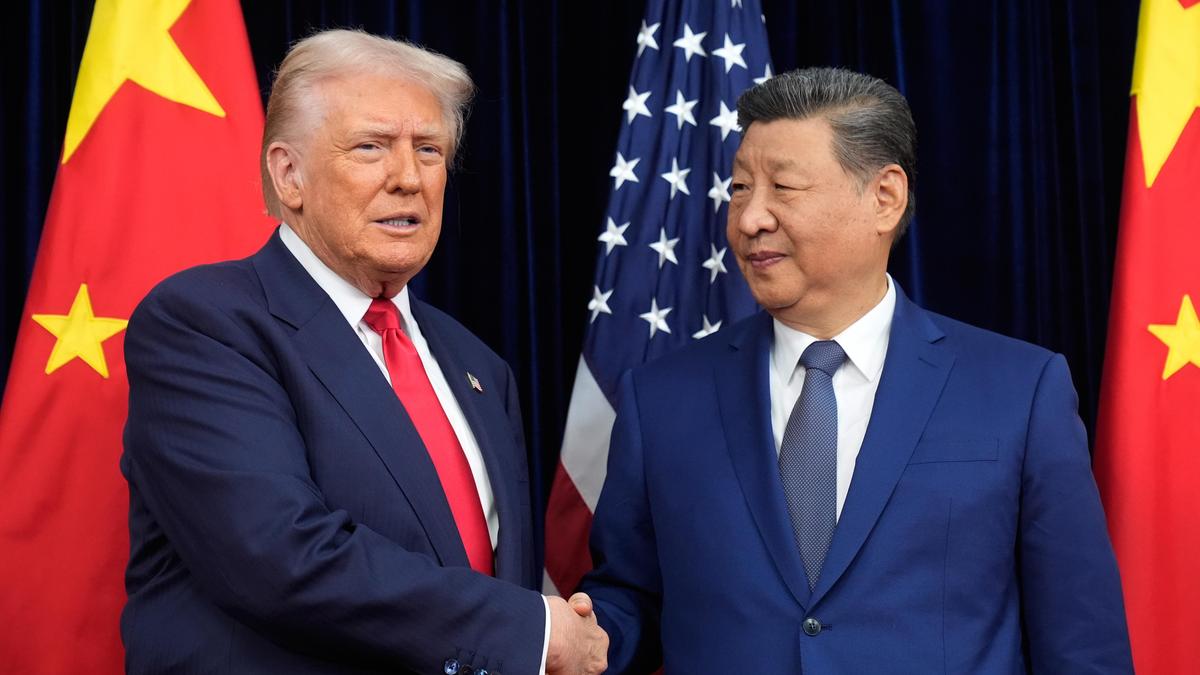
The beltway pundits are reading the map upside down. They look at the prospect of a second Trump term and a shifting Beijing and see a classic "art of the deal" showdown. They think this is a high-stakes poker game where the players are bluffing about their chip counts.
They are wrong.
The prevailing narrative—the "lazy consensus"—suggests that China is a wounded dragon watching the United States enter a period of terminal decay, waiting to swoop in and negotiate from a position of relative strength. It assumes that Donald Trump wants a "deal" in the traditional sense: a signed piece of paper, a handshake, and a return to some semblance of 1990s-era globalist stability.
Neither of these things is true. The reality is far more chaotic, far less predictable, and significantly more dangerous for any business leader still operating on a 2019 playbook. We aren't looking at a negotiation. We are looking at the managed demolition of the post-WWII economic order.
The Myth of Chinese Patience
The media loves the trope of the "century-long" Chinese perspective. They claim Beijing is playing 4D chess while Washington plays checkers. This is a comforting fairy tale for people who don't want to look at the math.
China isn't waiting for the U.S. to decline. China is frantically trying to outrun its own demographic and debt-laden collapse. When you look at the inverted population pyramid and the ghost cities built on the back of unsustainable local government debt, the "patient dragon" looks more like a frantic sprinter with a heart condition.
The idea that Beijing is "gauging" U.S. decline implies they have the luxury of time. They don't. Their aggression in the South China Sea and their tightening grip on domestic capital aren't signs of a rising superpower feeling its oats; they are the desperate maneuvers of a regime that knows its window of absolute leverage is closing. If you’re a CEO betting on China’s long-term stability as a hedge against American volatility, you’re jumping out of a frying pan and into a blast furnace.
Trump Does Not Want Your Deal
The biggest mistake analysts make is taking the word "deal" literally. In the Trumpian lexicon, a "deal" isn't an end state. It’s a tool for disruption.
The competitor piece suggests Trump is "eying a deal" to stabilize relations. This fundamentally misunderstands his brand of transactional populism. Trump doesn't want a return to "business as usual" because his entire political identity is built on the fact that "business as usual" failed the American working class.
For Trump, the friction is the point. The tariffs aren't just a negotiating tactic to get lower prices on soy; they are a structural barrier designed to force a decoupling that the corporate world has spent thirty years resisting.
If you think a "deal" in 2025 or 2026 looks like a reduction in trade barriers, you haven't been paying attention. A "deal" in this new era means a managed separation. It means "you stay on your side, we stay on ours, and we tax the hell out of anything that crosses the line." It is the end of the integrated supply chain. It is the death of the "Just-in-Time" world.
The Decline Fallacy: A Feedback Loop
Beijing is convinced the U.S. is in decline because they see our internal polarization as a fatal flaw. They see the chaos of our elections and the shouting matches on cable news and conclude the machine is broken.
They are misinterpreting noise for signal.
American "decline" is the most over-predicted event in modern history. We’ve been "declining" since the Sputnik launch in 1957. We "declined" during the stagflation of the 70s. We "declined" when Japan was going to buy every square inch of Manhattan in the 80s.
What the CCP fails to realize is that American chaos is our version of a self-correcting algorithm. Our messiness allows for the rapid shedding of bad ideas and the brutal emergence of new industries. While China doubles down on state-controlled AI and aging manufacturing models, the U.S. private sector—messy, loud, and uncoordinated—continues to dominate the actual frontiers of tech, from LLMs to orbital mechanics.
If Beijing bases its "deal" strategy on the assumption that the U.S. is a fading power, they will overplay their hand. They will assume they can demand concessions that the American political system, regardless of who is in the White House, is no longer capable of giving.
The Onshoring Lie
I’ve spent twenty years watching companies move production to Southeast Asia and then back to Mexico, and now, supposedly, "home" to the U.S.
Here is the truth: Most of the manufacturing jobs are never coming back to the U.S. heartland in the way the "deal-makers" promise. They are being replaced by high-end automation that requires ten technicians instead of a thousand assembly line workers.
When Trump talks about "bringing back jobs" through a deal with Beijing, and Beijing talks about "industrial cooperation," they are both lying to their respective publics.
The real deal isn't about jobs. It’s about sovereignty over the silicon.
$TSMC$ and the $ASML$ supply chain are the only things that matter. If a deal doesn't address the lithography bottleneck, the rest is just theater for the evening news. We are moving toward a world of "fortress economies."
Why Your Supply Chain is a Liability
If you are a logistics officer or a COO, the "wait and see" approach is professional negligence.
The consensus says: "Wait for the election results. Wait for the first summit. Wait for the trade representative to issue a memo."
I say: If your product requires a component that must pass through the Taiwan Strait, you don't have a business; you have a ticking time bomb.
The "nuance" the pundits miss is that the geopolitical climate has shifted from economic optimization to national security prioritization. In the old world, you optimized for the lowest cost. In the new world, you optimize for the lowest "geopolitical risk," which is inherently expensive and inefficient.
This isn't a temporary spike in friction. This is the new baseline.
The Thought Experiment: The 60% Tariff Reality
Imagine a scenario where the proposed 60% blanket tariff on Chinese goods isn't a bluff.
The "experts" claim this would be an economic disaster, a tax on the American consumer that would lead to an immediate recession. They cite standard Ricardian trade theory to prove their point.
$Total Cost = Price + (Price \times Tariff)$
But they ignore the secondary and tertiary effects. A 60% tariff is an extinction-level event for low-margin importers. It would trigger a massive, violent redirection of capital toward domestic production and "friend-shoring" in a timeframe that would make the COVID-era supply chain shifts look like a rehearsal.
Would it hurt? Yes. Would it be inflationary? Absolutely. But it would also achieve the one thing the Trump administration actually wants: the total severance of the umbilical cord between the American consumer and Chinese industrial capacity.
Beijing knows this. Their "gauging" isn't about whether the U.S. is declining; it’s about whether the U.S. is crazy enough to actually pull the plug.
The answer is: It doesn't matter if we're "crazy." It only matters if we're capable. And the U.S. economy, with its energy independence and demographic resilience compared to China, is the only entity on earth that could survive that divorce.
The Death of the Middle Ground
For decades, the "Chimerica" model worked because both sides agreed to ignore their fundamental ideological differences in exchange for cheap stuff and high growth.
That era ended the moment the U.S. realized that economic integration didn't lead to political liberalization in China, and China realized that economic integration made them vulnerable to American financial sanctions.
Now, we have two giants trapped in a room, each convinced the other is trying to poison the air.
- China's Miscalculation: Thinking American political division equals national weakness.
- The U.S. Miscalculation: Thinking a single "deal" or a specific set of tariffs will "fix" the problem.
This isn't a problem to be fixed. It’s a reality to be navigated.
Stop looking for the "breakthrough" headline. Stop waiting for the "Grand Bargain." It’s not coming. Even if a document is signed, it will be violated within six months. The trust is gone, the incentives have flipped, and the "decline" everyone is talking about is actually just the sound of the old world cracking open.
If you are still waiting for a return to the "normal" of 2015, you aren't an investor. You're a spectator at your own funeral.
The "Great Deal" is a ghost. The only thing real is the struggle for what comes after.
Build your walls. Diversify your sources. Stop believing the pundits who think a summit in Beijing can stop the tectonic plates from shifting.
The era of the deal is over. The era of the fortress has begun.