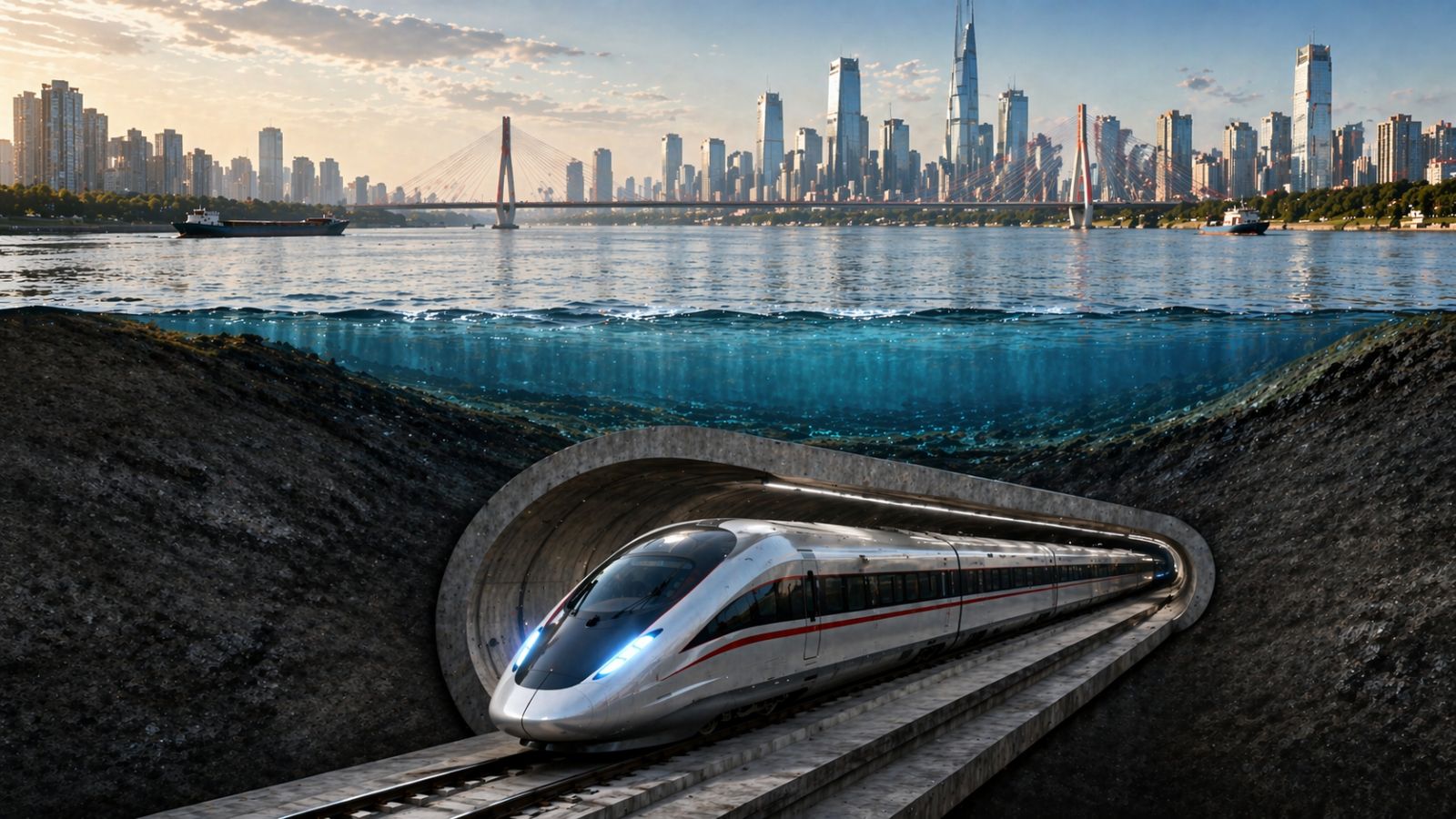
China has officially completed the primary excavation of the Jiantiao High-Speed Railway Tunnel, an 11-kilometer engineering feat that dives beneath the Yangtze River. This is not just another stretch of track. It is the deepest and longest underwater high-speed rail tunnel on the planet, designed to carry bullet trains at 350 kmph. By connecting the provinces of Jiangsu and Anhui, the project slashes travel times across the Yangtze River Delta from several hours to a mere fraction of that.
While the world watches the sheer scale of the construction, the real story lies in the geological nightmare the engineers had to overcome. This wasn't a standard dig. They were boring through a pressurized, silty riverbed with a massive Tunnel Boring Machine (TBM) that had to withstand immense water pressure while maintaining a diameter wide enough for two high-speed tracks.
The Pressure Cooker Under the Riverbed
Building a tunnel under the Yangtze is vastly different from boring through granite. The river sits on layers of soft soil, sand, and high-pressure water pockets. At its deepest point, the Jiantiao tunnel sits nearly 60 meters below the river's surface.
The weight of the water and the riverbed creates a crushing environment. To handle this, the project utilized a custom-built slurry TBM with a diameter exceeding 15 meters. Think of it as a subterranean factory. As the cutter head grinds through the silt, a pressurized fluid—the slurry—prevents the tunnel face from collapsing. If the pressure balance fails by even a small margin, the river could breach the shield, or the ground above could sink, threatening the very foundations of the river’s ecosystem and nearby infrastructure.
Engineering teams faced the constant threat of "clogging." The Yangtze silt is notorious for being sticky. It can gum up the massive cutting discs, turning a multi-million-dollar machine into an expensive paperweight. They solved this by using a high-precision circulation system that constantly filters the muck and replaces it with fresh slurry, a process that requires more computing power than some small cities.
Why 350 Kilometers Per Hour Changes Everything
Most underwater tunnels are bottlenecks. Because of air pressure and safety risks, trains usually slow down to 120 or 160 kmph when diving beneath the waves. The Jiantiao tunnel refuses to compromise.
Maintaining 350 kmph in a confined tube presents a massive aerodynamic challenge. When a train enters a tunnel at that speed, it pushes a wall of air ahead of it, creating a piston effect. Without sophisticated pressure relief shafts and a precisely calculated tunnel diameter, the resulting sonic boom at the exit would be deafening, and the pressure waves could shatter the train’s windows.
Solving the Sonic Boom
To keep the trains at full throttle, Chinese engineers designed a unique cross-section. The tunnel isn't just a circle; it’s an aerodynamic chamber. The interior lining is smoothed to a degree rarely seen in civil engineering to reduce drag. Furthermore, the transition zones at the tunnel portals are elongated to bleed off the air pressure gradually. This allows the Yangtze River Delta—a region with an economy larger than many G20 nations—to operate as a single, integrated urban sprawl.
The Economic Engine Behind the Concrete
Beijing isn't building these tunnels for the sake of prestige alone. The Yangtze River Delta is the heart of China’s manufacturing and tech sectors. For decades, the river has acted as a physical barrier. While bridges exist, they are vulnerable to weather and reaching their capacity limits.
By pushing the railway underground, the state is creating a "one-hour circle" of commerce. A worker can live in a lower-cost city in Anhui and commute to a high-paying tech job in Jiangsu in less time than it takes to cross Manhattan. This mobility of labor is essential for China’s shift from a low-end manufacturing economy to a high-tech superpower. It’s about density. By squeezing more people into a tighter logistical loop, they increase the "collision rate" of ideas and capital.
The Geopolitical Stakes of Infrastructure Export
There is a broader game afoot. This tunnel serves as a live laboratory for China’s Belt and Road Initiative. Every time they solve a problem beneath the Yangtze, they are perfecting a product they intend to sell to the rest of the world.
If you can build a 350 kmph tunnel under one of the world's most volatile rivers, you can build a tunnel anywhere. This expertise gives Chinese state-owned enterprises a massive edge when bidding on projects in Southeast Asia, the Middle East, and even parts of Europe. They aren't just exporting trains; they are exporting the ability to reshape geography.
The Maintenance Nightmare
Constructing the tunnel is the easy part. Keeping it operational for 100 years is where the difficulty spikes. The Yangtze is a living entity; its bed shifts, and the salt levels in the water can corrode steel reinforcements.
The Jiantiao tunnel is outfitted with thousands of fiber-optic sensors. These sensors monitor structural integrity, water seepage, and seismic activity in real-time. If the tunnel shifts by even a millimeter, the system alerts maintenance crews before a crack can even form. This level of "smart" infrastructure is necessary when you are hurtling 500 passengers through a pressurized tube at 100 meters per second.
Redefining High Speed Rail Boundaries
The completion of the Jiantiao tunnel signals the end of the era where water was a barrier to high-speed rail. We are looking at a future where 100-kilometer tunnels beneath seas are no longer science fiction but a matter of budget and timeline.
While the West struggles with decades of litigation and environmental reviews for a single bridge, China is moving the earth. They have accepted a high-risk, high-reward model where the state absorbs the astronomical costs of these tunnels to ensure long-term economic dominance. The engineering learned here will likely be applied to the proposed tunnel projects under the Bohai Strait or even more ambitious crossings in the future.
The sheer velocity of the project is what should haunt competitors. The TBMs didn't just dig; they set a pace that traditional construction methods cannot match. This is industrialization of the underground. By the time this line is fully operational, the data gathered from its construction will already be fueling the next, even deeper project.
The Yangtze River has been mastered. Not by bridging over it, but by piercing through the mud beneath it, proving that with enough pressure—both hydraulic and political—nature eventually yields to the machine.