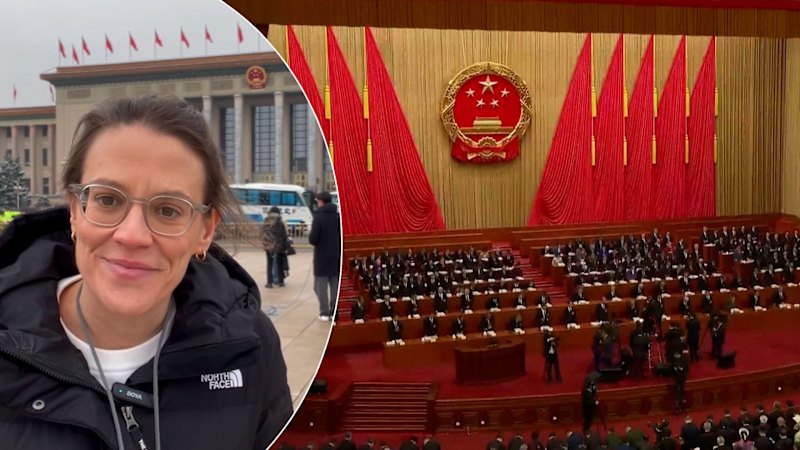
China's 2026 National People's Congress (NPC) functions not as a legislative debating chamber but as a signaling mechanism for the central government’s risk tolerance and resource allocation for the upcoming fiscal cycle. The announcement of a Gross Domestic Product (GDP) growth target of approximately 5% is less a projection of organic economic activity and more a commitment to a specific level of state-led intervention. To achieve this, the Beijing administration must navigate a trilemma: stabilizing a precarious property sector, transitioning to "New Quality Productive Forces" (high-tech manufacturing), and managing a burgeoning local government debt crisis that threatens the transmission of monetary policy.
The Mathematics of the Five Percent Target
The 5% growth target is a political floor rather than an economic ceiling. In a post-industrializing economy facing demographic headwinds—specifically a shrinking labor force and an aging population—achieving such growth requires a significant increase in Total Factor Productivity (TFP) or an aggressive expansion of the credit-to-GDP ratio. Since 2023, the marginal productivity of debt in China has declined.
Historically, one yuan of credit generated roughly 0.8 yuan of GDP; currently, that ratio has slipped closer to 0.4 in several provinces. The 2026 agenda confirms that the central government will fill the investment gap left by the private sector through the issuance of Ultra-Long Special Treasury Bonds. These instruments are designed to bypass the balance sheet constraints of local government financing vehicles (LGFVs), which are currently incentivized to prioritize debt servicing over new infrastructure projects.
The Structural Pivot to New Quality Productive Forces
The NPC has codified "New Quality Productive Forces" as the primary driver of the national economic transition. This framework replaces the old "Three Pillars" of growth—real estate, infrastructure, and low-end manufacturing—with a concentrated focus on three specific technological verticals:
- The Energy Transition Circuit: Scaling the "New Three" (electric vehicles, lithium-ion batteries, and photovoltaic products) to dominate global market share and drive domestic industrial upgrading.
- Quantum and Semi-conductor Sovereignty: Allocating strategic capital to bypass Western export controls on lithography and advanced logic chips.
- Artificial Intelligence Integration: Deploying AI across traditional manufacturing to offset rising labor costs and maintain the "World's Factory" status through automation rather than arbitrage.
This pivot creates a deliberate "industrial overcapacity" by design. By subsidizing the supply side, China aims to lower the global price point of green technologies, effectively forcing international adoption while securing long-term dominance in the energy value chain. The friction arises from the "Consumption Gap." While the NPC emphasizes supply-side excellence, domestic household consumption remains suppressed at approximately 38% of GDP, significantly lower than the global average of 60%. Without a structural transfer of wealth from the state-owned sector to households, the "New Quality Productive Forces" will inevitably lead to heightened trade tensions as excess capacity is exported to global markets.
The Property Sector Liquidation Trap
The property sector, which formerly accounted for nearly 30% of Chinese GDP, is undergoing a managed contraction. The NPC’s "White List" mechanism for developer financing is a triage strategy, not a bailout. The logic is to ensure the completion of pre-sold housing units to maintain social stability while allowing the equity of overleveraged developers to evaporate.
The fundamental bottleneck is the "Wealth Effect." With over 70% of Chinese household wealth tied to real estate, the stagnation of property prices has triggered a "Balance Sheet Recession" similar to Japan’s experience in the 1990s. Households are prioritizing debt repayment and precautionary savings over discretionary spending. The 2026 fiscal plan attempts to counter this by increasing social safety net spending—specifically in healthcare and pensions—to reduce the necessity for high household savings rates, though the scale of this deployment currently lacks the magnitude required to shift consumer behavior in the short term.
Geopolitical Friction as a Fixed Variable
Strategy at the NPC is now being formulated under the assumption of a "Fortress China" model. External pressures are no longer viewed as temporary hurdles but as permanent features of the international landscape. This has resulted in the "Dual Circulation" strategy becoming more inward-leaning.
- Internal Circulation: Strengthening domestic supply chains to ensure food and energy security. This includes the expansion of coal-fired power as a bridge to renewable dominance and the stockpiling of strategic grains.
- External Circulation: Redirection of trade from the G7 toward the Global South and BRICS+ nations. The 2026 data indicates that for the first time, China’s trade volume with developing markets has structurally decoupled from its reliance on US and EU demand.
The risk in this strategy is the "Middle Income Trap." If China’s technological advancements are met with widespread protectionist tariffs (as seen with the EU’s anti-subsidy probes into EVs), the state-led investment model will face a crisis of diminishing returns.
Fiscal Policy and the Local Government Debt Bottleneck
The most significant internal threat discussed—often in the margins of the NPC—is the sustainability of local government debt. The "Hidden Debt" of LGFVs is estimated to be upwards of $9 trillion. The central government's strategy for 2026 involves a "Debt-to-Bond Swap" program.
By allowing local governments to replace high-interest, short-term shadow banking debt with lower-interest, long-term official provincial bonds, the state is effectively buying time. However, this does not solve the underlying revenue problem. Since local governments rely on land sales for approximately 40% of their revenue, the property market downturn has created a permanent fiscal hole. The 2026 policy shift indicates a move toward a national property tax and a larger share of the Value Added Tax (VAT) being retained by local authorities, though these measures are politically sensitive and will be implemented with extreme caution.
The Military-Civil Fusion Mandate
Defense spending continues to outpace overall GDP growth, pegged at a 7.2% increase for the 2026 cycle. This expenditure is increasingly difficult to separate from "Technology R&D" due to the Military-Civil Fusion (MCF) mandate. The objective is twofold:
- Modernization: Transitioning the People’s Liberation Army (PLA) into a "mechanized, vectorized, and intelligentized" force by 2027.
- Industrial Counter-cyclicality: Using defense contracts to stimulate high-end manufacturing in provinces that have seen a decline in traditional industrial output.
Strategic Forecast and Operational Adjustments
The persistence of the 5% growth target suggests that the central leadership views economic momentum as a prerequisite for regime legitimacy, even at the cost of further leverage. For global stakeholders, the "China Playbook" for the remainder of 2026 requires an adjustment to three realities:
- Deflationary Export Pressure: Expect a surge of low-cost, high-tech Chinese goods in global markets as domestic overcapacity seeks an outlet.
- Selective De-risking: Foreign capital will find opportunities in "aligned" sectors (green energy, advanced manufacturing) while facing increasing regulatory barriers in data-heavy or culturally sensitive industries.
- State-Driven Volatility: Markets will react less to consumer data and more to "Policy Windows"—the specific periods following NPC announcements where state capital is deployed into the equity markets to signal stability.
The decoupling of Chinese economic policy from Western neoliberal norms is now complete. The 2026 NPC confirms that the "China Model" has shifted from "Growth at all costs" to "Security-centric development." Success will be measured not by the standard of living increases seen in the 2000s, but by the degree of technological self-sufficiency achieved before the next major geopolitical or demographic inflection point. Organizations must hedge against a "Long Plateau" in Chinese domestic demand while preparing for intensified competition from Chinese state-backed champions in third-party markets across Southeast Asia, Latin America, and the Middle East.