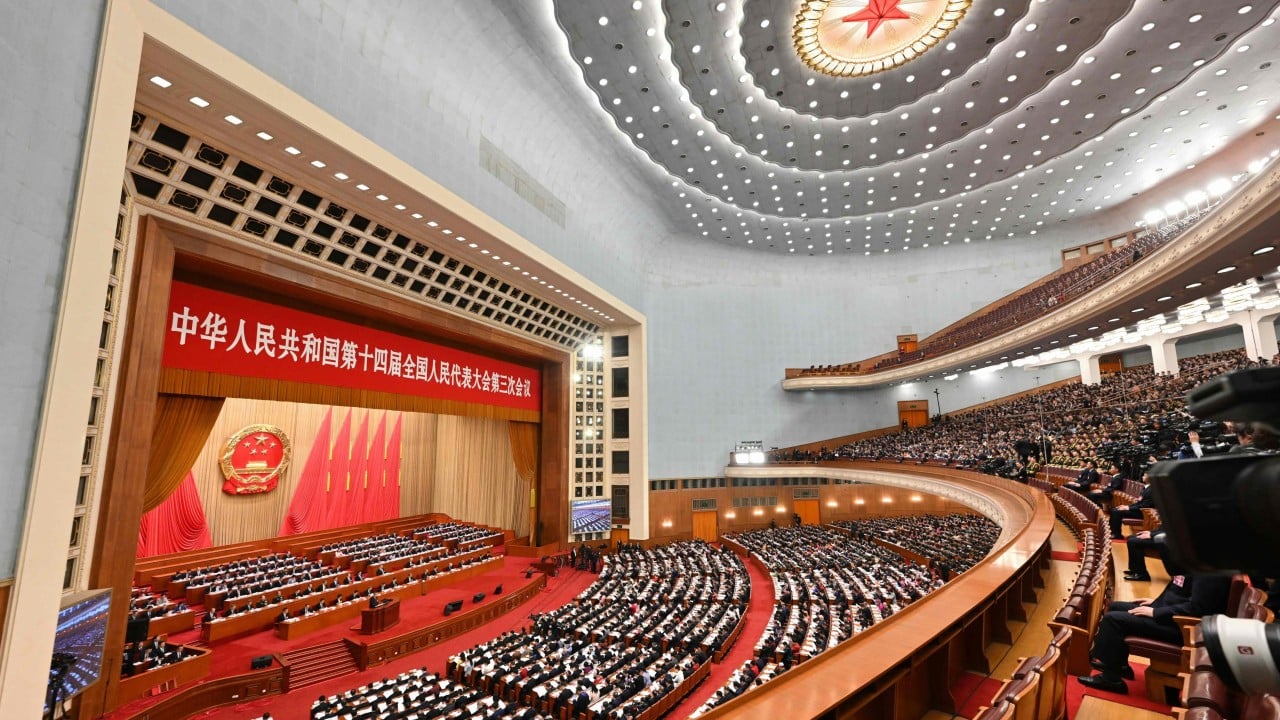
The Western financial press has a favorite ritual. Every time the National People's Congress (NPC) convenes in Beijing, a wave of articles emerges predicting the imminent "hitting of the wall." They point to the 5% growth targets with a mixture of pity and dread, claiming China has run out of runway. They cite the property crisis, the aging population, and the "middle-income trap" as if these were unforeseen accidents rather than the inevitable math of a maturing superpower.
They are missing the point. China isn't failing to grow; it is actively choosing to stop chasing the ghost of 8% GDP expansion.
The consensus view—that China is desperately trying and failing to revive its old economic engine—is lazy. It ignores the reality that the CCP has spent the last five years intentionally dismantling the very sectors (real estate and shadow banking) that Western analysts now claim are "dragging them down." You don't perform a controlled demolition on your house because you're "hitting a limit"; you do it because the foundations were rotten and you’re building something else.
The Property Ghost and the Allocation of Capital
The loudest critique involves the real estate sector. We’ve seen the headlines about Evergrande and Country Garden. The "lazy consensus" argues that the collapse of these giants is a sign of systemic failure.
In reality, the "Three Red Lines" policy introduced in 2020 was a deliberate, self-inflicted wound. Beijing knew that a $3 trillion property bubble was a parasitic drain on productive capital. For decades, the smartest minds in China weren't innovating in labs; they were flipping apartments in Shenzhen.
By strangling the credit flow to developers, the state signaled a brutal shift: the era of "growth at any cost" is dead. The goal now is Total Factor Productivity (TFP).
If you want to understand where the money is going, stop looking at the crane counts in Tier-3 cities. Look at the factory floors in the "New Three" industries: electric vehicles (EVs), lithium-ion batteries, and renewable energy. In 2023, these sectors saw export growth of nearly 30%. While the West obsessed over China’s "limit to growth," China became the world's largest auto exporter. That isn't a country hitting a wall; it's a country changing vehicles.
The Demographics Myth: Biology is Not Destiny
"China is getting old before it gets rich." It’s the catchphrase of every armchair demographer from London to New York. They point to the shrinking workforce as the ultimate "limit."
This argument assumes that economic output is a simple linear function of the number of warm bodies in a factory. It ignores the Solow-Swan Growth Model, which posits that long-term growth comes from technological progress and capital intensity, not just labor input.
$$Y = A \cdot K^\alpha \cdot L^{1-\alpha}$$
In this equation, the variable $A$ represents technology (Total Factor Productivity). China’s strategy is to aggressively increase $A$ to compensate for a declining $L$ (Labor). This is why China installs more industrial robots than the rest of the world combined. They aren't trying to fix the birth rate; they are trying to automate the need for one.
I’ve spent time on the ground in Dongguan. Ten years ago, the factories were filled with thousands of migrant workers stitching sneakers. Today, those same footprints are occupied by automated precision machining tools producing components for high-end medical devices. The workforce is smaller, yes, but the value-add per worker has tripled. To call this a "limit to growth" is to fundamentally misunderstand the nature of modern industrialization.
The Consumption Trap: Why Beijing Isn't Sending Checks
Western economists are screaming for a "big bang" stimulus. They want Beijing to send checks to households to jumpstart consumption, mimicking the US response to the 2020 lockdowns. They view the lack of such a package as a sign of policy paralysis.
It isn't paralysis. It’s a fundamental disagreement on the nature of economic sovereignty.
The CCP views Western-style consumerism—driven by debt and retail therapy—as a strategic weakness. They don't want a "TikTok economy" where growth is driven by people buying imported gadgets they don't need. They want a "hard tech" economy.
Beijing’s refusal to bail out the consumer is a feature, not a bug. They are prioritizing national resilience over quarterly retail sales. By keeping the stimulus targeted toward high-end manufacturing and domestic semiconductor supply chains, they are building a fortress economy designed to withstand external shocks (like sanctions or trade wars).
Is this painful for the average Chinese citizen? Absolutely. Is it a "limit to growth"? Only if you define growth by how many iPhones people buy. If you define growth by the ability to produce 5nm chips domestically despite a global blockade, China is accelerating.
The Middle-Income Trap is a Choice
The "middle-income trap" is the bogeyman of developmental economics. It suggests that once a country reaches a certain GDP per capita, it gets stuck because it can no longer compete on low wages but isn't yet ready to compete on high-end innovation.
The mistake analysts make is assuming China is a passive passenger in this process. They aren't "stuck." They are aggressively pivoting toward what they call "New Quality Productive Forces." This isn't just a slogan; it's a directive to move capital away from the "old" economy (infrastructure and cheap exports) toward:
- Quantum Computing: China currently leads or rivals the US in patent filings for quantum communications.
- Green Hydrogen: They are building the world's largest electrolyzer capacity while the West debates subsidies.
- Biotech: The regulatory environment for CRISPR and genomic research in China is far more aggressive (and controversial) than in the EU or US.
The risk isn't that China hits a limit; the risk is that the West underestimates the speed of this pivot because they are too busy looking at the "bad" data coming out of the traditional sectors.
The Transparency Paradox
Critics often cite the lack of transparent data as proof that things are worse than they seem. "If the numbers were good, they'd show us," the logic goes.
I’ll give you the contrarian take: the data is murky because the state is in the middle of a massive, chaotic restructuring. When you're moving a $18 trillion economy from a property-led model to a tech-led model, the metrics break.
Traditional GDP is a terrible way to measure this transition. It counts the $100 million spent building an empty apartment building as "growth," but it struggles to capture the systemic value of a domestic semiconductor breakthrough or a more efficient power grid.
We are witnessing the "Great Recalibration." The National People's Congress isn't meeting to figure out how to get back to 8%. They are meeting to ensure that 5% is "cleaner"—less debt, more tech, more control.
The Danger of Our Own Narrative
By convincing ourselves that China is "hitting its limits," we are falling into a dangerous trap of complacency. We see their aging population and real estate woes and assume the "China Threat" is over.
I've seen companies pull out of the Chinese market because they believed the "collapse" narrative, only to watch their local competitors gain 10 years of R&D lead time in their absence. The "limit to growth" is a Western projection. It’s what we want to happen so we don't have to deal with a competitor that plays by different rules.
The truth is much more uncomfortable: China is deliberately slowing down to get stronger. They are shedding the fat of the property years to build the muscle of a high-tech superpower.
Stop looking for a stimulus package. Stop waiting for the property market to "recover." It isn't coming back. The "limit" isn't a wall; it's the start of a new, much more difficult phase of global competition.
If you’re still waiting for China to "hit a wall," you might want to look up. They’re already building a roof over your head.