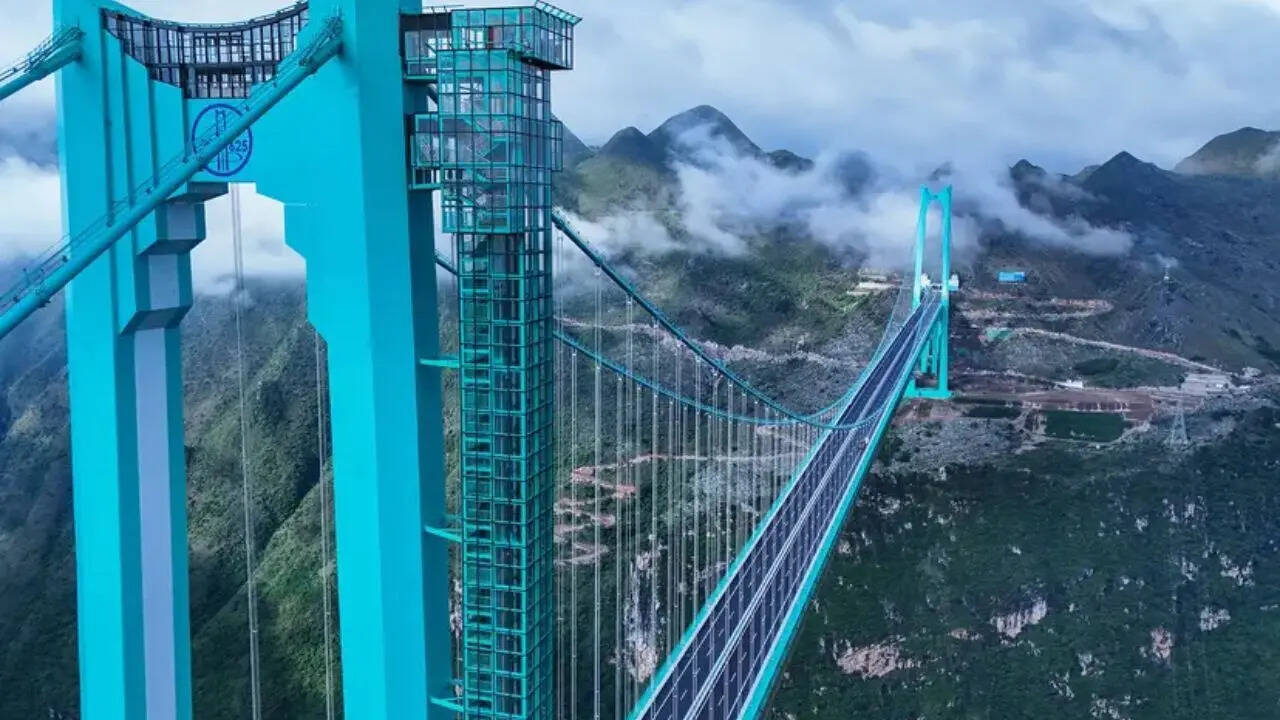
The sheer scale of the Huajiang Grand Canyon Bridge defies easy mental categorization. Expected to be completed in late 2025 and fully operational in 2026, this structure will claim the title of the world’s highest bridge, soaring roughly 625 meters above the Beipan River in Guizhou province. This isn't just a minor improvement in logistics. For the residents and freight haulers who have spent decades navigating the treacherous, winding roads of the canyon, the bridge shrinks a grueling two-hour descent and ascent into a flat two-minute dash across a steel-and-concrete span.
The project represents a definitive shift in how China approaches its internal "bridge museum" in the southwest. While previous records were often set by sheer necessity to connect impoverished regions, the Huajiang Grand Canyon Bridge is a calculated play for 2026 tourism dominance and long-term economic integration. It is the centerpiece of the Liuzhou-Gele Expressway, designed specifically to break the geographical isolation of the rocky desertification areas in Guizhou.
Beyond the Height Record
To understand this bridge, you have to look past the marketing headlines about height. The real story lies in the wind. Building a suspension bridge at this altitude means contending with the "canyon effect," where wind speeds can fluctuate violently and unpredictably.
Engineers faced a environment where traditional construction methods would have been too slow or too dangerous. To solve this, they deployed ultra-high-precision intelligent cable-stranding machines and utilized carbon fiber materials in critical segments to reduce the dead weight of the structure. By cutting the weight of the main cables without sacrificing tensile strength, the team managed to maintain a main span of 1,420 meters.
This isn't just about being tall; it’s about being stable in a place where the air wants to tear structures apart. The bridge uses a unique stiffening girder design that allows air to pass through the structure rather than pushing against it, a necessity when the bridge deck sits higher than the clouds on many mornings.
The Tourism Gamble
Guizhou has spent the last decade rebranding itself from a backwater to a global destination for "bridge tourism." The Huajiang Grand Canyon Bridge is the first major project designed with this as a primary business requirement rather than an afterthought.
Plans are already in motion to integrate a high-altitude glass walk, a luxury hotel built into the bridge towers, and a base-jumping platform that will likely become the most sought-after site for extreme athletes globally. This is a pivot in infrastructure philosophy. The government is no longer just building a way to get from Point A to Point B. They are building a destination that creates its own economy.
The "Greatest Places 2026" recognition reflects this fusion of utility and spectacle. However, the business risk remains. Maintaining a structure of this magnitude in a humid, high-altitude environment requires staggering annual budgets. The toll revenue from the expressway alone likely won't cover the long-term upkeep. The success of the project hinges entirely on whether the bridge can draw enough high-spending tourists to justify its $2 billion-plus price tag.
A Masterclass in Logistics
Moving thousands of tons of steel into a canyon that lacks proper access roads is a nightmare that most Western engineering firms would avoid. The Huajiang project utilized a "smart construction" system that tracked every single bolt and girder via 5G-connected sensors. This allowed for real-time adjustments as the temperature shifted throughout the day, preventing the metal from expanding or contracting in ways that would throw off the alignment of the suspension segments.
The towers, standing at 262 meters and 244 meters respectively, were poured using automated climbing forms that operated around the clock. This minimized human error and drastically reduced the timeline for completion. In a world where infrastructure projects often bloat into decades-long sagas, the speed of the Huajiang construction is an indictment of the slow-moving bureaucratic processes found in other global powers.
Ecological Tensions and Rocky Desertification
The Huajiang Grand Canyon is located in a region suffering from severe rocky desertification. The soil is thin, and the limestone karst landscape is fragile. Skeptics have raised concerns about the environmental footprint of such a massive industrial intrusion into a delicate ecosystem.
The project management team argues that by concentrating travel into a single, high-efficiency corridor, they are actually reducing the overall carbon footprint of the region. Instead of thousands of trucks burning fuel while idling on steep switchbacks for two hours, they move across the canyon in seconds. Furthermore, the bridge construction included a massive reforestation initiative around the anchorages to stabilize the slopes.
Whether these efforts truly offset the disruption of the canyon's natural airflow and the influx of thousands of tourists remains a point of contention among local conservationists. The bridge is a scar on the landscape to some, and a lifeline to others.
The Regional Ripple Effect
Guizhou is home to nearly half of the world's 100 highest bridges. This concentration of engineering talent has turned the province into a global hub for civil engineering expertise. The Huajiang Grand Canyon Bridge serves as a live-action showroom for Chinese construction firms looking to export their "mountain-spanning" technology to Belt and Road Initiative partners in Central Asia and Southeast Asia.
- Connectivity: It links the Liuzhou-Gele and the Shanghai-Kunming expressways, creating a massive high-speed network.
- Agriculture: Farmers in the Huajiang valley can now get perishable goods to major markets in Guiyang or Kunming while they are still fresh.
- Real Estate: Property values in previously inaccessible canyon villages have already begun to spike in anticipation of the 2026 opening.
The Brutal Reality of the Clouds
Standing on the edge of the construction site, the scale is genuinely disorienting. The clouds often sit far below the level of the bridge deck. For the workers, this meant operating in a world where the ground was invisible for days at a time. Safety protocols had to be reinvented for these conditions, including specialized harnesses that could withstand the high-velocity updrafts common in the canyon.
The technical success of the Huajiang bridge is undeniable, but its ultimate legacy will be determined by its performance after the ribbon is cut. If the tourism infrastructure fails to materialize or if the regional economy doesn't respond to the new connectivity, it risks becoming the world's most expensive piece of functional art.
High-altitude maintenance is the silent killer of bridge projects. The salt-laden mists of the river below and the intense UV radiation at this altitude will relentlessly attack the steel cables. The structural health monitoring system—a network of thousands of sensors—must work perfectly for the next century to ensure this record-breaker doesn't become a liability.
The world will watch in 2026 as the first cars cross the Huajiang. They won't see the millions of man-hours or the complex thermal calculations that kept the towers upright. They will only see the two-minute blur of the canyon floor 600 meters below, a brief moment where human ingenuity momentarily conquered the geography of the earth.
Engineers have already begun looking toward the next valley, the next record, and the next impossible height, but for now, the Huajiang stands alone as the final word in what is possible when a nation decides that a mountain is merely a suggestion rather than a barrier.
Invest in the equipment to keep the cables dry and the sensors live, or the clouds will eventually reclaim the span.