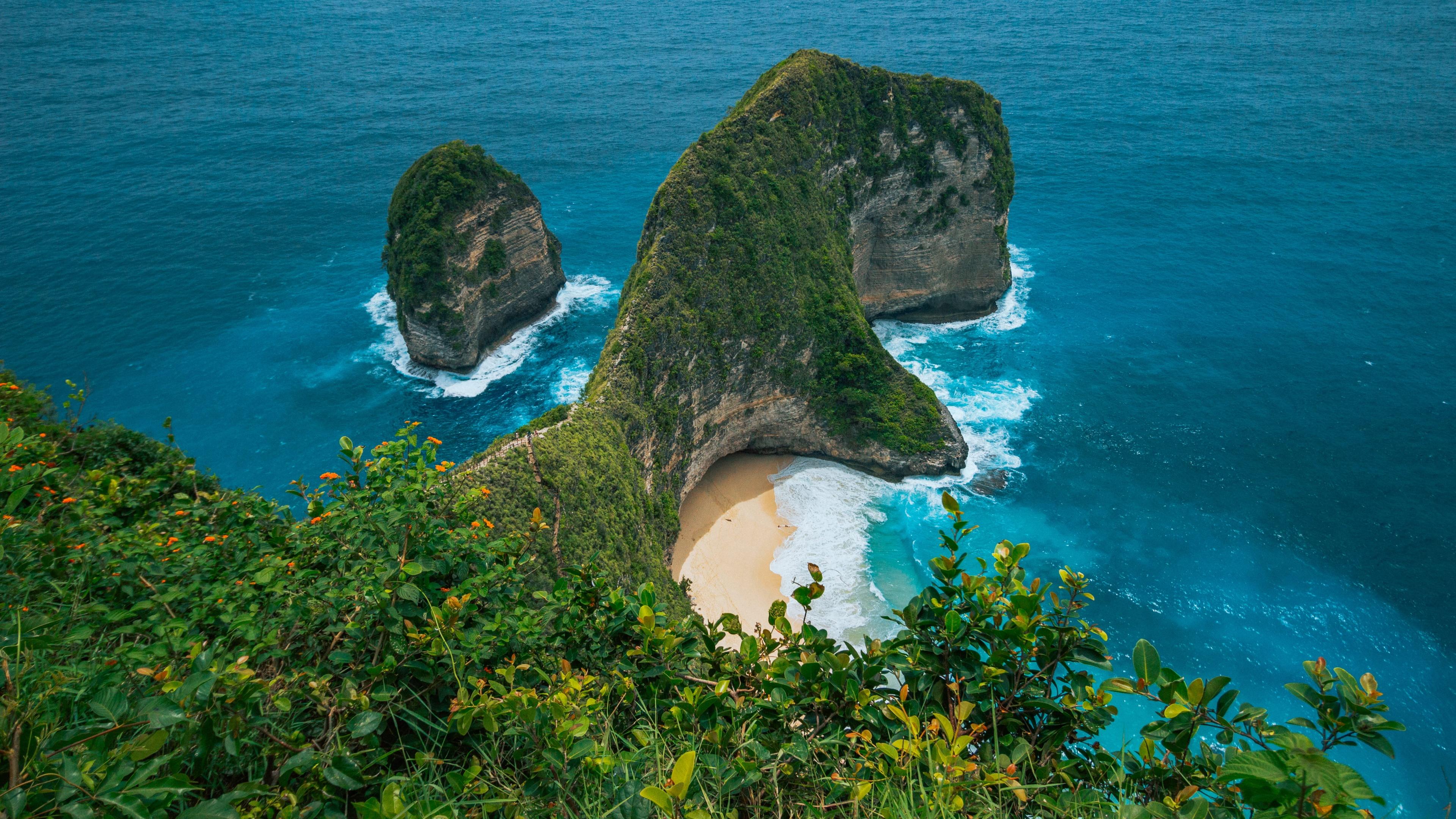
In the late summer of 1995, the residents of Plymouth, Montserrat, lived in a world defined by the color green. It was a lush, vibrant emerald that spilled down the slopes of the Soufrière Hills and met the turquoise lick of the Caribbean Sea. People didn't look at the mountain with fear. They looked at it as a provider. It caught the rain; it held the soil. It was the backbone of an island known as the Emerald Isle of the West.
Then the mountain cleared its throat.
Imagine a small-town baker named Elias. This is a hypothetical man, but he represents a thousand real stories from the streets of Plymouth. Elias would have woken up to a fine, grey dusting on his flour sacks. He might have wiped it away, thinking it was just a bit of grit from a passing truck or a particularly dry spell. But the grit didn't stop. It grew heavier. It began to smell of struck matches and ancient, subterranean rot. By the time the sky turned the color of a bruised plum in the middle of the afternoon, Elias wasn't thinking about bread anymore. He was thinking about survival.
The Weight of a Falling Sky
Most people think of a volcanic eruption as a cinematic explosion of bright red lava. They picture a slow-moving river of fire that you can outrun if you just keep your wits about you. The reality of the Soufrière Hills was far more insidious and infinitely faster. It wasn't just heat. It was weight.
The volcano didn't just leak; it exhaled. It sent millions of tons of pulverized rock and glass—what we call ash—into the atmosphere. When that material falls, it doesn't drift like snow. It settles with the crushing density of wet concrete. As the eruptions intensified over the next two years, the people of Plymouth watched their Georgian-era architecture disappear inch by inch.
Roofs that had stood for centuries under the battering of Atlantic hurricanes suddenly groaned and buckled. The ash absorbed the tropical rain, doubling in weight until the timber beams snapped like toothpicks. This wasn't a sudden departure for the citizens; it was a grueling, psychological siege. They evacuated, returned, cleaned, and evacuated again. They lived in a state of permanent "perhaps." Perhaps the mountain is done. Perhaps we can go home tomorrow.
The Ghost in the Machine
By June 25, 1997, the "perhaps" died.
A massive collapse of the volcano’s dome triggered pyroclastic flows. These are not lava streams. They are boiling clouds of gas and rock fragments traveling at over 100 miles per hour. They don't flow around obstacles; they erase them. The temperature inside these flows can exceed 700°C.
In a matter of minutes, the heart of the island was rendered uninhabitable. Nineteen people who had stayed behind to tend to their crops or protect their homes were gone. They weren't just killed; they were swallowed by a landscape that no longer recognized them.
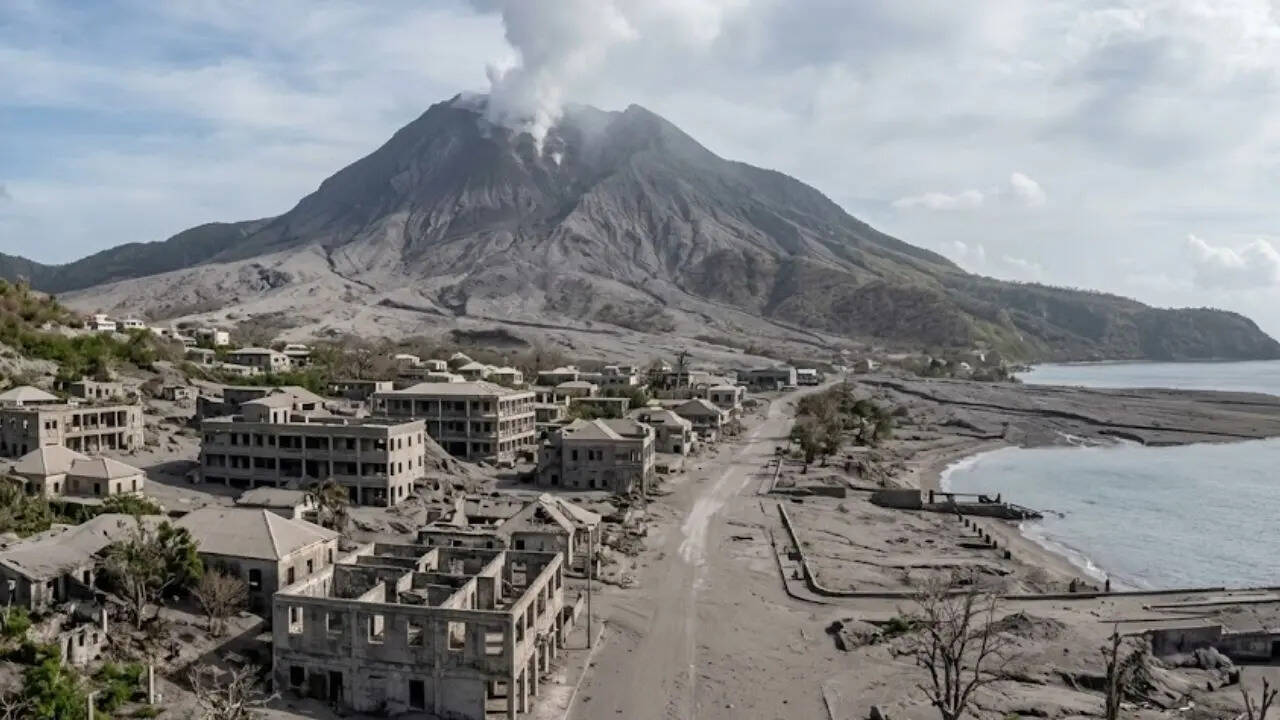
Walking through the Exclusion Zone today—if you can get the permits and a guide—is like walking through a dream where someone has pressed the pause button on humanity and then poured grey paint over everything. You see the top of a spire from a stone church poking through the ground. You see a rusted car where only the roof and the tops of the headrests are visible above the hardened volcanic mud.
There is a profound, echoing silence in Plymouth. It is a city of 12,000 ghosts where the only sound is the wind whistling through the skeletons of luxury hotels and government buildings. The capital wasn't just abandoned. It was entombed.
The Great Migration of the Soul
The tragedy of Montserrat isn't just geological. It is a story of a fractured identity. When the southern half of the island was declared a "no-go" zone, the population had nowhere to turn but north or away.
Over half the population left the island entirely. They moved to London, to New York, to neighboring islands, carrying the keys to houses they would never unlock again in their pockets. Those who stayed moved to the northern tip of the island, a rugged area that was never meant to support a nation’s entire infrastructure.
They had to build a new country on a tiny slice of rock while watching their old lives disappear under a rising tide of ash just a few miles away. Think about the mental toll of looking through binoculars from a safe distance and seeing the second floor of your childhood home vanish. You are a refugee in your own backyard.
The Biology of a Resilient Rock
Nature has a strange way of reclaiming what was taken. In the Exclusion Zone, life is beginning to creep back in, but it looks different. Feral pigs and donkeys roam the ash flats of what used to be the commercial district. Tropical vines move like slow snakes over the ruins, their roots prying apart the charred masonry.
The volcano is still active. It still vents steam and the occasional puff of ash, a reminder that the Earth is not a finished product. It is a work in progress, and humans are often just temporary tenants.
The people of Montserrat have learned to live with the giant. They have built a new capital at Little Bay, a place of hope and bright colors that stands in stark contrast to the monochrome graveyard of Plymouth. They have turned their tragedy into a masterclass in disaster management and scientific observation. The Montserrat Volcano Observatory is now one of the most sophisticated in the world. They listen to the mountain’s heartbeat so they never have to be surprised by its breath again.
The Invisible Stakes of Memory
Why does a buried city in the Caribbean matter to someone sitting in a skyscraper in London or a farmhouse in Kansas? Because Plymouth is a mirror. It reminds us that the structures we build—our banks, our courts, our cafes, our homes—are only as permanent as the ground beneath them allows.
We live with an arrogance of stability. We assume the street will be there tomorrow because it was there yesterday. Plymouth proves that the world can change its mind in an afternoon.
There is a house in the Exclusion Zone where a dining room table is still set. The ash blew through the windows and coated the plates, the silverware, and the centerpieces. It is a still life of a Tuesday that never ended. It represents the moment when a community's narrative was forcibly edited by a force that doesn't care about history or heritage.
The true capital of Montserrat isn't the collection of buildings under the ash, nor is it the new construction in the north. The capital lives in the stories of the people who remember the smell of the baker's bread before the ash fell. It lives in the resilience of a population that refused to let their culture be buried alongside their houses.
The mountain took the land, but it couldn't take the islanders' claim to it. They remain, perched on the edge of the green, watching the grey, waiting for a day that might never come when the mountain finally decides it has said enough.
The sun sets over the Soufrière Hills now, casting long, golden shadows over a wasteland that was once a paradise. The green is trying to return. It starts at the edges, a thin line of moss on a buried wall, a stubborn sprout in a crack of volcanic stone. It is a slow, quiet battle between the fire of the earth and the persistence of life.
For now, the city remains breathless, a monument to the terrifying speed of change and the enduring weight of what we leave behind.