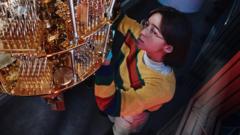
In a nondescript laboratory in Delft, the air doesn’t just feel cold. It feels impossible. To keep a quantum processor from shivering itself into incoherence, you have to bring the temperature down to roughly 0.01 Kelvin. That is colder than the deepest, most shadowed trenches of interstellar space. If you were to reach out and touch the gleaming copper cylinders of the dilution refrigerator—the "chandelier," as the scientists call it—your hand wouldn't just freeze. The heat from your body would act like a solar flare, obliterating the delicate, ghostly calculations happening inside.
Europe is currently building dozens of these artificial voids. They are the cathedrals of the twenty-first century, silent and expensive, housing a power that remains largely theoretical but terrifyingly potent.
We are told this is a race. The United States has the venture capital and the swagger of Silicon Valley. China has the state-mandated checkbook and a singular, terrifying focus on national security. Europe has something else: a long memory and a peculiar talent for fundamental physics that stretches back to the days when Max Planck first realized the universe was "chunky" rather than smooth.
But history is a cruel teacher. Europe has invented the future before, only to watch others sell it back to them.
The Architect’s Dilemma
Consider a researcher named Elena. She isn’t real, but her career trajectory is a composite of a thousand doctoral students currently working in Munich, Paris, and Innsbruck. Elena spends ten hours a day adjusting lasers to trap a single ion. If that ion moves by a fraction of a millimeter, the calculation dies.
For Elena, the stakes aren't about "beating Google." They are about the fact that her continent's economic sovereignty is currently tethered to silicon chips manufactured in a single factory in Taiwan and software designed in a three-mile radius in California. She knows that if quantum computing works—not if, but when—the current encryption methods protecting every bank transfer, every medical record, and every state secret in Europe will vanish. They will be as easy to crack as a child’s piggy bank.
This isn't a "tech trend." It is an existential deadline.
The current narrative suggests that Europe is trailing. If you look at raw investment numbers, the gap is glaring. In 2023, US-based quantum startups pulled in roughly $3 billion. European counterparts struggled to reach a third of that. Money, however, is a lagging indicator of genius. While American firms often focus on scaling up "noisy" qubits—basically trying to build a massive skyscraper on a foundation of sand—European labs are obsessed with the foundation itself.
They are looking for the "Topological Qubit." It is a mathematical trick so complex it sounds like science fiction: storing information in the way a particle moves, rather than the particle itself. It’s the difference between trying to keep a candle lit in a hurricane versus carving a message into a stone. The stone takes longer to carve, but it doesn't blow out.
The Ghost in the Machine
The problem with quantum computing is that it defies our monkey-brain logic. We like things to be here or there. A bit is a 1 or a 0. A light switch is on or off.
A qubit is both. And neither.
Imagine a coin spinning on a table. While it’s spinning, is it heads or tails? It’s a blur of both. That blur is "superposition." Now imagine you have two coins, and no matter how far apart you take them—one in Berlin, one in Lisbon—if you stop the Berlin coin and it lands on heads, the Lisbon coin instantly stops on tails. That is "entanglement."
Einstein hated this. He called it "spooky action at a distance."
Europe’s advantage is that it treats this spookiness as a craft rather than a commodity. In the sub-basements of the University of Copenhagen—the same halls where Niels Bohr redefined reality a century ago—researchers are building the "Quantum Internet." They aren't trying to build a faster way to scroll through social media. They are building a network that is physically impossible to hack because the act of observing the data changes the data itself.
The spy who tries to listen in doesn't just fail; they leave a footprint.
The Tragedy of the Missing Middle
Why, then, does it feel like Europe is destined to play the role of the brilliant, starving artist?
The answer lies in the "Valley of Death." In Europe, it is relatively easy to get a government grant to study the behavior of atoms. It is also relatively easy to find a small amount of "seed" money to start a company. But once that company needs $100 million to build a factory or a data center, the European spirit wavers.
Investors in London or Frankfurt are often more comfortable with a safe 5% return on a real estate development than a 1000% return on a machine that might not work for a decade. Consequently, Elena and her colleagues often find themselves being recruited by recruiters from Seattle or Beijing. The "brain drain" isn't a leak; it's a flood.
We see this pattern in every major technological shift. The World Wide Web was born at CERN in Switzerland. Today, how many European search engines do you use? The GSM standard for mobile phones was a European triumph. Where are the European equivalents to the iPhone?
The stakes this time are different. Quantum isn't just a new product; it's a new physics.
If a pharmaceutical company in Basel can use a quantum computer to simulate a new protein, they can cure a disease in weeks that would take a classical supercomputer a thousand years to model. If a logistics firm in Rotterdam can use quantum algorithms to optimize the path of every cargo ship in the world, they save billions in fuel and carbon.
The winner of this race doesn't just get a bigger market share. They get to write the rules of the physical world.
The Silent Hardware Revolution
There is a quiet corner of the industry where Europe actually holds the whip hand: the "picks and shovels."
To build a quantum computer, you need highly specialized equipment. You need microwave electronics that can operate at temperatures where electricity behaves like a liquid. You need lasers with a precision that borders on the divine. You need specialized glass and rare-earth gases.
Much of this hardware is made by small, family-owned firms in the German "Mittelstand" or specialized boutiques in the Netherlands and Finland. Even if IBM or Google builds the world's most powerful quantum computer, they will likely be using European components to keep it cold and keep it quiet.
This is the "ASML strategy." ASML, a Dutch company, is the only firm in the world capable of making the machines that print the most advanced microchips. Without them, the entire global tech economy grinds to a halt. Europe is currently trying to replicate that "bottleneck" brilliance in the quantum space.
They are betting that it’s better to own the oxygen than to own the mountain.
The Human Cost of the Cold War
We must be honest about the shadow this technology casts. There is a reason the phrase "Quantum Winter" exists. It refers to a period where the hype outpaces the results, the funding dries up, and the scientists are left staring at their silent, expensive chandeliers.
But there is a darker winter.
If Europe fails to achieve "Quantum Sovereignty," it becomes a digital colony. Every time a European researcher wants to run a complex simulation, they will have to send their data to a cloud server owned by a foreign superpower. They will be at the mercy of another nation’s export controls and another nation’s whims.
Imagine a future where a European startup discovers a breakthrough in battery chemistry, but they can't scale it because the quantum processing power required to refine the formula is "restricted" by a trade war between Washington and Beijing.
That is the invisible stake. It isn't about being first. It's about not being last.
The Austrian Experiment
In the mountains of Tyrol, there is a group of physicists who have managed to entangle atoms over several kilometers of open air. They are effectively teleporting information across the Alps. When you talk to them, they don't sound like "disruptors" or "tech bros." They sound like watchmakers.
They speak of "coherence times" and "gate fidelities" with a reverence usually reserved for the sacred. They understand that the quantum world is shy. It doesn't want to be measured. It doesn't want to be used. The moment the outside world touches a qubit, the "wavefunction collapses," and the magic evaporates.
This is the metaphor for Europe’s struggle. The continent has the talent, the history, and the hardware. But the moment the "measurement" of the market is applied—the demand for quarterly profits, the pressure to exit, the fear of failure—the delicate superposition of European innovation often collapses.
Success will require a level of political and financial entanglement that the continent has rarely achieved. It requires the French mathematician to trust the German engineer, funded by a Swedish pension fund, to build a machine in Poland.
A Choice of Realities
The race isn't a sprint. It's a marathon through a minefield.
Right now, in a basement in Helsinki, a qubit is holding its breath. It is suspended in a vacuum, shielded by layers of steel and copper, vibrating at a frequency that matches the heartbeat of the universe. For a few milliseconds, it knows every possible answer to a question we haven't even learned how to ask yet.
The scientists watching the monitors aren't looking at lines of code. They are looking at the possibility of a world where energy is clean, medicine is perfect, and data is truly private. They are also looking at a world where those same tools could become the ultimate weapons of digital conquest.
Europe’s win wouldn't look like a flashy product launch in a black turtleneck. It would look like a quiet, steady accumulation of the fundamental truths of nature. It would look like a continent finally deciding that its brains are worth more than its borders.
The chandelier is humming. The temperature is dropping. The coins are spinning.
Whether they land for us or against us depends entirely on whether we have the courage to keep the room cold and the vision to keep the lights on.
We are no longer just observers of the quantum world. We are its architects. And the ghost of Alan Turing is watching to see if we have learned how to keep a secret.