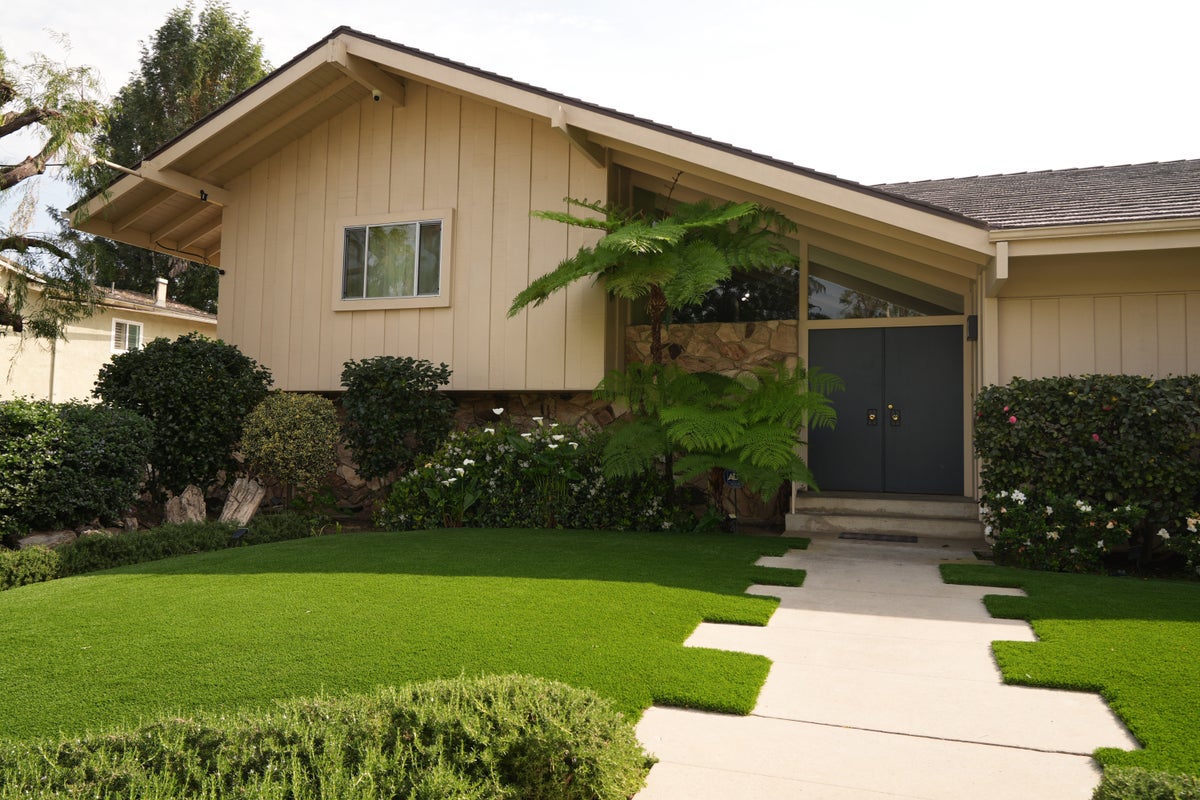
The designation of the "Brady Bunch House" at 11222 Dilling Street as a Historic-Cultural Monument by the Los Angeles City Council represents a shift from private residential real estate to a managed cultural asset. This transition is not merely symbolic; it is a calculated intervention in the lifecycle of a property where the intangible brand equity has superseded the underlying land value. When a municipal body intervenes to freeze the physical state of a mid-century split-level, they are effectively managing a "nostalgia-based monopoly" on a specific visual coordinate in the American consciousness.
The Valuation Paradox of Pop Culture Real Estate
The market value of a standard residential property is typically derived from three primary variables: geographic utility (location), physical improvements (sq footage/upkeep), and scarcity. For the North Hollywood residence, a fourth, dominant variable—Parasocial Equity—destabilizes traditional appraisal methods. For a different look, see: this related article.
Standard appraisals failed this property during its 2023 sale cycle because the physical structure (a 1959 build) did not justify its $3.2 million price tag based on square footage alone. The valuation discrepancy is explained by the Asset-Image Duality:
- The Shell (Physical Asset): A ranch-style house with limited modern utility and high maintenance costs.
- The Image (Intellectual Property): A visual anchor for a multi-billion dollar television franchise.
HGTV’s 2018 purchase for $3.5 million—nearly double the listing price—was not a real estate play but a Content Acquisition strategy. By renovating the interior to match the studio sets (which never existed inside the actual house), they synchronized the Physical Asset with the Intellectual Property. The recent landmark status ensures this synchronization remains permanent, preventing future owners from "de-branding" the site to reclaim residential utility. Further reporting on this matter has been shared by Reuters Business.
Structural Protection and the Loss of Developmental Optionality
Historic-Cultural Monument (HCM) status in Los Angeles imposes a rigid set of constraints that alter the property’s long-term IRR (Internal Rate of Return). By designating the house as a landmark, the city has stripped the site of its Developmental Optionality.
The Constraint Framework
- Demolition Moratoriums: Under the California Environmental Quality Act (CEQA), any permit to alter or demolish an HCM-designated site triggers a mandatory environmental impact report. This creates a bureaucratic friction point that effectively renders the land value irrelevant to developers.
- The Preservation Burden: Owners are required to maintain the "original" facade and specific interior elements. This transforms a home into a museum, where capital expenditures are dictated by historical accuracy rather than resident comfort or modern efficiency.
- Mills Act Incentives: To offset these costs, the property may qualify for property tax reductions. However, these savings are frequently eclipsed by the specialized labor and materials required to maintain a 1970s aesthetic in the 21st century.
This creates a Maintenance-to-Revenue Trap. If the property is used as a private residence, the owner pays a premium for the privilege of restricted living. If used as a commercial or tourist site, the logistical constraints of a residential neighborhood (parking, noise ordinances, zoning) limit the ability to monetize the asset’s fame.
The Mechanism of Aesthetic Fossilization
The designation of the Brady house represents "Aesthetic Fossilization"—the act of legally mandating that a property remain a static representation of a specific era. This process is driven by three distinct social and economic drivers:
1. The Scarcity of Shared Visual Language
In a fragmented media environment, physical locations that retain universal recognition are increasingly rare. The Brady house functions as a "Universal Anchor." Its preservation is a hedge against the volatility of digital media; as long as the house stands, the franchise retains a physical footprint in the real world.
2. The Neighborhood Externality Effect
For the surrounding Studio City residents, the landmark status is a risk-mitigation tool. A historic designation prevents the lot from being subdivided into "mansionized" luxury units or multi-family housing. The neighbors trade the nuisance of tourists for the certainty of architectural stability and the preservation of the neighborhood's low-density character.
3. The Institutionalization of Nostalgia
By granting landmark status, the city validates "Television History" as being on par with architectural or political history. This expands the definition of "Historical Significance" to include emotional resonance and mass-market consumption. It suggests that the idea of a suburban family is as worthy of protection as the residence of a founding father.
Operational Hazards of Landmark Status
While the designation protects the house from the wrecking ball, it introduces systemic risks for future liquidity. The pool of potential buyers for a landmarked pop-culture icon is significantly smaller than for a standard luxury home.
- Zoning Friction: The house is located in a residential zone. Converting it into a functional museum or revenue-generating site would require a Conditional Use Permit (CUP), which is notoriously difficult to obtain in Los Angeles due to local opposition.
- The Depreciation of Relevance: Historic status is permanent, but cultural relevance is not. As the primary demographic that consumed The Brady Bunch ages out of the market, the Parasocial Equity of the asset will likely diminish. The owner may find themselves holding a "protected" asset that has high maintenance requirements but declining cultural value.
- The Tourism-Privacy Inverse: The more famous the house becomes through official designation, the less viable it is as a private residence. Constant foot traffic and photography by outsiders create a "Privacy Tax" that reduces the property's utility for anyone not seeking public attention.
Strategic Asset Positioning
For a commercial entity like HGTV or a private collector, the objective must be to decouple the asset from its residential limitations. The historical designation should be viewed as a Regulatory Shield rather than an honorific. It protects the asset from market pressures to modernize, allowing the owner to treat the property as a "Brand Monument."
To maximize the value of this designation, the management of the property must shift toward a Licensing and Digital Twin model.
- Digital Capture: Create a high-fidelity 1:1 digital twin of the interior and exterior to be licensed for virtual productions, gaming, and VR experiences.
- Controlled Access: Utilize the landmark status to negotiate limited-entry boutique events that justify high ticket prices without violating local noise or traffic ordinances.
- Tax Arbitrage: Fully exploit the Mills Act and other preservation incentives to lower the carry cost of the asset while its book value is depreciated.
The Brady Bunch house is no longer a residence; it is a specialized vehicle for cultural capital. The designation ensures that even if the neighborhood around it evolves, the property remains a locked-in variable in the city’s architectural inventory. Investors and observers should treat this as a case study in how "fame" can be codified into "land use policy," effectively turning a 1970s sitcom backdrop into a permanent infrastructure of the Los Angeles brand.
Secure the Mills Act contract immediately to lock in the property tax basis at the lowest possible assessment, then pivot the asset's valuation model from "Price per Square Foot" to "Brand Impressions per Annum."