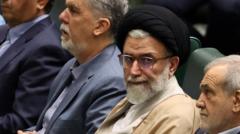
The headlines are screaming about a decapitation strike. Pundits are dusting off their maps of Tehran, claiming the "shadow war" has finally stepped into the light because Esmail Khatib, Iran’s Intelligence Minister, was reportedly erased from the board by an air strike.
They are wrong.
The Western obsession with "Great Man Theory"—the idea that history is shaped by specific, irreplaceable individuals—is a strategic blind spot. We love the narrative of the silver bullet. We want to believe that removing a single node in a complex hierarchy causes the entire system to crash. It doesn’t. In the world of high-stakes intelligence and asymmetric warfare, a minister is often just a face on a door.
If you think this strike disables the Ministry of Intelligence (MOIS), you don't understand how institutionalized paranoia works.
The Myth of the Irreplaceable Spymaster
I have watched analysts make this mistake for decades. They did it with Qasem Soleimani. They did it with Mohsen Fakhrizadeh. Each time, the prediction is the same: "This is the tipping point. The regime will scramble. Their intelligence capabilities are blinded."
Then, six months later, the drones are still flying, the proxies are still funded, and the domestic crackdowns are more efficient than ever.
Esmail Khatib was not the architect of the Iranian security state; he was a refined product of it. The MOIS is not a startup dependent on a charismatic founder. It is a bureaucratic leviathan. It functions on the principle of redundant systems. In any regime that survives forty years of sanctions and internal unrest, "Minister" is a title that implies a manager of processes, not a lone genius.
When a central node in a decentralized network is removed, the traffic simply reroutes. The MOIS and the IRGC’s Intelligence Organization are built to withstand exactly this scenario. To assume otherwise is to ignore the structural reality of the Islamic Republic’s survival mechanism.
The Intelligence-Industrial Complex
The common misconception is that the MOIS is a traditional spy agency. It’s not. It is a massive data-harvesting and social-engineering machine.
The "lazy consensus" says that losing a leader at the top stops the flow of information. On the contrary, in a regime like Iran's, the death of a high-ranking official often triggers an automated, pre-planned "State of Exception" protocol.
The MOIS relies on three pillars that don't care who sits in the minister’s chair:
- Algorithmic Social Control: The ministry has spent the last decade shifting from human-led surveillance to automated digital footprints. They don't need Khatib to tell them who to arrest; the data already flagged the dissidents.
- Institutional Redundancy: The MOIS competes directly with the IRGC Intelligence Organization. This rivalry creates a fail-safe. If one is "decapitated," the other is incentivized to fill the power vacuum instantly to secure more funding and influence.
- The Deep Bureaucracy: There are mid-level directors within the MOIS who have held their posts through three different presidencies. These are the men who actually run the operations. Khatib was the political shield and the bridge to the Supreme Leader.
Removing Khatib is like removing the CEO of a company that has a ten-year backlog of automated orders. The factory keeps humming.
The Danger of "Tactical Success, Strategic Failure"
We are addicted to tactical victories because they make for great TV. An air strike is visible. It's measurable. It’s a "win" on a spreadsheet.
But look at the cost-benefit analysis. A strike like this doesn't degrade capability; it validates the regime’s internal narrative. It justifies the next five years of increased "security" budgets. It allows the hardliners to purge any remaining moderates under the guise of "hunting for the moles" who provided the coordinates for the strike.
I’ve seen this play out in corporate espionage and geopolitical maneuvers alike: you think you’ve cut off the head of the snake, but you’ve actually just stimulated the immune system.
The real question isn't "Who replaces Khatib?" The question is "What does the regime do with the martyr?"
The "Mole Hunt" is More Dangerous than the Strike
The most immediate impact of a strike on a figure like Khatib isn't a loss of intelligence—it’s a surge in internal cleansing.
Imagine a scenario where a high-level official is hit. The immediate assumption is a leak. This triggers a "Purge Protocol." The MOIS will now turn inward with a ferocity that Khatib himself might have found excessive. Anyone with even a hint of Western contact, anyone who studied abroad, anyone who argued for a softer line—they are now targets.
By killing the Minister, the attacker has effectively given the Iranian hardliners a "Get Out of Jail Free" card to eliminate their internal political rivals.
The Precision Trap
Modern warfare has fallen into the "Precision Trap." We believe that because our missiles are precise, our outcomes are controlled.
In intelligence, precision is a double-edged sword. Yes, you hit the target. But you also created a vacuum. In the vacuum of Iranian politics, the vacuum is never filled by someone more reasonable. It is always filled by the person most capable of proving they are more radical than their predecessor.
The new Minister of Intelligence won't be a reformer. He will be the man who promises to find the "Zionist spies" within the ranks. He will be the man who increases the intensity of the "Smart Hijab" surveillance. He will be the man who feels he has something to prove.
Stop Asking "Who's Next?"
The "People Also Ask" section of the internet is currently obsessed with succession.
- "Who will be the next Iranian Intelligence Minister?"
- "How will Iran retaliate?"
These are the wrong questions. The right question is: "Does the Iranian security apparatus require a Minister to function?"
The answer is a resounding no. The MOIS is a self-correcting organism. It is a system of committees, sub-directorates, and parallel hierarchies. The Minister is a coordinator. The real work—the signals intelligence (SIGINT), the human intelligence (HUMINT) networks in the Levant, the domestic suppression—is handled by career officers who don't change when the guy at the top gets vaporized.
The Professionalism of Paranoia
There is a certain "expert" arrogance in the West that assumes Middle Eastern bureaucracies are shambolic. This is a lethal misunderstanding.
The MOIS is a professional organization. It is brutal, yes. It is repressive, certainly. But it is not incompetent. It has survived the most intense pressure-cooker environment on the planet for nearly half a century.
When you strike a leader in a system like that, you aren't "demystifying" their power. You are testing their resilience. And history shows that the Iranian security state passes these tests with blood and efficiency.
We need to stop celebrating these kinetic actions as if they are solutions. They are maneuvers. And in the long game of regional influence, a maneuver that results in a more radical, more paranoid, and more technologically integrated security state is not a win. It’s a complication.
The strike on Khatib is a headline. The survival of the MOIS is the reality.
If you want to actually disrupt Iranian intelligence, you don't target the man in the suit. You target the servers, the fiber optics, and the financial architecture that allows the bureaucracy to breathe. Anything else is just pyrotechnics for a Western audience.
The regime isn't mourning a loss of capability. They are already interviewing the replacement, and he will be much, much worse.
Go back to your maps. Look at the infrastructure. Ignore the names. The names are temporary. The system is the enemy.
Would you like me to analyze the specific digital surveillance infrastructure the MOIS uses to maintain control during leadership transitions?