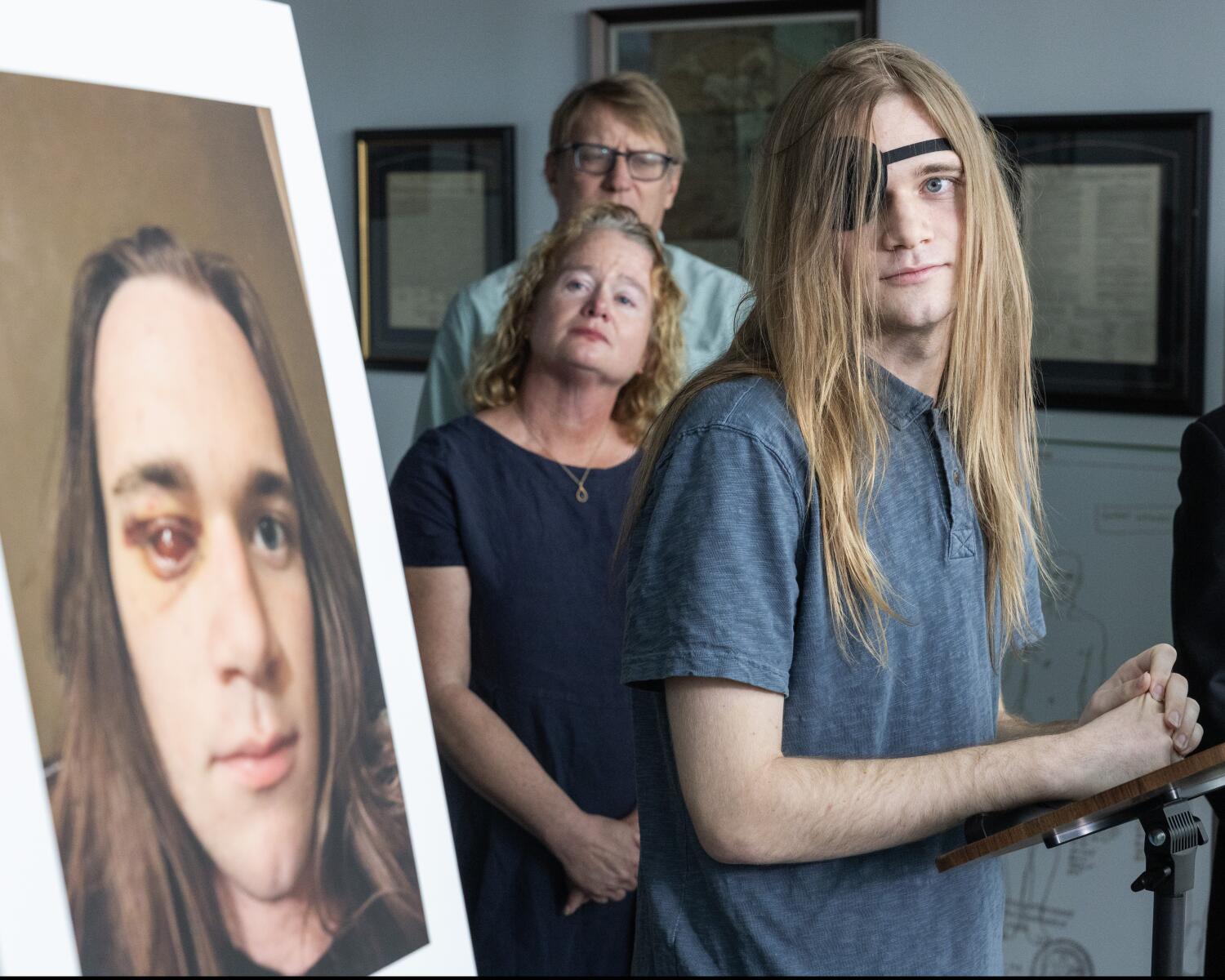
Civil rights attorneys are moving to sue the Department of Homeland Security after a federal agent fired a projectile into the face of a demonstrator at a "No Kings" rally, resulting in the permanent loss of the man’s eye. The incident, which occurred during a period of heightened friction between federal law enforcement and domestic protesters, has reignited the debate over the use of "less-lethal" munitions in crowd control. Legal experts suggest the case will hinge on whether the agent’s use of force met the constitutional standard of objective reasonableness under the Fourth Amendment, or if it constituted an excessive display of state power against a non-violent participant.
The lawsuit underscores a systemic lack of oversight within the specialized units of Homeland Security, particularly those deployed to urban centers for rapid response.
The Cost of Less-Lethal Force
When a kinetic impact munition strikes a human face, the results are rarely "less" than catastrophic. The victim in this case was attending a peaceful assembly, part of a broader movement protesting perceived government overreach, when he was struck by a projectile launched from a federal weapon. The physical damage was immediate. Surgeons could not save the eye. Beyond the individual tragedy, the incident serves as a grim data point in a long-standing pattern of federal agents using high-velocity tools in situations where verbal commands or traditional de-escalation tactics might have sufficed.
These munitions, often sponge grenades or bean bag rounds, are marketed as tools to avoid the use of deadly force. However, when fired at the head or neck, they become lethal instruments. The training manuals for most federal agencies strictly forbid aiming at the head. Yet, time and again, we see footage of protesters with shattered orbital bones and traumatic brain injuries. This suggests either a failure in training or a culture of impunity where the rules of engagement are treated as optional suggestions when the adrenaline of a confrontation spikes.
A Legacy of Federal Intervention in Domestic Protests
The presence of DHS agents at civil demonstrations is not a new phenomenon, but the intensity of their involvement has scaled significantly over the last few years. Traditionally, domestic protests were the purview of local and state police. The shift toward using federal agents—often from Customs and Border Protection (CBP) or Immigration and Customs Enforcement (ICE)—to manage crowds far from any international border has created a jurisdictional and tactical mess.
These agents are trained for border interdiction and high-stakes arrests, not for the delicate balance of First Amendment protection and public safety. When you take an agent whose daily job involves hunting cartels and place them in a city square filled with angry civilians, the psychological framework of "us versus them" becomes dangerous. The "No Kings" rally was a protest against the very idea of unchecked executive power. The irony of a federal agent then blinding a participant is a dark reflection of the grievances that brought the crowd out in the first place.
The Problem of Identification and Anonymity
One of the most chilling aspects of these federal deployments is the lack of identifiable markings on the agents. During many of these "No Kings" events, agents have appeared in tactical gear without name tapes or badge numbers, making it nearly impossible for victims of misconduct to identify their attackers. This creates a functional shield for bad actors.
If a local police officer strikes a citizen, there is a clear chain of command and a public record. In the federal sphere, the bureaucracy is so vast and the layers of protection so thick that seeking justice becomes a multi-year marathon through the federal court system. The pending claim against DHS must navigate the Federal Tort Claims Act (FTCA), a complex statute that often protects the government from liability even in cases of clear wrongdoing.
The Qualified Immunity Shield
The primary obstacle for the victim in this case is the doctrine of qualified immunity. This legal principle protects government officials from being held personally liable for constitutional violations—like the use of excessive force—as long as their conduct did not violate "clearly established" law.
In practice, this means that unless a lawyer can find a previous court case with almost identical facts, the agent may never face a jury. If there isn't a prior ruling that says, "an agent cannot shoot a No Kings protester in the left eye at exactly 10 p.m. on a Tuesday," a judge might dismiss the case. It is a high bar that many argue has become an insurmountable wall for victims of state violence.
Broken Ribs and Blinded Eyes
The physical toll of these encounters is often minimized by officials as "incidental contact." But there is nothing incidental about losing an eye. The medical bills alone for a permanent disability of this nature can reach into the hundreds of thousands of dollars. Then there is the loss of livelihood. A man who loses an eye cannot work certain jobs, cannot drive with the same confidence, and carries a psychological scar that never fully heals.
The government’s defense will likely argue that the crowd was "hostile" or that the agent feared for their safety. This is the standard script. They will look for any footage of a water bottle being thrown or a harsh word being yelled to justify the use of a projectile. But the proportionality of the response is what matters. A plastic bottle thrown from twenty yards away does not justify the permanent blinding of a citizen by a trained professional.
Accountability Within the DHS Bureaucracy
The Department of Homeland Security is the largest law enforcement agency in the country, yet it arguably has the least external oversight. While major metropolitan police departments have civilian review boards and independent monitors, the DHS operates largely behind closed doors. Internal Affairs investigations are notoriously slow and rarely result in public discipline.
The Lack of Body Camera Footage
While most major cities now require body-worn cameras for their officers, federal agencies have been slow to adopt the technology. This creates a "he said, she said" scenario where the government’s version of events is given undue weight in court. In the "No Kings" incident, the absence of federal camera footage forces the victim to rely on shaky cellphone video from bystanders. This is not how a modern, transparent law enforcement agency should operate.
The push for mandatory body cameras for all federal agents is a common-sense reform that has been stalled by budget concerns and union resistance. Until every agent is recorded, these shootings will continue to happen in a fog of ambiguity that favors the shooter over the victim.
The Economic Impact of Litigation
Beyond the moral and legal arguments, there is a massive financial cost to the taxpayer. Every time a federal agent acts recklessly, the public picks up the tab for the settlement. Millions of dollars are diverted from actual security missions to pay for the legal defense and eventual payouts to victims of misconduct.
- Settlement Costs: The government often settles these cases quietly to avoid a precedent-setting loss in court.
- Legal Fees: Department of Justice lawyers spend thousands of hours defending agents, a cost that is never fully accounted for in the DHS budget.
- Operational Strain: Deploying agents to cities for protest duty takes them away from their primary missions, such as border security or anti-human trafficking operations.
The Chilling Effect on Free Speech
The most lasting damage of the "No Kings" shooting isn't the physical injury, but the message it sends to the public. When people see that attending a protest can result in a permanent disability at the hands of the state, they are less likely to show up. This is the definition of a chilling effect.
The right to assemble and petition the government for a redress of grievances is the bedrock of the American system. If that right is conditioned on the willingness to risk an eye, the right ceases to exist in any meaningful way. The federal government’s use of force in these contexts acts as a deterrent to political participation. It creates a vacuum where only the most radical elements are willing to take the risk, while the average citizen stays home out of fear.
Reforming the Rules of Engagement
To prevent another tragedy like the one at the "No Kings" rally, the DHS must overhaul its use-of-force policies for domestic deployments. This starts with a total ban on the use of kinetic impact munitions for general crowd dispersal. These tools should be reserved for life-threatening situations where the alternative is the use of a firearm.
Furthermore, any federal agent deployed to a domestic protest should be required to wear a clearly visible identification number and a functioning body camera. The anonymity that currently exists is a recipe for abuse. If an agent knows their name is visible and their actions are being recorded, the likelihood of a "split-second" bad decision decreases significantly.
Transparency is the Only Solution
The lawyers for the blinded protester are not just seeking money; they are seeking a public admission of wrongdoing. In many of these cases, the government refuses to apologize or even admit that an agent was involved, hiding behind the "ongoing investigation" excuse for years. True accountability requires a public accounting of what went wrong, why it went wrong, and what specific steps are being taken to ensure it never happens again.
The "No Kings" shooting is a reminder that the power of the state is absolute and often indifferent. When that power is turned against the people it is sworn to protect, the damage goes far beyond a single eye. It punctures the trust that holds a society together. The upcoming legal battle will determine if that trust can be repaired, or if the federal government will continue to operate as if it is, in fact, a king above the law.
The case moves to federal court next month, where a judge will decide if the shield of qualified immunity holds firm or if a citizen’s right to keep his sight outweighs an agent’s right to fire into a crowd.