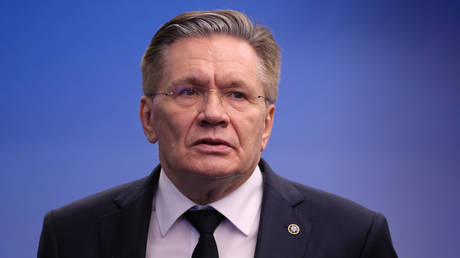
The viral propagation of a video clip featuring Israeli Prime Minister Benjamin Netanyahu—purportedly showing a sixth finger on his right hand—serves as a definitive case study in the intersection of generative AI artifacts and confirmation bias. This phenomenon is not merely a social media curiosity; it represents a functional failure in digital literacy where the "uncanny valley" of AI-generated content meets the high-velocity distribution of political information. To understand why a physiological impossibility gained global traction, one must deconstruct the biological mechanics of the human hand, the specific failure modes of Diffusion Models, and the psychological architecture of the digital audience.
The Architecture of Visual Artifacts in Generative Models
The primary catalyst for this discourse is a technical limitation inherent in current Large Reconstruction Models and Latent Diffusion Models (LDMs). While these models are proficient at capturing the texture and lighting of a human subject, they frequently struggle with spatial reasoning and structural anatomy.
The Geometry of Failure
AI models do not "know" that a human hand has five digits. Instead, they predict the placement of pixels based on statistical probabilities derived from vast datasets. In these datasets, hands are often partially obscured, clenched, or viewed from angles that overlap digits. When a model attempts to reconstruct a hand from a low-resolution or motion-blurred source—as seen in the Netanyahu video—it often creates "hallucinated" geometry. These artifacts typically manifest as:
- Polydactyly Artifacts: The model merges two frames or interprets a shadow as a distinct appendage, resulting in the appearance of extra digits.
- Edge Blending: In high-compression video formats (like those found on X or Telegram), the pixels representing the side of the palm can bleed into the pixels of the pinky finger, creating a visual extension that the human eye interprets as a sixth finger.
- Temporal Inconsistency: In video, AI upscaling or "enhancement" tools often generate different structures frame-by-frame. When played at 30 frames per second, these inconsistencies create a flickering effect that mimics physiological movement.
The Compression Bottleneck
The video in question suffered from heavy "generation loss." Each time a video is downloaded, re-encoded, and re-uploaded, the bitrate drops. Lower bitrates result in macroblocking—where the software groups pixels into blocks to save space. If a macroblock occurs at the edge of a hand during a rapid gesture, the resulting blur can easily be misconstrued as a physical deformity. The specific clip utilized in the Netanyahu conspiracy was a low-quality crop, which intentionally removed the environmental context that would have allowed for better spatial orientation.
The Three Pillars of Viral Misinformation
The transition of a technical glitch into a global conspiracy theory requires a specific environmental chemistry. This can be quantified through three distinct pillars:
1. The Proximity to Truth
Effective misinformation rarely relies on a 100% fabrication. It thrives on "the grain of truth" or a verifiable medium (in this case, an actual video of a world leader). Because the subject is real, the viewer lowers their initial skepticism. The anomaly—the extra finger—becomes a "punctum," a specific detail that pricks the viewer's attention and demands explanation.
2. Cognitive Dissonance and Reinforcement
Audiences do not consume media in a vacuum. They apply a "prior probability" to any information involving a controversial figure. For those already predisposed to view Netanyahu (or any high-profile politician) as "deceptive" or "non-human" (a common trope in lizard-people or occult conspiracies), the visual artifact serves as empirical "proof" of a pre-existing belief. The brain prioritizes the visual "evidence" over the biological impossibility because the evidence satisfies an emotional narrative.
3. The Velocity of the Feed
Algorithmic curation prioritizes engagement over accuracy. A video claiming a world leader has six fingers generates high "dwell time" and a high comment-to-view ratio as users debate the validity of the claim. This signals to the algorithm that the content is high-value, leading to further distribution. By the time a fact-check is issued, the original video has already reached peak saturation within its target echo chambers.
Quantifying the Cost of Digital Illiteracy
The Netanyahu video highlights a growing "Verification Gap." As AI tools become democratized, the cost of creating a convincing visual lie drops toward zero, while the cost (in time and resources) of verifying that lie remains high.
The Verification Asymmetry
- Creation Time: 30 seconds (using a basic AI video enhancer or simple crop).
- Distribution Time: Instantaneous across global networks.
- Verification Time: 2–6 hours (requiring forensic frame-by-frame analysis, sourcing the original high-resolution broadcast, and expert consultation).
This asymmetry creates a permanent state of "Information Debt," where the public is consistently processing more unverified data than the infrastructure of truth can handle.
The Occam’s Razor of Digital Forensics
In the case of the Netanyahu video, the simplest explanation—low-resolution motion blur combined with digital artifacts—was ignored in favor of complex theories involving body doubles or genetic anomalies. From a strategic standpoint, the most effective way to debunk these claims is not to argue the politics, but to demonstrate the physics. By overlaying the high-resolution original broadcast over the viral clip, the "sixth finger" is revealed to be nothing more than the side of the palm illuminated by a specific lighting angle, distorted by the camera's shutter speed.
Strategic Framework for Navigating Synthetic Media
To mitigate the impact of visual misinformation, organizations and individuals must move beyond "fact-checking" and toward "structural skepticism."
The Heuristic of Technical Probability
Before accepting a visual anomaly as fact, one must evaluate the likelihood of a technical failure.
- Lighting Check: Is the "anomaly" receiving light from the same source as the rest of the subject?
- Motion Check: Does the anomaly move in perfect synchronization with the skeletal structure, or does it "float"?
- Source Pedigree: Is the video a direct download from a reputable news agency, or is it a screen-recording of a screen-recording?
The Institutional Response
Governments and public figures cannot afford to ignore these "minor" artifacts. A failure to address a viral lie about a finger allows the underlying infrastructure of that lie—the idea that the leader is "fake"—to take root. The strategic play is not a press release, but the immediate release of the RAW, uncompressed master files of the event. Transparency in the "source code" of the media is the only functional antidote to synthetic distortion.
The Netanyahu video is a harbinger of a "Post-Visual" era where "seeing is believing" is no longer a viable survival strategy. The burden of proof has shifted from the creator of the image to the viewer. In a world where pixels are plastic, the only defense is a rigorous understanding of the tools that shape them. We are moving toward a reality where the most important skill in political analysis is not a knowledge of policy, but a deep familiarity with the failure modes of the algorithms that broadcast it.