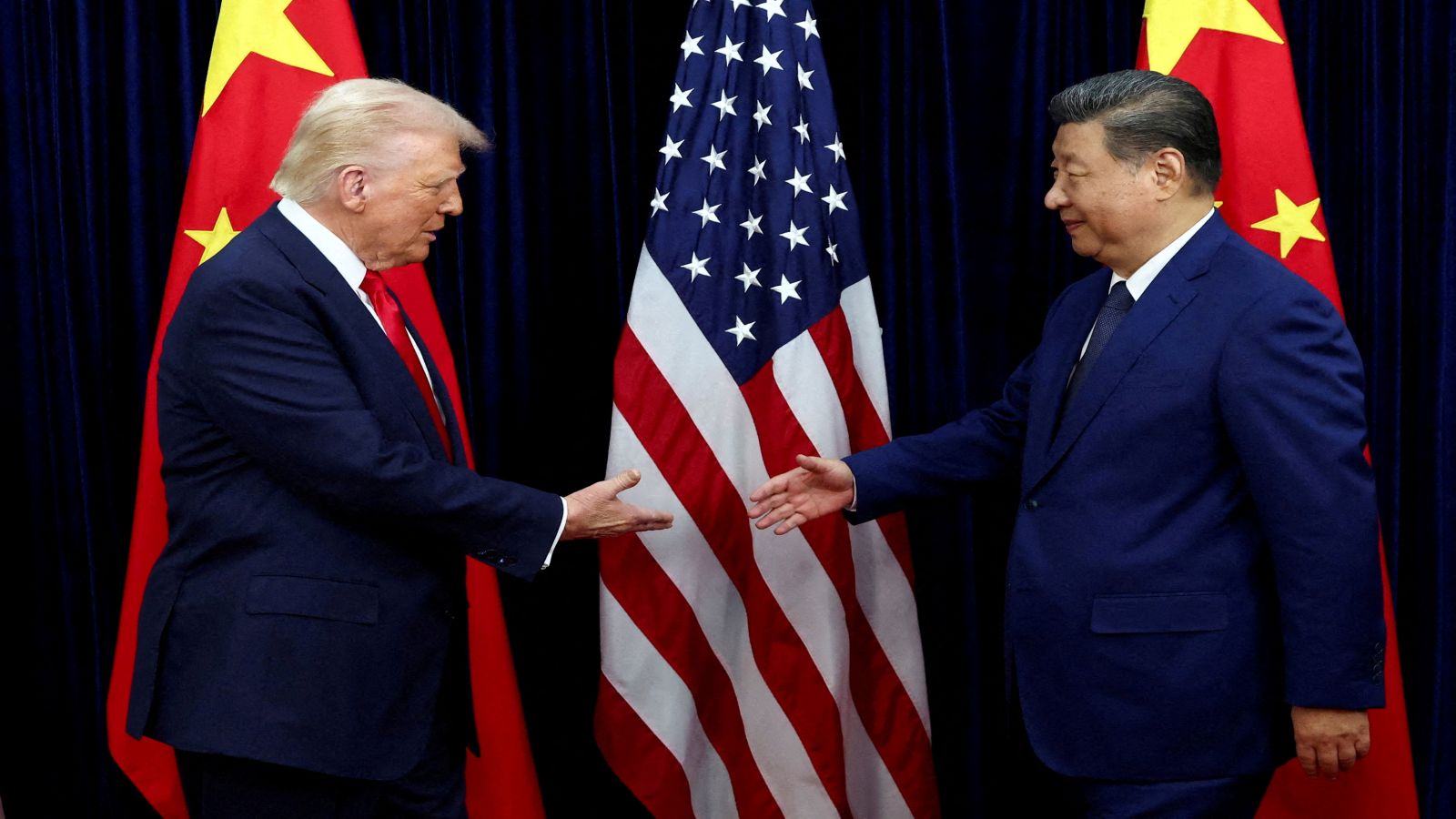
The air in Beijing during November has a way of tasting like cold iron and ancient dust. It settles in the lungs, a physical reminder that you are standing in a city that measures its history not in fiscal quarters, but in dynasties. When Donald Trump’s motorcade rolled toward the Forbidden City, the silence was heavy. This wasn't the usual diplomatic pageantry. It felt like a collision.
On one side, a man who built a brand on the jagged edges of Manhattan real estate, where a handshake is a weapon and the loudest voice usually wins the floor. On the other, Xi Jinping, a leader whose power is quiet, structural, and rooted in a vision that stretches toward the middle of the twenty-first century.
This isn't just about soybeans. It isn't just about steel or the fluctuating value of the yuan.
It is about the fundamental friction of two different ways of existing. If you want to understand why your smartphone might cost three hundred dollars more next year, or why a farmer in Iowa is staring at a silent grain elevator with a knot in his stomach, you have to look past the televised handshakes. You have to look at the ghosts in the room.
The Ghost of the Factory Floor
Think of a woman named Lin. She doesn't exist in the official briefings, but she is the reason the briefings exist. Lin works in a high-precision manufacturing plant in Shenzhen. For twenty years, her life was defined by the steady "click-hiss" of assembly lines producing components for Western markets. She is the human face of the "China Price"—the economic reality that dictated global trade for three decades.
When Trump talks about "the art of the deal," he is talking to a voter in Ohio who believes Lin took his job. When Xi talks about "the Great Rejuvenation," he is telling Lin that her days of making cheap plastic toys are over. He wants her making semiconductors. He wants her making the nervous system of the future.
The conflict in Beijing isn't a spat over a ledger. It’s a battle over who gets to own the next century of human ingenuity. The US wants to protect the intellectual property that has been its lifeblood. China wants to stop being the world’s workbench and start being its architect.
But the friction creates heat.
Consider the "Trade War" not as a singular event, but as a tectonic shift. When the US imposes tariffs, it isn't hitting a faceless entity. It is hitting the supply chain that connects a silicon chip in Taiwan to a design studio in California to a consumer in London. We have spent forty years weaving the world together so tightly that trying to pull the threads apart doesn't just change the pattern—it tears the fabric.
The Theater of Power
There is a specific kind of psychological warfare that happens in these meetings. Trump relies on unpredictability. He uses the tweet as a scouting party, testing defenses, looking for a crack in the opponent’s resolve. He treats the global economy like a high-stakes closing room in a midtown skyscraper.
Xi, however, plays the long game. In Chinese diplomacy, time is a resource, not a constraint. While the American side looks for a "win" they can broadcast on the evening news, the Chinese side looks for "stability"—a word that carries the weight of a mountain in Beijing.
Imagine two players at a table. One is playing speed chess, slamming the clock, forcing errors through sheer velocity. The other is playing Go, quietly placing stones one by one, surrounding the opponent so slowly they don't realize they've lost until the final move is made.
The "deal" being discussed is a phantom. The US demands structural changes to the Chinese economy—ending state subsidies, stopping forced technology transfers, opening up the firewall. To the American ear, these sound like fair play. To the Chinese ear, they sound like a demand to rewrite their national identity.
Beijing remembers the "Century of Humiliation." They remember when foreign powers dictated their internal laws. Xi cannot be seen as the man who folded. Trump cannot be seen as the man who got "ripped off."
The Hidden Cost of the Handshake
While the leaders dine in the Hall of Supreme Harmony, the real-world consequences are filtering down to people who couldn't find the Forbidden City on a map.
Take a small-scale electronics hobbyist in Seattle. He relies on cheap, rapid prototyping from Chinese vendors. Suddenly, the shipping costs double. The parts are held in customs. The innovation he was building in his garage—the thing that might have been the next big tech breakthrough—dies in a spreadsheet because the margins no longer work.
Or look at the American soybean farmer. He spent thirty years building a relationship with buyers in Dalian. He knows their families. He knows their preferences. Overnight, that relationship is severed by a political maneuver. The silos fill up. The bank starts calling.
These aren't just statistics. This is the erosion of trust.
Trust is the invisible currency of the global market. You don't sign a contract with someone you think might disappear tomorrow. The meeting in Beijing is an attempt to see if trust can be manufactured where it no longer grows naturally.
The Architecture of the New World
The real tension isn't about what is on the table, but what is under it.
We are moving away from a unipolar world where the US dollar and American values set the rhythm of the global dance. We are entering a fractured era. Some call it "decoupling." That is a sanitized word for a messy, painful divorce between the world’s two largest economies.
If the "Art of the Deal" fails, we aren't just looking at higher prices for washing machines. We are looking at a world of two internets, two GPS systems, two sets of technical standards. A world where a device made in one hemisphere literally cannot "talk" to a device made in the other.
That is the invisible stake.
As the two men walked through the courtyard of the Forbidden City, the cameras caught them smiling. But look at the eyes. There is a recognition of the stakes. Trump knows his legacy depends on bringing home a "trophy" that looks like a victory for the American worker. Xi knows his survival depends on ensuring China’s rise isn't choked off by Western containment.
They are both right, and they are both trapped.
The deal isn't a document. It’s a temporary truce in a struggle that will define the rest of our lives. It’s the realization that the world we knew—the one where goods and ideas flowed without friction—was an anomaly.
The cold iron air of Beijing doesn't care about quarterly reports. It has seen empires rise and fall. It has seen deals made and broken. As the motorcade pulled away, the smog settled back over the ancient yellow roofs, leaving the rest of us to wonder if the men inside the cars actually understood the gravity of the shadows they were chasing.
Economics is often taught as a series of graphs and equations, but in the end, it is just a story we tell about what we value. Right now, the story is being rewritten in a language that neither side quite understands yet.
The silence in the Forbidden City wasn't peace. It was the breath taken before the next round.