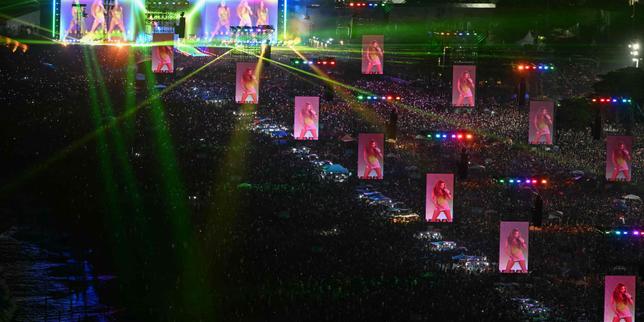
Shakira’s performance at Copacabana beach represents a peak in the commodification of "mass-event" spectacle, where the primary value driver is no longer ticket revenue but the strategic accumulation of cultural capital and urban branding. To categorize a crowd of 2 million people as merely a "concert audience" ignores the complex logistical and economic architecture required to sustain such a density. This event functions as a stress test for municipal infrastructure and a high-stakes play for global soft power.
The Structural Mechanics of Free Access Events
Traditional concert economics rely on a closed-loop system where entry is restricted and revenue is captured at the point of sale. The Rio de Janeiro model—famously utilized by Rod Stewart and The Rolling Stones, and now Shakira—operates on an open-system logic. In this framework, the "customer" is not the attendee, but the city’s tourism board and global brand partners.
The viability of a 2-million-person event rests on three structural pillars:
- Topographical Advantage: Copacabana serves as a natural amphitheater. Its linear, 4-kilometer stretch allows for a distribution of sound and visual relays that prevents the fatal "crush" points found in enclosed stadiums.
- Municipal Underwriting: When a city reports 2 million attendees, it is justifying a massive expenditure of public funds. The investment is predicated on the "multiplier effect"—the theory that for every dollar spent on security and staging, several dollars are generated in local hospitality, transport, and international visibility.
- The Saturation Threshold: There is a point where the marginal utility of adding another attendee becomes negative due to safety risks and resource depletion. Management of this threshold determines the success or failure of the event's operational logic.
Quantifying the Crowd Measurement Discrepancies
The figure of 2 million people is frequently cited by municipal authorities but rarely verified by independent spatial analysis. To understand the reality of this scale, one must apply the Jacobs Method for crowd estimation. This involves dividing the total occupied area into sections, determining the average density per square meter, and multiplying.
- High Density: 4 people per square meter (m²). This is the limit of physical comfort.
- Mosh Pit Density: 5–6 people per m². This level carries significant medical risk and limits movement.
- Average Event Density: 2 people per m².
If we assume the concert area spans approximately 500,000 square meters (the approximate usable space of the beach and adjacent boulevard), a crowd of 2 million would require a sustained density of 4 people per square meter across the entire footprint. This level of saturation is rarely maintained over several kilometers. Most likely, the "2 million" figure represents a cumulative total of everyone who passed through the perimeter over an 8-hour window, rather than a simultaneous peak.
The discrepancy between "reported" and "actual" attendance serves a specific marketing function. High numbers signal dominance in the attention economy, which Shakira uses to leverage future sponsorship deals and streaming algorithmic favor.
The Logistics of Extreme Density
Managing an audience of this magnitude introduces nonlinear variables that do not exist in standard arena tours. The primary bottleneck is "ingress and egress"—the movement of people in and out of the site.
The Transit Bottleneck
Rio’s infrastructure is forced to handle a load equivalent to five times its daily peak capacity. The failure of a single subway line or a bottleneck at a specific street corner can lead to a "turbulent flow" state. In fluid dynamics applied to crowds, turbulence occurs when people lose the ability to choose their own walking speed, leading to shockwaves that can cause mass falls.
Sanity and Sanitation
The metabolic requirements of 2 million people over a 6-hour period are staggering.
- Water Supply: To prevent mass dehydration in Rio's climate, the site requires a distributed network of "hydration points" capable of delivering hundreds of thousands of liters per hour.
- Waste Management: The post-event cleanup for a crowd of this size typically involves the removal of over 300-500 tons of solid waste. The speed of this recovery is a key metric for municipal competence.
Digital Amplification vs Physical Presence
The value of the Rio concert is increasingly decoupled from the physical experience of the attendees. For a significant portion of the crowd, the line of sight to the stage is nonexistent, and audio is filtered through secondary and tertiary delay towers. The event is, in essence, a content production set.
The true audience is the hundreds of millions watching via social media clips and live streams. Shakira’s team utilizes the 2-million-person backdrop as a visual proof of "relevance." In the current music industry, where "stadium status" is the ultimate currency, an event that dwarfs a stadium by a factor of 20 creates an unassailable brand moat. This is the Visual Proof Hierarchy: a crowded beach is a more potent marketing asset than a sold-out arena because it implies a cultural movement rather than a mere transaction.
Risk Factors and Operational Limits
The "mega-concert" model is fragile. Its primary threat is not financial, but reputational and physical.
- Thermal Stress: In high-humidity environments, the "wet-bulb" temperature can reach dangerous levels when 4 people are packed into every square meter, creating localized microclimates of extreme heat.
- Communications Collapse: High-density crowds cause immediate cellular network saturation. In the event of an emergency, the inability to transmit data or make calls creates a "blackout" that hinders coordinated response.
- Security Dilution: Traditional policing models cannot scale to 2 million people. Security becomes a matter of "crowd psychology management" rather than enforcement. If the collective mood shifts from celebration to panic, there is no physical force capable of containing the movement.
Strategic Economic Impact
For the city of Rio, the "Shakira Effect" is measured in "Earned Media Value" (EMV). If the city were to purchase the equivalent global advertising space that the concert generated through news cycles and social media impressions, the cost would likely exceed the event's production budget by a factor of ten.
However, the "leakage" of economic benefits is a significant concern. While hotels and large vendors see a surge, the informal economy often bears the brunt of the logistical chaos. Furthermore, the "displacement effect" suggests that regular high-spending tourists may avoid the city during these windows, potentially offsetting some of the gains.
The Shift to Eventized Hegemony
The success of the Rio event signals a shift in how legacy artists maintain their positions at the top of the industry. As streaming royalties remain thin, the focus moves toward "Eventized Hegemony"—creating moments so large they cannot be ignored by global media.
To replicate this success, organizers must move beyond the "talent + stage" formula. The future of the mega-concert lies in:
- Algorithmic Integration: Timing performances to peak during specific digital traffic windows.
- Infrastructure Partnerships: Deep integration with city-wide IoT (Internet of Things) to manage crowd flow in real-time.
- Dynamic Tiering: Finding ways to monetize "free" crowds through localized digital commerce (e.g., geofenced merchandise drops).
The 2-million-person concert is a high-risk, high-reward instrument of urban and personal branding. It is less a musical performance and more a feat of civil engineering and psychological signaling. The data suggests that while the "2 million" figure may be a generous municipal estimate, the cultural impact of such a claim is a concrete asset that will define Shakira’s market position for the next decade.
The strategic play for any artist or city attempting to scale to this level is to prioritize flow over capacity. Ensuring that the crowd can move, breathe, and share content is more critical than the actual number of bodies on the sand. The goal is to create a "controlled spectacle"—an event that feels like a riot but functions like a clock.