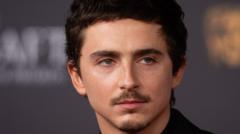
Timothée Chalamet’s recent public assertions regarding the perceived accessibility and cultural utility of ballet and opera represent more than a public relations friction point; they expose a fundamental misunderstanding of the Status-Scarcity Loop that governs the high-culture economy. By framing these art forms as "pretentious" or "outdated," the actor inadvertently attacked the very structural scaffolding that supports his own brand equity as a purveyor of "elevated" cinema. The resulting backlash is not merely a social media phenomenon but a defense mechanism by the cultural institutions that provide the intellectual legitimacy Hollywood stars require to transcend the category of mere "celebrity."
The Value Proposition of High Culture Architecture
High-culture mediums—specifically ballet and opera—operate on a different economic and social logic than mass-market entertainment. While a blockbuster film relies on high-volume, low-margin consumption (the "Wide Net" model), these traditional arts rely on Exclusive Narrative Signaling.
Chalamet’s critique suggests that these forms are failing because they are not "approachable." This analysis misses the three primary pillars that sustain their value:
- Technical Barrier to Entry: Unlike film, which uses editing to simulate perfection, ballet and opera require visible, unedited physical mastery. The "prestige" is derived from the scarcity of the human capability required to perform at that level.
- Institutional Longevity: These forms represent "Lindy Effect" assets—works that have survived centuries and are therefore statistically likely to survive many more. By dismissing them, an actor dismisses the very concept of enduring legacy.
- The Luxury Paradox: In the luxury goods market, as well as the high-arts market, increased accessibility often leads to a decrease in perceived value. If an opera is "for everyone" in the same way a TikTok trend is, it loses the specific gravitas that attracts high-net-worth patronage and academic canonization.
The Brand Cannibalization Mechanism
Chalamet’s career trajectory has been meticulously managed to position him as the heir to the "Auteur Era." His participation in projects directed by Villeneuve, Guadagnino, and Gerwig suggests a strategic alignment with high-brow intellectualism. When a brand built on intellectual prestige attacks the foundations of that prestige, it creates a Cognitive Dissonance Gap.
The backlash originates from two distinct groups: the Institutional Gatekeepers (critics, historians, and practitioners) and the Prestige Consumers (the audience segment that buys into the "serious actor" narrative). For the gatekeepers, Chalamet’s comments signaled a lack of "Artistic Literacy," a prerequisite for the roles he seeks. For the consumers, it broke the illusion of his sophistication, reclassifying him as a standard pop-culture product rather than a cultural icon.
This friction is best understood through the lens of Social Identity Theory. Fans of high art perceive an attack on the medium as an attack on their own identity-based investment in "refined" taste. When a figurehead of that world—Chalamet—defects, it triggers a defensive mobilization to protect the boundaries of the "In-Group."
The Myth of Cultural Democratization
A recurring theme in Chalamet’s rhetoric is the idea that art must be "democratized" to remain relevant. In a market analysis, this is a flawed premise. Total democratization leads to Commoditization.
If every art form is optimized for the widest possible audience, the unique selling proposition (USP) of niche forms disappears. Ballet and opera do not compete with Netflix on the basis of convenience or price; they compete on the basis of Sacralization. They offer an experience that is intentionally "other" than daily life.
The "pretentiousness" Chalamet cited is actually a protective barrier. It ensures that the audience is self-selecting and highly engaged. Removing this barrier doesn't "save" the art form; it removes the friction that makes the experience feel significant. The "cost" of entry—whether intellectual, financial, or time-based—is what generates the high "value" signal in the consumer's mind.
Operational Fallacies in Celebrity Advocacy
The primary error in the "Chalamet Defense" is the assumption that an actor’s platform grants them the authority to dictate the evolution of unrelated disciplines. This is an Authority Transfer Error. Success in the film industry (a visual, narrative, and digital medium) does not provide the structural insights required to reform live, acoustic, and physical disciplines.
The backlash highlighted a significant "Blind Spot" in modern celebrity strategy: the failure to recognize Ecological Interdependence. Hollywood does not exist in a vacuum; it feeds off the aesthetics, techniques, and talent pools of the theater and dance worlds. By devaluing the "roots," the "branches" (cinema) eventually suffer a loss of aesthetic depth.
The Strategic Path Toward Cultural Re-integration
To mitigate the brand damage and realign with the prestige market, the required move is not a standard "apology tour," which would appear disingenuous. Instead, the strategy must shift toward Structural Appreciation.
The objective is to move from "Democratization" (which implies the art is broken and needs fixing) to "Contextualization" (which implies the audience needs the tools to understand the art's inherent value).
- Pivot from Critic to Student: Publicly engaging with the technical rigors of these forms (e.g., highlighting the 10,000-hour mastery requirement of a prima ballerina) re-establishes respect for the discipline.
- Highlight the Cross-Pollination: Emphasizing how operatic structures or balletic movement inform cinematic performance creates a logical bridge that justifies his presence in both worlds.
- Invest in Infrastructure, Not Just Rhetoric: Supporting the physical survival of these institutions (grants, scholarships) carries more weight than verbal "inclusivity" statements.
The long-term risk for Chalamet is the "Middle-Market Trap." If he loses the support of the high-culture elite while remaining too "niche" for the purest mass-market blockbusters, his brand equity will stagnate. The current friction is a signal that the market requires him to choose: remain a "Cool" celebrity with a limited shelf life, or lean back into the "Prestigious" icon status that requires a disciplined respect for the arts' historical hierarchy.
The most effective strategic play is to acknowledge the Friction of Excellence. High art is difficult because it is excellent; it is exclusive because it is rare. Re-aligning with these truths allows a celebrity to maintain their "Elevated" status while acknowledging that not all culture needs to be flattened for the sake of a modern algorithm.
Would you like me to analyze the specific audience sentiment data across different demographic brackets to identify which segment felt most alienated by these remarks?