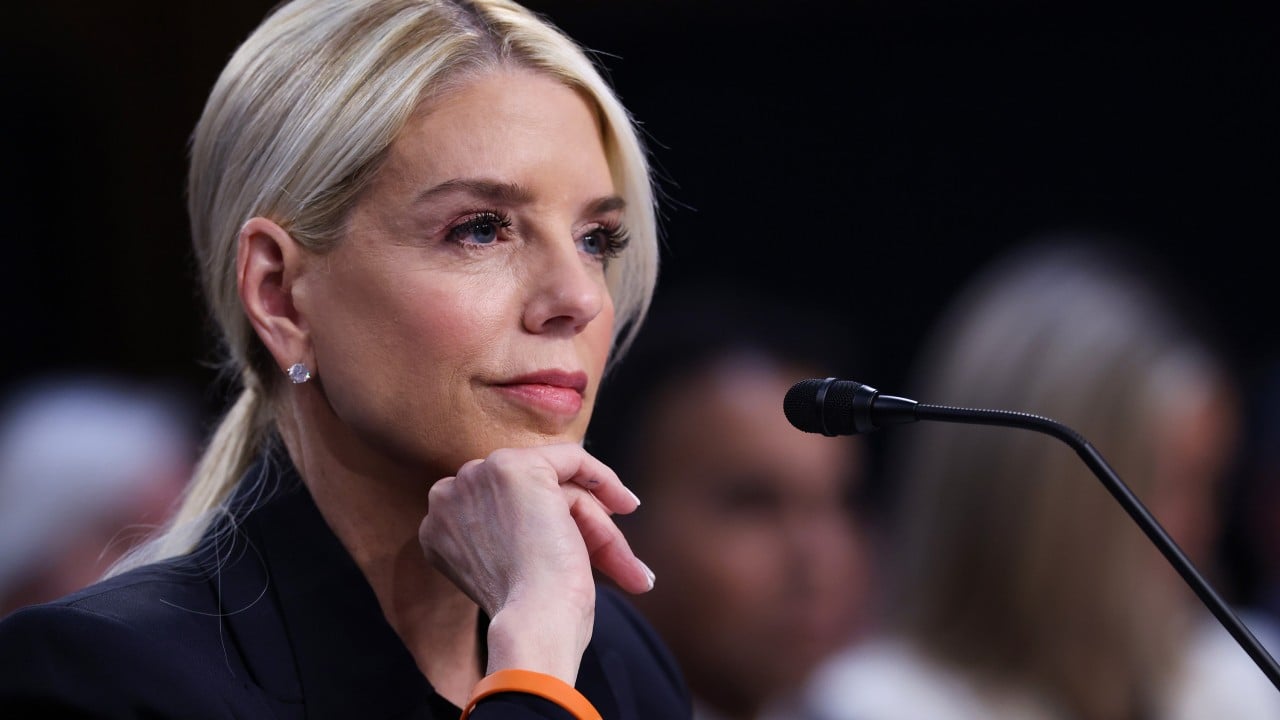
The Department of Justice’s refusal to permit Attorney General Pamela Jo Bondi to testify before the House Oversight Committee regarding the Jeffrey Epstein files is not a singular event of political friction, but a calculated deployment of the Office of Legal Counsel (OLC) immunity doctrine. This maneuver prioritizes the structural integrity of executive branch autonomy over the legislative branch’s investigative mandate. To understand the friction between the DOJ and Congress, one must analyze the interplay of three distinct factors: the doctrine of testimonial immunity for close presidential advisors, the operational sensitivity of ongoing criminal investigations, and the legal barriers imposed by Federal Rule of Criminal Procedure 6(e).
The Doctrine of Absolute Testimonial Immunity
The DOJ’s position rests on a long-standing executive branch interpretation that senior advisors to the President—and by extension, the Attorney General—possess absolute immunity from compelled congressional testimony regarding their official duties. This is not a statutory right but a constitutional theory derived from the separation of powers.
The logic follows a three-step progression:
- Confidentiality Requirements: The President requires candid, unvarnished advice to execute the laws of the United States.
- The Chilling Effect: Compelling a Cabinet official to testify before a politically charged committee creates a "chilling effect," where officials might self-censor or alter their advice to avoid public scrutiny or legislative reprisal.
- Institutional Independence: If Congress could summon the Attorney General at will to explain the internal deliberations of the Department, the executive branch would effectively become a subordinate entity to the legislature, violating the core architecture of the U.S. Constitution.
Critics of this doctrine point to the 2019 D.C. District Court ruling in Committee on the Judiciary v. McGahn, which held that "no one is above the law" and that absolute immunity does not exist. However, the DOJ frequently ignores district court precedents in favor of its own OLC memos, which serve as the internal "law" for executive agencies. In the Bondi case, the DOJ is effectively betting that the time required for a judicial resolution will outlast the current legislative cycle, a strategy known as procedural attrition.
Grand Jury Secrecy and the Rule 6e Bottleneck
The specific subject matter—the Epstein files—introduces a secondary, more rigid legal barrier: Federal Rule of Criminal Procedure 6(e). This rule prohibits the disclosure of "matters occurring before the grand jury."
Most public discourse conflates "government files" with "public records," but in high-profile criminal cases, the bulk of the investigative material is generated through grand jury subpoenas and testimony. The Attorney General is legally barred from disclosing this information to Congress unless a court orders the release for a specific judicial proceeding. Congress’s oversight function is rarely classified as a "judicial proceeding" under current case law.
The DOJ uses Rule 6(e) as a defensive perimeter. Even if Bondi were to appear, her testimony would be functionally hollow because:
- Any mention of witnesses who appeared before the grand jury is a violation.
- Any discussion of documents subpoenaed by the grand jury is restricted.
- Any disclosure of the strategic direction provided by prosecutors to the grand jury is prohibited.
This creates a Transparency Gap. Congress wants to know why certain individuals were not prosecuted, but the evidence explaining those decisions is locked behind 6(e), and the person responsible for those decisions is shielded by testimonial immunity.
The Operational Risk of Investigation Interference
Beyond the legal abstractions of immunity and secrecy lies the pragmatic concern of investigative integrity. The DOJ maintains that congressional testimony on open or sensitive closed matters risks "prejudicial publicity."
If Bondi were to testify about the Epstein files, she would risk revealing the identities of "unindicted co-conspirators." In the DOJ’s internal framework, naming individuals who were investigated but not charged is a violation of due process and departmental policy (the Justice Manual). The harm is two-fold:
- Reputational Damage: Individuals mentioned in a congressional hearing have no formal way to defend themselves, unlike in a court of law.
- Witness Intimidation: Future witnesses in related sex-trafficking or financial crime investigations may be less likely to cooperate if they believe their private testimony will be weaponized in a televised hearing.
The DOJ is operating on the principle that the executive branch must maintain a "monopoly on prosecution." By refusing to allow Bondi to appear, they are asserting that the evaluation of evidence and the decision to charge (or not charge) is a core executive function that cannot be shared with or reviewed by a co-equal branch of government in real-time.
The Structural Failure of Congressional Oversight
The current impasse reveals a failure in the mechanisms of oversight. When the DOJ refuses a request for testimony, Congress has limited tools to compel compliance:
- Contempt of Congress: This is largely symbolic when applied to a sitting Cabinet official, as the DOJ (the agency headed by the person in question) is responsible for prosecuting the contempt charge.
- Civil Litigation: As seen in previous administrations, lawsuits to enforce subpoenas take years to move through the appellate courts.
- Power of the Purse: Congress can threaten to withhold funding from the DOJ, but this is a "nuclear option" that rarely gains enough bipartisan support to pass, as it risks defunding critical law enforcement functions.
The DOJ’s refusal is a calculated assessment that the legal and political costs of compliance (revealing internal decision-making and potentially compromising future cases) outweigh the institutional costs of defiance (a standoff with the House Oversight Committee).
Quantitative Implications of the Stalemate
The absence of Bondi’s testimony ensures that the "Epstein Files" remain in a state of evidentiary limbo. Without a formal mechanism to bypass Rule 6(e) or a waiver of executive privilege, the public record will remain static. This leads to a speculation tax on the American legal system, where the lack of transparency fuels public distrust and forces the legislative branch to rely on leaks and secondary sources rather than direct evidence.
From a strategic standpoint, the DOJ is executing a "Long-Game Defense." By establishing this precedent with Bondi, they reinforce the shield for all future Attorneys General, regardless of the administration. This is an institutional preservation play, not a partisan one.
The path forward for the House Oversight Committee is not through further requests for voluntary testimony, which have a 0% success rate under the current OLC guidelines. Instead, the strategy must shift toward:
- Seeking 6(e) Waivers: Filing specific motions in the Southern District of New York to release grand jury materials under the "exception for a judicial proceeding."
- Targeting Non-Immune Witnesses: Subpoenaing career officials or third-party contractors who do not fall under the "close advisor" umbrella of absolute immunity.
- Legislative Reform: Drafting amendments to the Contempt of Congress statutes to allow for expedited judicial review, bypassing the DOJ’s internal gatekeeping.
The standoff is not a glitch in the system; it is the system working as designed to protect executive secrets. Until the judicial branch narrows the scope of testimonial immunity or the legislative branch exerts its fiscal authority, the files will remain inaccessible. The only viable move for investigators is to pivot away from the figurehead and toward the raw data points held by non-privileged entities.