The weight of a passport is deceptive. It is just a few ounces of paper and stitched thread, yet it carries the gravity of an entire history. When you stand in a fluorescent-lit customs hall in a city halfway across the globe, that little book is the only thing that proves you exist to the world. It is your shield. It is your permission slip. Now, it is becoming a canvas for a new kind of national identity.
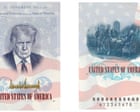
As the United States hurtles toward its 250th anniversary in 2026, the State Department is readying a radical aesthetic shift for the Semiquincentennial. The "America250" passport isn't just a routine update or a fresh coat of security ink. It is a deliberate, high-contrast snapshot of the American story, featuring the likeness of the 45th and soon-to-be 47th President, Donald Trump.
For the average traveler, the passport has long been a quiet document. We rarely look at the internal pages unless we are hunting for the last bit of white space for a stamp. Since the 2007 redesign, those pages have been filled with the sweeping vistas of the Tetons, the sturdy silhouette of the Liberty Bell, and the maritime grace of a clipper ship. They were symbols of a shared geography. The new edition, however, pivots from the land to the leaders, centering the personhood of the presidency in a way that feels both historic and startlingly immediate.
Imagine a young woman named Elena. She is a first-generation American, the first in her family to pack a suitcase for a semester abroad in Florence. She holds her new America250 passport at the kitchen table, tracing the embossed eagle on the cover. When she flips to the internal visa pages, she isn't met with a generic eagle or a grainy mountain range. Instead, she sees the unmistakable profile of Donald Trump set against a backdrop of the American flag.
This isn't a metaphor. It is the literal reality of the document she must present to every border agent from London to Tokyo.
The decision to include the President’s image marks a departure from the traditional anonymity of travel documents. Usually, we think of passports as being above the fray of daily headlines. They are meant to represent the enduring state, not the temporary administration. But the America250 initiative seeks to bridge that gap. By placing the image of the current Commander-in-Chief alongside the founders of the 1776 revolution, the design suggests a direct line of succession—a narrative of "Great Men" that spans two and a half centuries.
The logistics of this change are as complex as the emotions it stirs. The State Department must balance the inclusion of new portraits with the dizzying array of security features required to thwart modern counterfeiters. This means the images are not just printed; they are woven into the very fiber of the page using polycarbonate technology and color-shifting inks.
Consider the technical friction involved. Each page contains layers of "tactile" features—small ridges you can feel with a fingernail—and ultraviolet reactive elements that only reveal themselves under a blacklight. To incorporate a human face into this architecture without compromising the document’s integrity is a feat of engraving. In the America250 version, the President’s image is embedded within these layers. It is a ghost in the machine, visible to the naked eye but fortified by the same technology that protects the nation's most sensitive data.
Critics argue that a passport should remain a neutral vessel. They worry that a traveler’s personal politics might be projected onto them by a foreign official the moment the book is opened. A passport is, after all, a request for safe passage. In the past, that request was made on behalf of "The People of the United States." Now, that request is visually tied to a specific individual.
But there is another side to the coin. Supporters see the redesign as a long-overdue injection of pride and personality into a stale bureaucracy. To them, the image of Donald Trump represents a specific era of American resurgence. It is a badge of a nation that refuses to be quiet or invisible on the world stage. For these citizens, carrying this version of the passport feels like carrying a piece of the current struggle and triumph, rather than a dusty history book.
The tension lies in the fact that we don't choose our passport’s aesthetic. It is a mandatory uniform. If you need to travel, you carry the book the government gives you. This creates a strange, intimate relationship between the citizen and the state. You might disagree with every policy the man in the picture stands for, yet you must carry his likeness in your breast pocket to get home to your family. Or, you might find his image a source of immense comfort, a reminder of a leadership style you believe saved the country.
Either way, the document ceases to be invisible. It becomes a conversation starter—or a conversation stopper.
Beyond the portrait, the America250 edition is rumored to include quotes and excerpts from pivotal moments in the last decade of American life, attempting to capture the "spirit of the era." This is a departure from the 19th-century poetry and quotes from the Founding Fathers that defined the previous "e-Passport" series. The goal is to make the document feel contemporary. It wants to be a living record, not a museum piece.
The hidden cost of this transition isn't just financial. It is the cost of our collective focus. We are a nation that has become obsessed with the "now." We have traded the slow-moving symbols of the forest and the stream for the high-definition intensity of the political arena. The passport, once a symbol of where we came from, is now a statement of where we are standing right this second.
Think of a businessman landing in Dubai. He hands over his America250 passport. The agent looks at the photo, then at the man, then at the engraved image of Trump. In that three-second interaction, a thousand assumptions are made. The traveler is no longer just an anonymous American tourist; he is a representative of a very specific, very polarized moment in time.
This shift reflects a broader trend in global identity. Countries are increasingly using their official documents to project "soft power." Whether it's the sleek, minimalist designs of the Nordic countries or the vibrant, flora-heavy pages of the Australian passport, these books are the primary marketing tool for a nation's brand. By choosing a presidential portrait, the US is leaning into a brand of personality and power. It is a move that says the American identity is no longer just about the Constitution or the Bill of Rights, but about the people who wield those documents.
The security implications are equally fascinating. Human faces are significantly harder to forge than landscapes. Our brains are hardwired to recognize tiny discrepancies in a nose or a jawline. By placing a globally recognized face on every page, the State Department is adding a psychological layer of security. A counterfeiter might get the shades of a mountain right, but if the President’s eyes look "off," even a distracted clerk might notice.
As the 2026 deadline approaches, the rollout will likely be staggered. Millions of Americans still hold the "old" blue books, featuring the quote from Abraham Lincoln about a "government of the people." For a few years, we will exist in a dual reality. Two different Americas will be circulating in the world's airports. One will be the America of the wide-open West, of purple mountains and fruited plains. The other will be the America of the 250th anniversary—bold, personality-driven, and unapologetically centered on the current holder of the Oval Office.
We often forget that the word "passport" comes from the French passer porte, to pass through a gate. The gate is not just a physical one. It is a psychological threshold. When we cross it, we are leaving behind the nuances of our private lives and becoming "The American."
In the quiet of a late-night flight, when the cabin lights are dimmed and the only sound is the hum of the engines, travelers often take out their documents to fill out customs forms. They look at the names of their children, their own birthdates, and the expiration dates that remind them of the passage of time. With the America250 edition, they will also be looking at a face that has defined the most turbulent and transformative years of the 21st century.
The passport has stopped being a mirror of the land and has become a mirror of our choices. Whether you see that mirror as a tribute or a challenge, you will still have to hold it in your hand when you ask the world to let you in. The blue book remains, but the story inside has changed its protagonist.