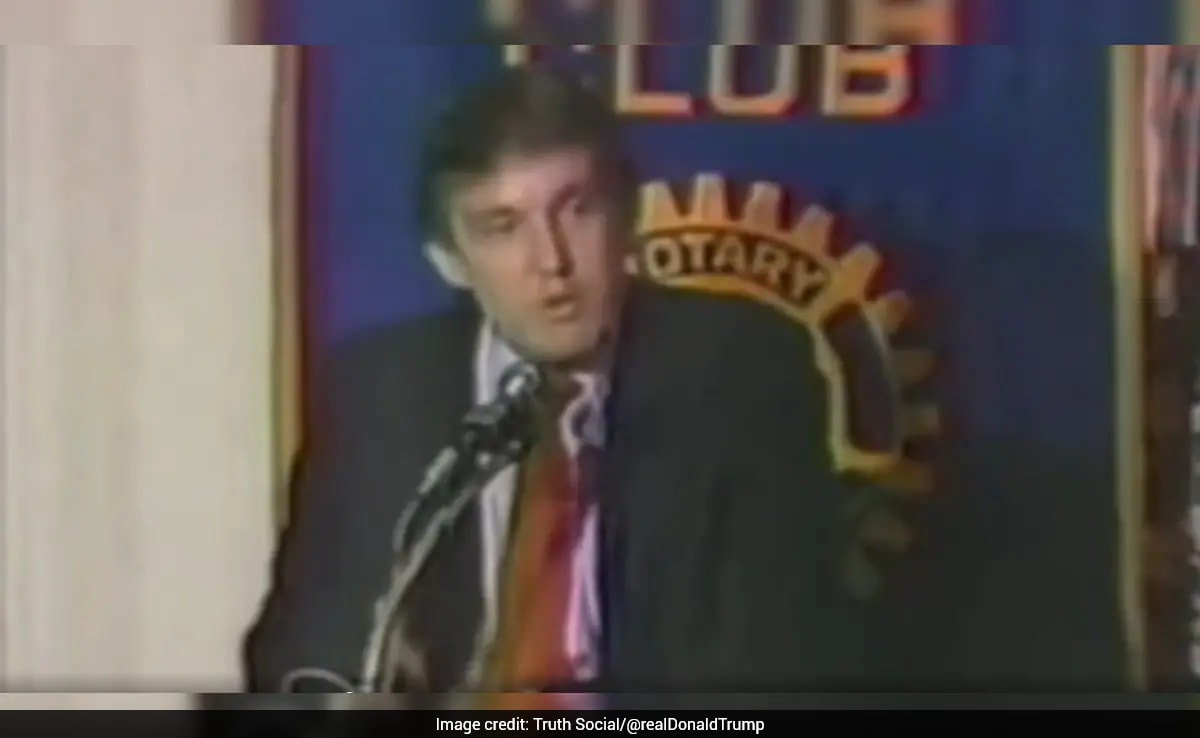
The year was 1980. The air in New York was thick with the scent of roasted chestnuts and the palpable anxiety of a nation held hostage. Fifty-two Americans were sitting in a basement in Tehran, and back home, a real estate developer with a penchant for gold leaf and tabloid headlines was watching the news. He wasn't just watching; he was simmering. He looked at the maps of the Middle East, not as a student of history or a diplomat, but as a landlord looking at a tenant who refused to pay rent.
Donald Trump sat in his office, long before the golden escalators or the Oval Office, and hit upon a philosophy that would remain unchanged for nearly half a century. To him, the world was a collection of assets. Iran was a storefront. The oil was the inventory. And the United States? We were the security guards working for free.
The Landlord’s Lament
Think about a small-town hardware store. The owner spends forty years watching the shop across the street. He doesn’t care about the owner of that shop, their family history, or the beautiful architecture of the building. He just wants the lawnmowers in the window. He believes that because he pays for the streetlights and the police patrols, those lawnmowers should be his.
This isn't a metaphor. It is the fundamental blueprint of a worldview that treats geopolitics like a predatory lease agreement. When Trump began talking to reporters in the early eighties, he didn't speak of democracy or human rights. He spoke of "taking the oil." He saw the massive wealth of the Persian Gulf as a debt owed to America for the "protection" we provided.
It was a radical departure from the Cold War consensus. While the State Department was busy playing a three-dimensional chess game with the Soviets, trying to balance regional alliances and prevent a nuclear apocalypse, Trump was playing Monopoly. He saw a board where the most valuable spaces were colored in oil-slick black, and he couldn't understand why the U.S. government hadn't already put a hotel on them.
A Ghost in the Machine
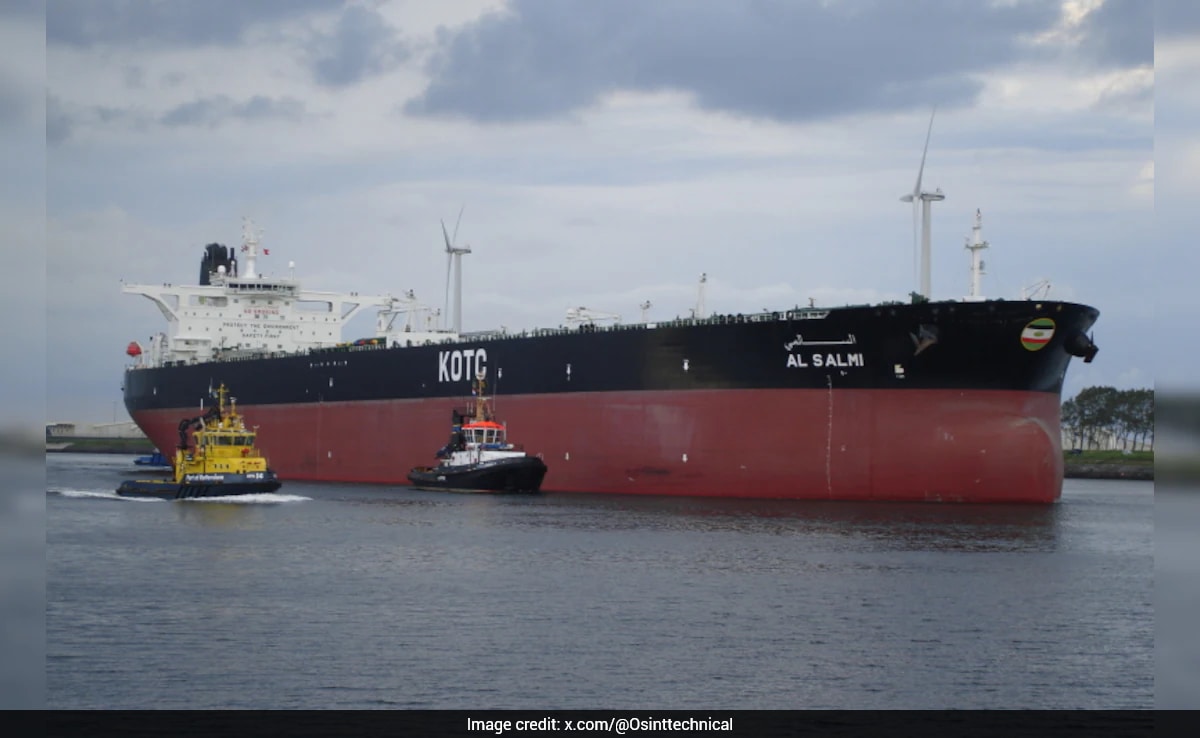
Fast forward to the late 1980s. A young sailor on the USS Samuel B. Roberts is staring at the dark waters of the Persian Gulf. It’s the "Tanker War." Mines are bobbing in the waves like mechanical sharks. The mission is simple: protect the flow of oil. For the sailor, the stakes are life and limb. For the analysts in Washington, the stakes are global economic stability.
But for the man in Trump Tower, the stakes were purely transactional. He took out full-page ads in major newspapers—a staggering expense for a private citizen—to scream into the void that America was being laughed at. He argued that we were protecting countries that had more money than we did, and we were getting nothing in return.
"The world is laughing at us," he wrote. It became his mantra. It wasn't about the sailor on the deck. It wasn't about the sovereignty of nations. It was about the "carry." In real estate, the carry is the cost of holding an investment. Trump viewed the entire U.S. military budget as the carry for a global oil investment where the dividends were being paid to someone else.
The Long Memory of an Asset Manager
We often treat political shifts as sudden storms, but this was a slow-thawing glacier. The rhetoric Trump used in 2016 and 2024 regarding Iran wasn't a new strategy cooked up by campaign advisors. It was a vintage 1987 vintage, bottled and aged.
When he looked at the Iran Nuclear Deal, he didn't see a complex diplomatic mechanism designed to prevent a regional arms race. He saw a bad closing. He saw a contract where the "seller" (Iran) got to keep their assets while the "buyer" (the world) gave up their leverage.
Consider the perspective of an Iranian family in Isfahan. They live in a city of turquoise domes and ancient bridges. For them, the "oil" is the lifeblood of their infrastructure, their schools, and their future. When an American leader talks about "taking" that resource, it doesn't sound like a business negotiation. It sounds like an existential threat. This is where the business logic of a developer hits the hard wall of national identity. You can't "foreclose" on a country of 85 million people without starting a fire that burns for generations.
The Architecture of Confrontation
The transition from "taking the oil" to "maximum pressure" was seamless. If you can't seize the asset, you devalue it. You block the doors. You cut off the electricity. You make the tenant so miserable that they have no choice but to hand over the keys.
But nations aren't office buildings. They don't declare Chapter 11 and walk away. When you squeeze a nation's economy, the pain doesn't hit the "landlords" in the government first. It hits the person trying to buy insulin at a pharmacy in Tehran. It hits the student whose scholarship is suddenly worthless. These are the invisible stakes of a policy rooted in the belief that everything is a commodity.
There is a cold, mathematical logic to it. If the U.S. controls the flow of energy, it controls the heartbeat of its rivals. If China needs that oil, and the U.S. sits on the tap, the U.S. wins. But this logic ignores the friction of the human soul. It ignores the fact that people will eat grass before they surrender their dignity to a landlord they never asked for.
The Echo in the Boardroom
The obsession with Iran's resources reveals a deep-seated suspicion of "soft power." In the world of the master storyteller, the hero usually wins through courage or wisdom. In the world of the master developer, the winner is the one who walks away with the most physical stuff.
During his presidency, this 40-year-old obsession manifested in a series of "what if" scenarios that horrified his generals. What if we just stayed in Iraq and took the oil? What if we demanded 100% of the profit from Persian Gulf protection? The generals spoke of international law, the Geneva Convention, and the "rules-based order." Trump spoke of "spoils."
It is a clash of eras. One side believes in a world governed by invisible lines and signed papers. The other believes in a world of fences and fuel tanks.
The Unfinished Deal
As the sun sets over the Gulf today, the tankers still move. They are the shadows of a global hunger that never ends. The man who first complained about them in 1980 is still complaining. The core of the argument hasn't shifted an inch.
We are often told that history is a series of accidents, a chaotic tumble of events. But sometimes, history is just the dogged persistence of a single idea. The idea that the world is a giant pie, and America hasn't been getting its slice.
It is a seductive story. It simplifies the terrifying complexity of the Middle East into a ledger of credits and debits. It tells us that we don't need to understand the history of the Safavids or the intricacies of Shia-Sunni relations. We just need to know the price per barrel.
But the price of "taking the oil" is never just the cost of the extraction. It’s the cost of the resentment that builds in the dark. It’s the cost of a world where every neighbor is a potential squatter and every alliance is a temporary lease.
The map of the Middle East remains spread out on the desk. The lines are drawn in sand, but the eyes looking at it see only the pipelines, glowing like veins under the skin of a world that refuses to be bought.