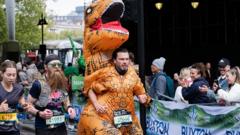
Frank McCourt wants the City of Los Angeles to pick up a $500,000 tab for his private marathon. It's a bold move. Some might call it audacious. When you own a massive sporting event that winds through the streets of one of the most expensive cities in the world, police and traffic control costs aren't just an afterthought. They're the whole game. McCourt, the former Dodgers owner who's no stranger to public friction, is now at the center of a tug-of-war over who should pay for the "public good" of a race that's technically a private business.
The Los Angeles Marathon isn't just a 26.2-mile run. It's a massive logistical beast. It requires hundreds of LAPD officers, thousands of traffic cones, and enough city coordination to make a logistical expert sweat. Currently, the city subsidizes a massive chunk of these costs. McCourt’s team argues that the marathon brings in millions of dollars in economic impact. They say it’s a postcard for the city. But critics look at McCourt’s net worth and ask why the taxpayers are footing the bill for a billionaire's side project. You might also find this similar coverage interesting: The Real Reason Prediction Markets Can’t Touch the Kentucky Derby.
Why the City Subsidy is Under Fire
Cities love marathons until they see the invoice. For years, Los Angeles has treated the marathon as a premier civic event, similar to a parade or a major holiday celebration. This designation allows the race organizers to avoid paying the full freight for city services. We're talking about the officers who stand at every intersection from Dodger Stadium to the Avenue of the Stars.
When you look at the numbers, the marathon gets a break that most local businesses would die for. The city currently covers roughly $500,000 to $600,000 in costs. McCourt and the McCourt Foundation argue that this is a fair trade. They point to the "halo effect." Runners stay in hotels. They eat at restaurants. They buy shoes. The city gets sales tax and hotel tax. It’s a classic "spend money to make money" argument. As highlighted in latest articles by ESPN, the effects are notable.
But here’s the problem. Los Angeles is currently staring down a massive budget deficit. Every dollar spent on police overtime for a race is a dollar not spent on homelessness, infrastructure, or basic neighborhood services. The optics are terrible. You’ve got a city struggling to fix its sidewalks while writing a check to support a race owned by a man who sold the Dodgers for $2 billion.
The McCourt Factor and Public Perception
You can't talk about the LA Marathon without talking about Frank McCourt. His reputation in Los Angeles is complicated, to put it mildly. For many fans, the McCourt era at Chavez Ravine was defined by drama and a messy exit. Even though he’s used his foundation to do charity work through the marathon, that history follows him.
When the marathon asks for a subsidy, people don't just see a race. They see Frank McCourt. It makes the "charitable" angle harder to sell. While the McCourt Foundation does donate to local causes, the marathon itself is a revenue-generating machine. Registration fees aren't cheap. Sponsorship deals with big brands bring in millions.
If the race is profitable, why does it need a public handout? That's the question being asked in City Hall hallways. The counter-argument is that without the subsidy, the race might have to move or shrink. But where would it go? You can't have the Los Angeles Marathon in a parking lot in Orange County. The city has leverage here, but it’s afraid of losing the prestige that comes with the event.
Comparing LA to Other Major World Marathons
Los Angeles isn't the only city dealing with this. Look at New York or Boston. Those races are massive economic engines, but the relationship with the city is often more transparent. In New York, the New York Road Runners (NYRR) pays a significant amount for city services. It’s a different model. The NYRR is a non-profit, but it operates with a level of financial independence that LA hasn't quite reached.
The True Cost of Public Safety
- LAPD Overtime: Hundreds of officers on 12-hour shifts.
- Traffic Control: Thousands of barricades and signage.
- Sanitation: Cleaning up miles of discarded water cups and gel packets.
- Emergency Services: Staging ambulances along the entire route.
The $500,000 figure being debated is actually just a portion of the total cost. The actual price of hosting a marathon is likely in the millions when you account for every city department involved. The subsidy is essentially a discount on the bill. If the city pulls the plug, McCourt has to find that half-million elsewhere. That likely means higher entry fees for you and me.
The Economic Impact Myth
Every major event uses an "economic impact study" to justify its existence. These studies are almost always commissioned by the event itself. They claim the marathon brings in $70 million or $100 million in economic activity. Economists often laugh at these numbers. They call it "swapping dollars."
If a local runner spends $150 on the marathon, that’s $150 they aren't spending at a local movie theater or a different restaurant. It’s not "new" money; it’s just moved money. The only real gain comes from out-of-towners. While the LA Marathon does attract international runners, a huge portion of the field is local. When you strip away the fluff, the actual net gain to the city treasury is much smaller than the headlines suggest.
The city knows this. They’re looking at the actual tax receipts, not the flashy brochures. And right now, the receipts don't seem to justify the gift to McCourt.
What Happens if the Subsidy Vanishes
If the City Council decides to play hardball, the marathon faces a crossroads. They could raise registration fees. Currently, it costs a few hundred dollars to run. Bumping that up by $20 or $30 per runner would cover the gap. But it also makes the race less accessible.
There's also the sponsorship route. If McCourt wants the city to save him $500,000, he could find a "Presenting Sponsor" to cut a bigger check. But those deals are getting harder to close in a crowded sports market.
What’s more likely is a compromise. The city might agree to phase out the subsidy over three to five years. This gives the marathon time to adjust its business model without a sudden shock to the system. It also allows politicians to tell their constituents they’re being fiscally responsible.
The Reality of Running a City in 2026
Los Angeles isn't the same city it was twenty years ago. The priorities have shifted. Public safety and housing are the only things people care about right now. Spending a half-million dollars to help a private foundation put on a footrace feels like a relic of a different era.
If the marathon is truly a "charitable" endeavor, then the finances should reflect that. Transparency is the only way forward. If McCourt wants the subsidy, he should open the books. Show the city exactly where the money goes. If the profits are going back into the city in a meaningful way, then maybe the $500,000 is a good investment. If not, it’s just another billionaire asking for a coupon.
The debate isn't going away. As the race gets closer, the pressure on City Hall will only grow. They want the marathon. They want the glory. They just don't want to pay for it anymore. McCourt is going to have to decide if the race is worth the full price of admission.
If you're a runner, expect your bib price to go up. If you're a taxpayer, keep an eye on how your representatives vote on this. It’s a small amount in the grand scheme of a multi-billion dollar budget, but it’s a massive signal of where the city’s heart—and wallet—actually lies. Don't be surprised if the "Stadium to the Stars" route ends up with a much higher price tag for the guy at the top.
Stop waiting for the city to bail out big business. If you want to see how your local taxes are actually being spent, check the City Council's weekly budget briefings. You’ll see that $500,000 could pave about a dozen blocks of broken streets. That’s a trade-off most residents would take in a heartbeat.