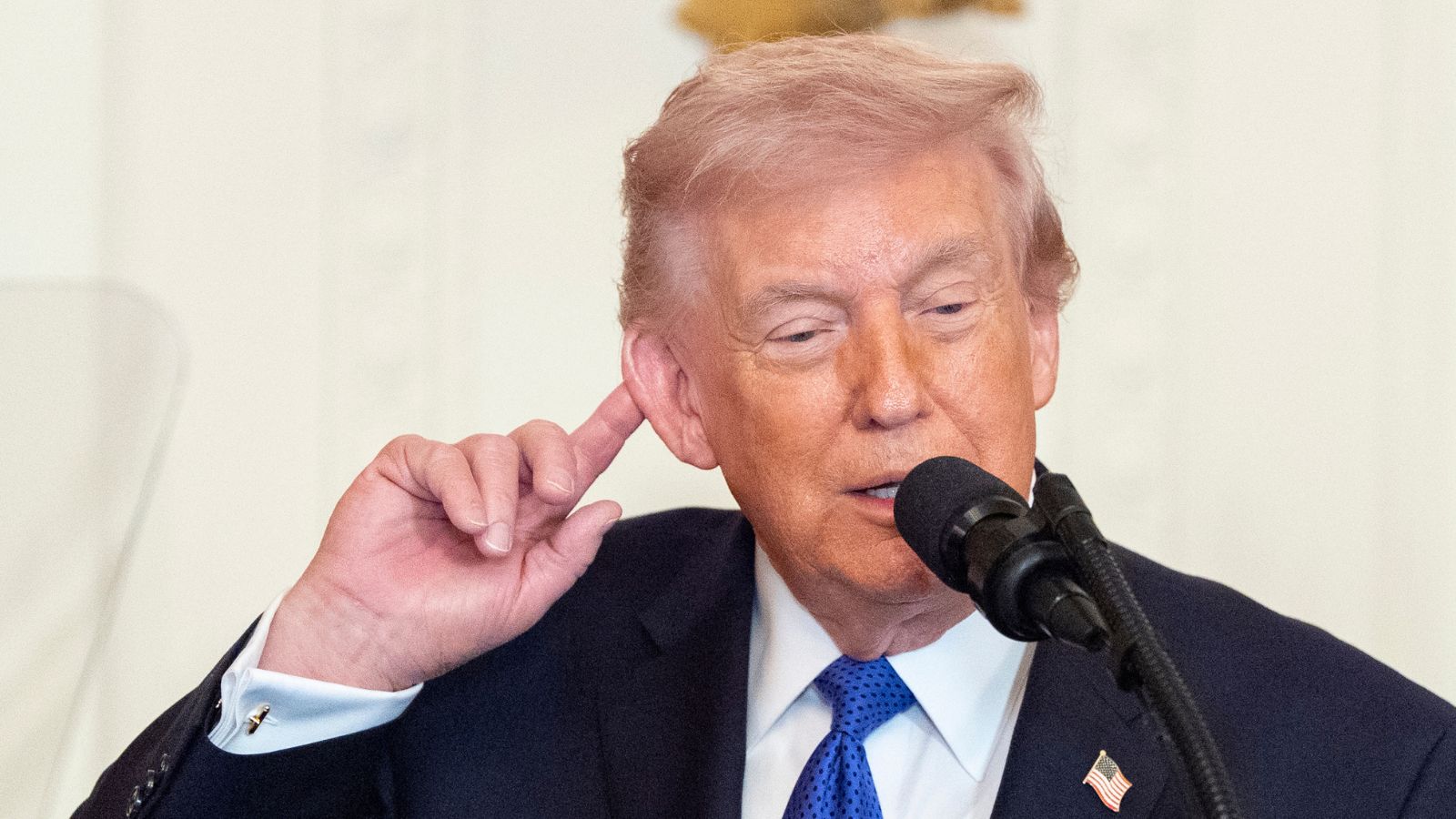
The friction between Donald Trump and his Secretary of State Marco Rubio over the strategy toward Tehran has finally broken into the open. At the heart of the dispute is a fundamental question of agency. Rubio recently suggested that the United States pushed Israel toward its recent strikes against Iranian military infrastructure. Trump has spent the last forty-eight hours dismantling that narrative. He claims he did not merely "allow" Israel to act but created the geopolitical conditions where they had no other choice. This is not a minor semantic squabble between a president and his top diplomat. It is a high-stakes battle over who owns the most volatile foreign policy portfolio in the world.
The tension centers on a specific set of strikes targeting Iranian missile production facilities and air defense batteries. Rubio, an institutionalist with deep ties to the intelligence community, framed the operation as a coordinated bilateral effort. His version of events implies a Washington that is still very much in the driver’s seat, steering Jerusalem through a calibrated escalation. Trump’s rebuttal suggests something far more chaotic and aggressive. By stating he "forced their hand," Trump is signaling a departure from the traditional "consult and coordinate" model of the State Department. He is asserting a doctrine of necessity where the U.S. sets the fuse and lets the regional players handle the explosion.
The Rubio Doctrine Versus the Trump Instinct
Marco Rubio represents the classic hawk's approach to the Middle East. He views Israel as a strategic asset that must be managed, funded, and occasionally restrained to prevent a global energy crisis. When Rubio speaks of "pressure," he refers to the diplomatic channels and military-to-military backchannels that have defined the relationship for decades. To Rubio, the strikes on Iran were a success because they were precise, limited, and signaled a unified front.
Trump views this institutionalist perspective as a weakness. He argues that "pressure" is what you apply to an enemy, not an ally. In his view, the previous four years of regional instability were a direct result of Washington trying to micromanage every tactical move in the Levant. Trump’s counter-claim—that he forced the hand of the Israeli government—implies that he withdrew the traditional American safety net, effectively telling Jerusalem that if they didn't deal with the Iranian threat now, they would be doing it alone later.
This shift in rhetoric matters because it changes the risk calculation for Tehran. If the Iranian leadership believes Rubio’s version, they see a predictable American administration that will try to keep the lid on the pot. If they believe Trump, they see a White House that is willing to let the pot boil over to achieve its long-term goals.
The Invisible Mechanics of Forced Escalation
How does a president actually "force the hand" of a nuclear-capable ally? It isn't done through a single phone call or a televised threat. It is done through the strategic manipulation of intelligence and the tightening of the logistical noose. By publicly highlighting Iranian vulnerabilities and simultaneously signaling a "Middle East First" withdrawal of U.S. ground forces, Trump created a closing window of opportunity.
Intelligence reports suggest that the Israeli cabinet was divided on the timing of the strikes. Some ministers wanted to wait for more advanced munitions from the U.S. or for a clearer provocation from Tehran. Trump’s rhetoric effectively removed the "wait and see" option from the table. When the leader of the free world suggests that the time for talk is over, the political cost for an Israeli Prime Minister to remain idle becomes domestic suicide.
The logistics are equally telling. The U.S. military presence in the region acts as both a shield and a leash. By shifting the posture of carrier strike groups and emphasizing that the U.S. would not be responsible for the "day after" cleanup of a failed Israeli strike, the administration forced Jerusalem into a "now or never" scenario. It is a brutal form of diplomacy that ignores the delicate sensibilities of the State Department in favor of raw leverage.
Behind the Scenes at Foggy Bottom
The halls of the State Department are currently vibrating with a quiet, desperate energy. Career diplomats who have spent their lives building the "special relationship" now find themselves caught between a Secretary of State who wants to maintain the status quo and a President who wants to set it on fire. Rubio’s attempt to frame the strikes as a coordinated effort was a move to protect the department's relevance. If the U.S. is "pressuring" Israel, then the diplomats are still the ones holding the levers.
If Trump’s version is the reality, the State Department is essentially a spectator. This creates a massive vacuum in American foreign policy. When the President and the Secretary of State cannot agree on the narrative of a major military operation, allies and enemies alike begin to look for alternative power centers. This internal rift is being watched closely in Riyadh, Doha, and Ankara. They need to know who to call when the next crisis hits. Right now, there are two different phone numbers, and they lead to two very different wars.
The Economic Shadow of Iranian Instability
The market’s reaction to this public disagreement has been surprisingly muted, but that is because the true cost hasn't been realized yet. Crude oil prices typically spike during periods of Middle Eastern instability, but the current surplus in American shale production has provided a temporary buffer. However, the Trump-Rubio rift introduces a new kind of volatility: policy unpredictability.
Investors hate uncertainty more than they hate conflict. If Rubio is in charge, the market can price in a measured, predictable escalation. If Trump is truly forcing hands, the market has to account for the possibility of a total regional conflagration that could shut down the Strait of Hormuz overnight. The disagreement isn't just about history; it's about the future price of energy.
The Missile Production Bottleneck
One of the primary targets of the recent strikes was Iran’s ability to produce solid-fuel missiles. These are the weapons used to threaten both Israel and maritime shipping. Rubio’s claim of "pressure" suggests that the U.S. provided the specific targeting data to ensure these facilities were neutralized without causing a massive civilian body count. Trump’s claim of "forcing their hand" suggests that he didn't care about the specifics, only the result.
This distinction is vital. Precision requires deep, ongoing cooperation between the Pentagon and the IDF. A "forced" strike is more likely to be broad, messy, and prone to unintended consequences. The fact that the strikes were, by all accounts, highly surgical actually lends some weight to Rubio’s side of the argument, even if it contradicts the President’s desired image of a lone-wolf strategist.
The Intelligence Community’s Quiet Revolt
Deep within the intelligence agencies, there is a growing concern that Trump’s rhetoric is burning sources and methods. To "force a hand" often requires leaking highly sensitive information to make a certain course of action seem inevitable. Rubio, as the former head of the Senate Intelligence Committee, is acutely aware of how much damage this can do to long-term assets.
The disagreement over the Iranian strikes is, in many ways, a proxy war over the use of classified information. Rubio wants to use intelligence to manage the relationship; Trump wants to use it as a blunt force instrument to drive headlines and change reality on the ground. This isn't just a personality clash; it’s a fundamental disagreement on the nature of American power in the 21st century.
The Ghost of the 2015 Nuclear Deal
Everything in the current Iran policy is still haunted by the wreckage of the JCPOA. Rubio has long argued for a "maximum pressure" campaign that leads back to a more stringent deal. He believes in the "diplomatic off-ramp." Trump, however, seems to have concluded that there is no deal to be had. By forcing Israel’s hand, he is moving the goalposts from "containment" to "degradation."
If the goal is to degrade Iranian capabilities to the point where they can no longer project power, then diplomacy is an obstacle, not a tool. This explains why Trump is so quick to dismiss Rubio’s narrative. If Rubio is right, then the door to a new treaty is still ajar. If Trump is right, that door has been kicked off its hinges and used for firewood.
The problem with forcing an ally's hand is that you lose the ability to stop them once they start. Israel has its own domestic pressures, its own security requirements, and its own timeline. By pushing them into this current cycle of violence, the administration has surrendered its most valuable asset: the power to say "no." When you force someone to act, you become responsible for the outcome, whether you planned for it or not.
The real danger isn't the disagreement itself, but the lack of a unified exit strategy. If the U.S. and Israel are not on the same page regarding the endgame in Tehran, they risk stumbling into a regional war that neither is fully prepared to finish. Rubio is trying to provide the map; Trump is busy stepping on the gas.
The Iranian regime is currently conducting its own internal assessment of this American rift. They are experts at exploiting cracks in Western alliances. If they perceive that Rubio and Trump are at odds, they will attempt to drive a wedge between the State Department and the Oval Office. They will offer "concessions" to Rubio’s diplomats while simultaneously preparing for the next round of kinetic conflict with Trump’s preferred proxies. It is a classic move, and right now, the U.S. is making it very easy for them.
The next few months will determine if this public spat is a temporary lapse in discipline or a permanent shift in how the United States handles its most sensitive alliances. If Rubio cannot bring the President’s rhetoric in line with the department’s tactical reality, his tenure as Secretary of State will be defined by damage control rather than diplomacy. Meanwhile, the missiles in the desert are being refueled, and the hands that were "forced" are now reaching for the next set of targets.
Check the latest diplomatic cables regarding the Red Sea shipping corridors to see how this rhetoric is already shifting naval posture.
[/article]