The air in the courtroom doesn't circulate. It sits heavy, smelling of old paper and the sharp, clinical scent of floor wax. If you sit in the gallery long enough, you start to notice the silence isn't actually silent. It’s a vibration. It’s the sound of a system humming, a machine designed to decide who belongs to the light and who is cast into the shadow.
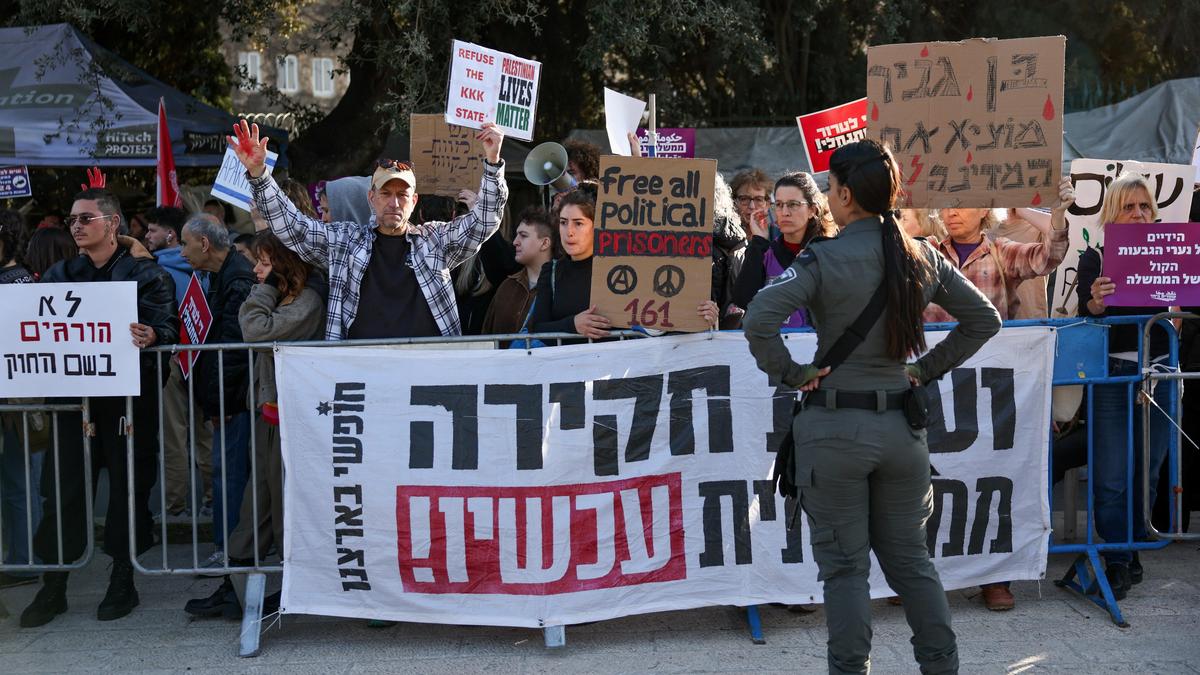
In March 2023, the Knesset passed a preliminary reading of a bill that changed the vibration in that room. It wasn't just another amendment. It was a declaration. The bill proposed the death penalty for "terrorists," but the definition of that word is where the story begins to fray at the edges. Under the proposed law, the ultimate price is reserved for those who intentionally or representatively harm the State of Israel as the national home of the Jewish people.
Think about that phrasing. It doesn't just criminalize an act. It criminalizes a motive tied to an identity.
The Invisible Scale
Imagine two men standing before a judge. Let’s call the first one Omar. He is a Palestinian from the West Bank. The second man, we’ll call Amit. He is an Israeli citizen. Suppose both are accused of a violent act that results in a loss of life. In a vacuum, a life is a life. A crime is a crime. But the law is never a vacuum.
Under this legislative framework, the scale isn't balanced. It’s weighted by the very definition of the state. If Omar’s actions are interpreted as a challenge to the "national home of the Jewish people," he faces the gallows. If Amit commits a similar act of ideological violence, he does not. The law, by its very design, creates a two-tiered reality where the ethnicity of the perpetrator and the perceived intent against a specific national identity determine whether they live or die.
The United Nations Committee on the Elimination of Racial Discrimination watched this unfold from afar, but their report wasn't just a list of grievances. It was a warning about the soul of a legal system. They saw a pattern. This isn't an isolated incident; it is a brick in a wall that has been rising for decades.
A Neighborhood of Divided Rules
To understand the weight of this, you have to look at the map—not the one in a textbook, but the one written in the dirt. In the West Bank, two different legal systems exist in the same physical space. An Israeli settler is governed by civil law. Their neighbor, a Palestinian, is governed by military law.
This is the "invisible stake" that the UN watchdog highlighted. When you introduce the death penalty into a landscape already fractured by systemic inequality, you aren't just punishing a crime. You are weaponizing the law.
The UN report pointed out that the 2018 Basic Law, which defines Israel as the "nation-state of the Jewish people," provides the ideological foundation for this disparity. It’s a document that tells one group they are the owners of the house and another group they are merely guests—guests whose stay can be revoked by a hangman’s knot if they step out of line.
The Psychology of the Ultimate Penalty
Death is different. You can't undo it. You can't offer a pardon to a ghost. When a state takes the power to execute, it assumes a level of infallibility that no human institution possesses. But when that power is filtered through a lens of racial and ethnic identity, it stops being about justice. It becomes about control.
Critics of the bill argue it’s a deterrent. They say it’s necessary for security. But history is a cruel teacher. It shows us that when the state targets a specific group with the ultimate punishment, it doesn't create peace. It creates martyrs. It deepens the resentment that fuels the very violence the law claims to stop.
The UN experts weren't just being bureaucratic when they expressed "deep concern." They were looking at the mechanics of discrimination. They noted that the law specifically targets "acts of terrorism" motivated by a desire to harm Israel as a Jewish state. This means a Palestinian attacking an Israeli for nationalist reasons faces death, while an Israeli attacking a Palestinian for nationalist reasons—even if the result is exactly the same—does not fall under the same terminal criteria.
Equality. It’s a word we use until it becomes inconvenient.
The Human Echo
Wait. Listen.
Beyond the legal jargon and the international reports, there are families. There is a mother in Hebron and a mother in Tel Aviv. Both fear the phone call in the middle of the night. Both want their children to grow up in a world where the law is a shield, not a sword.
But the sword is being sharpened.
The UN watchdog’s findings suggest that the Israeli government’s policies are increasingly moving toward a "permanent" state of discrimination. This isn't just about the death penalty. It’s about the demolition of homes. It’s about the restriction of movement. It’s about the Basic Law that prioritizes one identity over all others. The death penalty bill is simply the sharpest point of that trajectory.
Consider the reality of a military court. In these settings, conviction rates for Palestinians are staggeringly high. The protections that we take for granted in a civil trial—access to counsel, the right to see evidence, a jury of peers—are often muffled or absent. Now, imagine adding the death penalty to that specific environment. It is a recipe for a tragedy that cannot be retracted.
The international community watches this with a mixture of fatigue and alarm. The "watchdog" barked, but the caravan moved on. The bill passed its preliminary stage because it tapped into a primal desire for retribution. It’s easy to sell a "tough on terror" stance to a public that feels under siege. It’s much harder to explain that by eroding the principle of equal justice, you are actually undermining the foundation of the state itself.
The Weight of the Gavel
The law is a mirror. It reflects who we think we are and what we value. When a law says that one person's life is worth more—or that their crimes are more "terminal" based on their heritage—the mirror cracks.
We like to think of justice as a blindfolded woman holding scales. We want to believe she doesn't see the color of the skin or the language on the tongue. But in this narrative, the blindfold has been slipped. She is looking directly at the identity of the person in the dock. She is checking their ID card before she decides whether to drop the gavel or the trapdoor.
The UN report is a document of facts, but those facts are the coordinates of a human tragedy. They tell us that discrimination isn't just an abstract social ill. It is a legislative choice. It is a series of votes cast in a well-lit room that result in shadows being cast over thousands of lives.
If this law moves from a "preliminary reading" to a permanent reality, it won't just be a change in the penal code. It will be the moment the state officially decides that some people are more human than others.
The vibration in the courtroom continues. The machine hums. The gavel is raised. And in the silence that follows, we are forced to ask: once we start choosing who deserves to live based on who they were born to be, where does the choosing stop?
Justice doesn't die in a single moment. It dies in the small, quiet spaces between the lines of a bill, in the rooms where "us" and "them" are codified into the language of the executioner. The shadow of the gallows is long, and it covers everyone, whether they realize it yet or not.