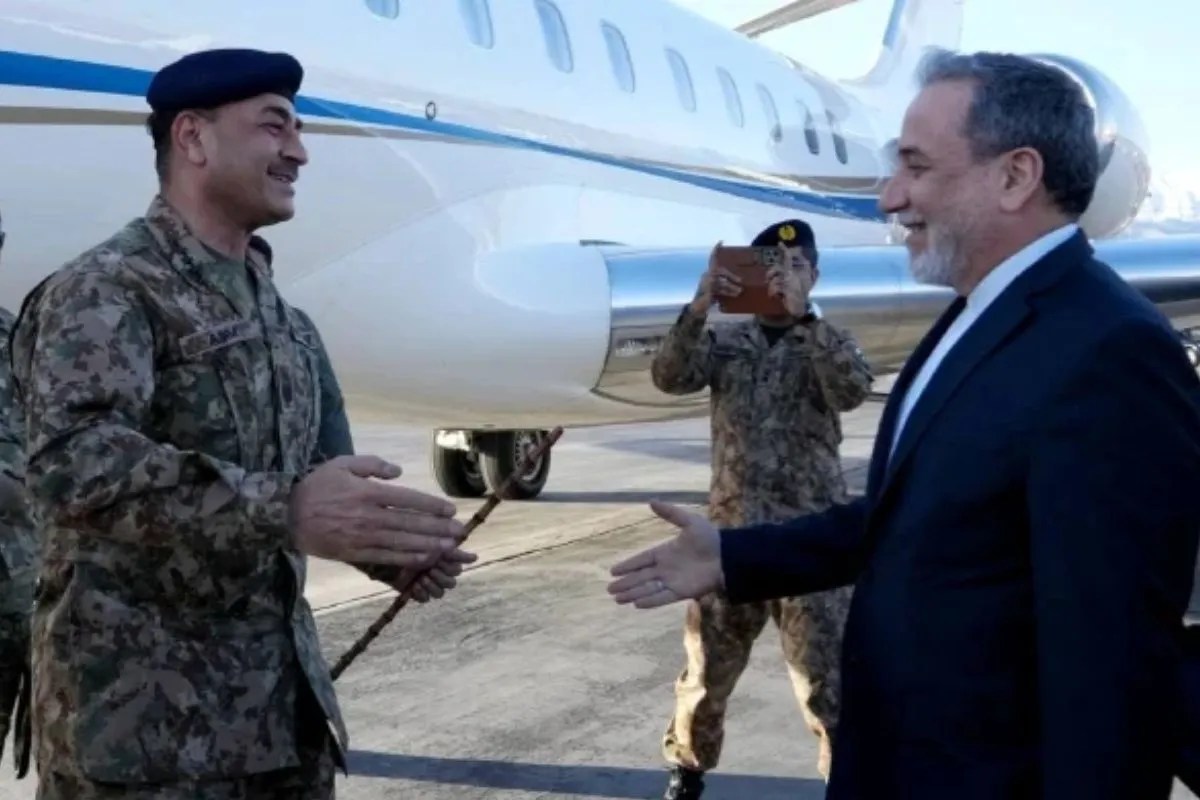
The arrival of Pakistan’s Chief of Army Staff, General Asim Munir, in Tehran represents far more than a routine diplomatic exchange between neighbors. While surface-level reports suggest a simple push for peace between the United States and Iran, the reality is a jagged web of survival, brinkmanship, and desperate economic necessity. Pakistan is not acting as a disinterested peacemaker. It is acting as a state squeezed between a crumbling domestic economy and the terrifying prospect of a cross-border spillover from a wider Middle East conflagration. The General’s mission is to ensure that as the U.S. and Iran negotiate their shadow war, Pakistan does not become the accidental floor mat for the conflict.
The timing is critical. Washington and Tehran have been engaged in back-channel communications for months, largely moderated by Oman and Qatar. However, Pakistan offers something those intermediaries cannot: a direct military-to-military perspective and a shared, porous border that serves as a pressure cooker for insurgent groups. Munir’s presence in the Iranian capital signals that the military establishment in Rawalpindi has decided to take the lead on a foreign policy file that the civilian government in Islamabad is too fragile to handle. Meanwhile, you can find other stories here: Shadows Against the Sanctuary.
The Secret Architecture of the Tehran Visit
The regional security apparatus is shifting. For decades, Pakistan played a delicate balancing act, maintaining deep military ties with Saudi Arabia while trying to avoid a direct confrontation with Iran. That balance was shattered by the recent exchange of missile strikes between Islamabad and Tehran, a brief but violent reminder of how quickly "brotherly" relations can dissolve.
General Munir is not in Tehran to talk about trade volumes or cultural exchanges. He is there to discuss the security architecture of the Sistan-Baluchestan border. This region has become a playground for Jaish al-Adl and various Baloch separatist groups. From the Pakistani perspective, an Iran that feels backed into a corner by U.S. sanctions and Israeli intelligence operations is an Iran that is more likely to lash out or ignore the movement of militants across the frontier. To understand the complete picture, check out the detailed article by Al Jazeera.
The "peace" being sought is not a grand bargain that solves the nuclear issue. It is a tactical de-escalation. Pakistan needs Iran to stay stable so that the multi-billion dollar China-Pakistan Economic Corridor (CPEC) projects—specifically those near the Gwadar port—remain viable. If Iran becomes a kinetic battlefield, the shockwaves will paralyze Pakistan’s western provinces, effectively killing the country’s last hope for foreign investment.
Why Washington is Watching Rawalpindi
The United States has a complicated relationship with the Pakistani military, but it recognizes the institution as the only reliable point of contact in a sea of political chaos. By facilitating or at least encouraging Munir’s outreach to Tehran, the U.S. gains a window into the Iranian military’s current mindset.
- Intelligence Sharing: Pakistan has a unique, albeit strained, vantage point into Iranian internal dynamics.
- Buffer Management: Washington wants to ensure that any potential escalation with Iran doesn't result in a total collapse of the Afghan-Pakistan border region, which is already a haven for the TTP (Tehrik-i-Taliban Pakistan).
- The Nuclear Shadow: As Iran edges closer to breakout capacity, the "Sunni bomb" narrative—the long-standing fear that Saudi Arabia might turn to Pakistan for nuclear tech—remains a background anxiety for Western planners.
The U.S. isn't looking for Pakistan to broker a treaty. They are looking for Pakistan to act as a containment wall. If Munir can convince the Iranian leadership that their regional proxies are creating a liability that Pakistan will no longer tolerate, it serves the American interest of isolating Tehran's influence without firing a shot.
The Economic Ghost in the Room
You cannot understand Pakistani foreign policy without looking at its empty treasury. The country is currently surviving on a series of life-support injections from the IMF and "rollover" loans from friendly Gulf nations. However, the Iran-Pakistan gas pipeline remains a massive, looming headache.
Iran has completed its side of the project. Pakistan, under heavy pressure from U.S. sanctions, has stalled for years. Tehran has recently signaled that it may take the matter to international arbitration, which could cost Pakistan billions in penalties—money it simply does not have. Munir's visit likely involves a desperate attempt to find a "security-for-delay" trade-off. If Pakistan can provide Iran with intelligence or border guarantees that help Tehran manage its domestic unrest, the Iranians might be persuaded to hold off on the legal onslaught regarding the pipeline.
The Balochistan Factor
Both nations face a common enemy in the Baloch insurgency. For Iran, it is a matter of sectarian and ethnic rebellion in its poorest province. For Pakistan, it is a threat to the sovereign integrity of its largest landmass.
There is a growing realization in both GHQ Rawalpindi and the Iranian Revolutionary Guard Corps (IRGC) that they have been played against each other. When they trade blows, the only winners are the separatist groups who find sanctuary in the chaos. Munir’s mission is to establish a hotline for rapid de-confliction. The goal is simple: no more "accidental" missile strikes that force both nations into a war neither can afford.
The China Variable
Beijing is the silent partner in this entire maneuver. China has a 25-year strategic agreement with Iran and a "higher than the mountains" friendship with Pakistan. They want a quiet neighborhood.
A conflict between Iran and Pakistan would be a catastrophic failure of Chinese diplomacy and a direct hit to their energy security. Reports from the ground suggest that Chinese diplomats have been leaning heavily on General Munir to bridge the gap with Tehran. China sees a trilateral security arrangement—Beijing, Islamabad, Tehran—as the ultimate counter-weight to U.S. influence in the Middle East and Central Asia.
However, this puts Pakistan in a bind. Moving too close to the China-Iran axis risks alienating the U.S. and the European Union, who remain Pakistan’s largest export markets. Munir has to play the role of the "honest broker" while everyone in the room knows he is carrying a heavy burden of debt and internal political instability.
The Limits of Military Diplomacy
We must be realistic about what a single general can achieve. While the Iranian leadership respects the hard power that Munir represents, they are also deeply suspicious of Pakistan’s history of siding with the West. The IRGC, which holds the real keys to Iran’s regional policy, views the Pakistani military as an entity that can be rented but never truly owned.
Furthermore, the domestic situation in Pakistan is a wildcard. A military chief traveling abroad to fix regional problems while the streets at home are simmering with inflation and political anger creates a disconnect. If Munir returns with nothing but vague promises of "cooperation," the trip will be seen as an expensive distraction.
The Hard Reality of the New Middle East
The old rules of the Middle East are dead. The Abraham Accords, the Saudi-Iran rapprochement brokered by China, and the ongoing war in Gaza have created a landscape where traditional alliances are fluid. Pakistan is trying to find its footing in this shifting sand.
By engaging Tehran now, Munir is signaling that Pakistan will not be a passive spectator in the reshuffling of regional power. He is asserting that Pakistan is a stakeholder, not just a transit point. This is a high-stakes gamble. If he succeeds, he secures the western border and potentially avoids a multi-billion dollar legal disaster. If he fails, he leaves Pakistan more isolated than ever, caught in the crossfire of a struggle between an aging Islamic Republic and a hesitant American superpower.
The success of this visit will not be measured by the photos of handshakes or the generic press releases issued by the Inter-Services Public Relations (ISPR). It will be measured in the silence of the border. If the IEDs stop exploding in Sistan and the missiles stay in their silos, we will know the General made a deal. If the violence continues, it means the rift between these two neighbors is now too deep for even the most powerful military man in Pakistan to bridge.
The stakes involve the survival of a nuclear-armed state trying to navigate an era where its traditional patrons are distracted and its neighbors are increasingly aggressive. Munir is fighting for time. In the world of high-stakes geopolitics, time is the only currency that matters when your bank account is empty.
Pakistan has spent decades looking toward the sunset of Western aid; now, it is being forced to look at the sunrise of a much more complicated, multi-polar reality. The road to Washington may now, ironically, run through Tehran.