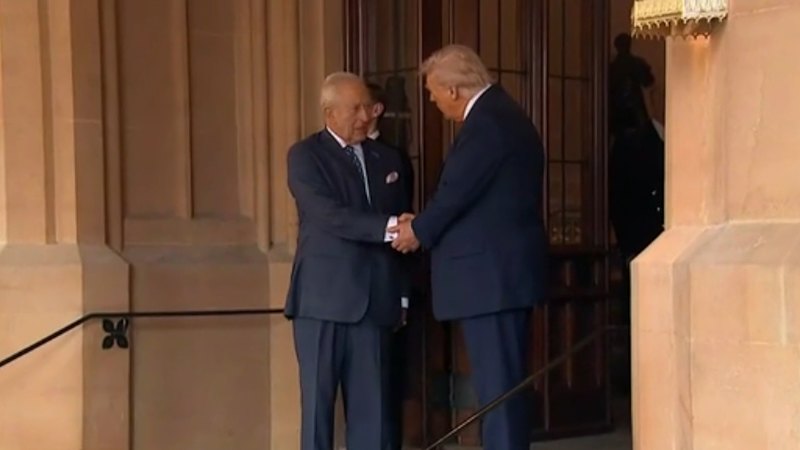
The British Sovereign's visit to Washington functions as a high-stakes diplomatic instrument designed to repair structural fissures in the Special Relationship that have widened since 2016. While media narratives often prioritize the optics of the state dinner or the personal rapport between the King and the President, a rigorous analysis reveals this visit is an exercise in soft power deployment to mitigate the "Brexit Discount" in U.K. foreign policy. The objective is the stabilization of the Transatlantic Security Architecture through three distinct vectors: defense interoperability, green energy standardization, and the maintenance of the Five Eyes intelligence hierarchy.
The Constitutional Constraints of the Royal Diplomatic Function
The British monarch operates under a strict "Advise, Encourage, and Warn" mandate. In the context of a Washington visit, this translates into a role as a non-partisan facilitator of continuity. Because the King sits above the electoral cycle, his presence acts as a hedge against the volatility of Westminster politics. This creates a "Stabilization Premium" for U.S. policymakers who may be wary of the rapid turnover of British Prime Ministers.
The mechanism of this influence is not legislative but atmospheric. The King provides a neutral platform for high-level "backchannel" negotiations where ministers and secretaries of state can engage without the immediate pressure of a joint communique. The efficacy of this visit must be measured by the subsequent alignment of U.K.-U.S. policy on the AUKUS pact and the synchronization of carbon-accounting standards, rather than the length of the handshake on the South Lawn.
The Three Pillars of the Strategic Reset
The friction in the Anglo-American relationship is not personal; it is structural. To address this, the visit targets three specific friction points that have degraded the bilateral efficiency over the last decade.
1. The Security and Intelligence Synchrony
The U.K.’s primary value proposition to the United States is its status as a "Tier 1" military power and a foundational member of the Five Eyes. However, divergent approaches to integrated technology and cybersecurity have created bottlenecks.
- The Intelligence Asymmetry: The U.S. has increasingly looked toward the "Indo-Pacific Tilt," demanding that the U.K. demonstrate its relevance outside the European theater.
- AUKUS Integration: This visit serves as a symbolic ratification of the submarine technology-sharing agreement. The King’s role is to signal that the British state’s commitment to this 30-year project is absolute, regardless of which party holds the keys to 10 Downing Street.
2. Economic Alignment and the FTA Deficit
The failure to secure a comprehensive U.K.-U.S. Free Trade Agreement (FTA) post-Brexit remains a significant strategic vulnerability for London. While the King cannot negotiate trade terms, he can address the "Regulatory Drift" that threatens to decouple the two economies.
- Sectoral Agreements: The strategy has shifted from a "Grand Bargain" to a series of modular agreements. The King's meetings with U.S. business leaders are designed to facilitate investment in the U.K.’s life sciences and AI sectors, framing Britain as the "Sand Hill Road of Europe."
- The Atlantic Declaration: This visit reinforces the framework of the 2023 Atlantic Declaration, focusing on critical minerals and supply chain resilience. The goal is to ensure the U.K. is not excluded from the subsidies provided by the U.S. Inflation Reduction Act.
3. The Soft Power Diversification
The monarchy is the U.K.'s most potent brand asset. In a period where British hard power is constrained by fiscal austerity, the King’s "Convener-in-Chief" status is used to bridge gaps in environmental policy.
- The Green Finance Vector: By leveraging his decades of environmental advocacy, the King can engage with U.S. stakeholders on climate finance—a rare area of bipartisan potential.
- Commonwealth Continuity: For the U.S., the U.K.’s leadership of the Commonwealth offers a diplomatic reach into the Global South that Washington often struggles to replicate. The King’s visit reinforces this "Gateway" function.
Quantifying the Diplomacy of Statecraft
The impact of a royal visit is often dismissed as intangible, yet it follows a specific "Diplomatic Multiplier" effect. We can categorize the utility of the Washington mission through the following logical framework:
The Influence Matrix of the State Visit
| Objective | Mechanism | Expected Outcome |
|---|---|---|
| Institutional Trust | Multi-generational continuity of the Crown | Reduced risk perception for long-term U.S. defense contracts |
| Market Access | High-level networking with CEOs/Investors | Capital inflow into U.K. tech hubs (Oxford-Cambridge Arc) |
| Geopolitical Weight | Joint focus on global security (Ukraine/Middle East) | Reaffirmation of the "Special Relationship" as a functional reality |
This matrix illustrates that the King is not a participant in the "game" of politics, but rather the "stadium" in which the game is played. By providing the venue and the prestige, the monarchy lowers the transaction costs of high-level diplomacy.
Identifying the Strategic Bottlenecks
Despite the choreographed nature of the visit, several variables could impede a successful "reset." The primary friction point is the Northern Ireland Protocol and its successor, the Windsor Framework. While the U.S. administration has signaled approval of recent progress, any perceived instability in Belfast creates a "Political Tax" on U.K.-U.S. relations.
Furthermore, the "Middle Power Trap" looms over the U.K. As the U.S. focuses on its systemic rivalry with China, the U.K. must prove it is a necessary partner rather than a junior dependent. If the King’s visit is seen purely as a nostalgia tour, it fails. To succeed, it must be perceived as a forward-looking partnership focused on the "Frontier Technologies" that will define the 21st-century economy.
The Cost Function of Diplomatic Absence
The risk of not conducting this visit is the continued "Provincialization" of the U.K. In the absence of high-level royal engagement, the U.K. risks being grouped with other mid-sized European powers in the eyes of the U.S. State Department. The royal visit re-establishes the "Exclusivity Premium." It reminds the American public and political class that the U.K. possesses a unique cultural and historical link that no other ally can replicate.
This creates a "Defense in Depth" for British interests. Even when policy disagreements occur—such as differences in approach to trade with China or agricultural standards—the underlying cultural bond acts as a shock absorber, preventing a total breakdown in communication.
Operationalizing the Royal Visit for Economic Gain
The U.K. government must now capitalize on the "Aura of Stability" generated by the King. This requires a three-step tactical follow-up:
- The Legislative Pivot: Immediately following the visit, the U.K. must advance specific, narrow trade memoranda in areas like data privacy and professional qualifications to maintain the momentum of the Atlantic Declaration.
- The Intelligence Audit: Senior U.K. defense officials must use the "Royal Afterglow" to push for deeper integration in the next generation of fighter jet technology (the Global Combat Air Programme) and AI-driven surveillance.
- The Investment Roadshow: The Department for Business and Trade must deploy a follow-up delegation to the U.S. to target the specific investors who met with the King, converting the social capital of the royal visit into hard capital commitments for British infrastructure.
The success of the mission hinges on moving beyond the "Sentimentality of History." The U.S.-U.K. relationship is currently a marriage of convenience based on shared threats and integrated markets. The King’s role is to provide the "Social Glue" that makes this hard-nosed cooperation palatable to the voting publics of both nations.
The strategic play is to utilize the King as a "Permanent Ambassador" who transcends the noise of the news cycle. By grounding the relationship in the institution of the Crown, the U.K. secures a seat at the table in Washington that is not dependent on the shifting winds of the next U.S. election. This is not a mission of sentiment; it is a mission of survival in a post-globalization world where mid-sized powers must fight for relevance in a bipolar system.