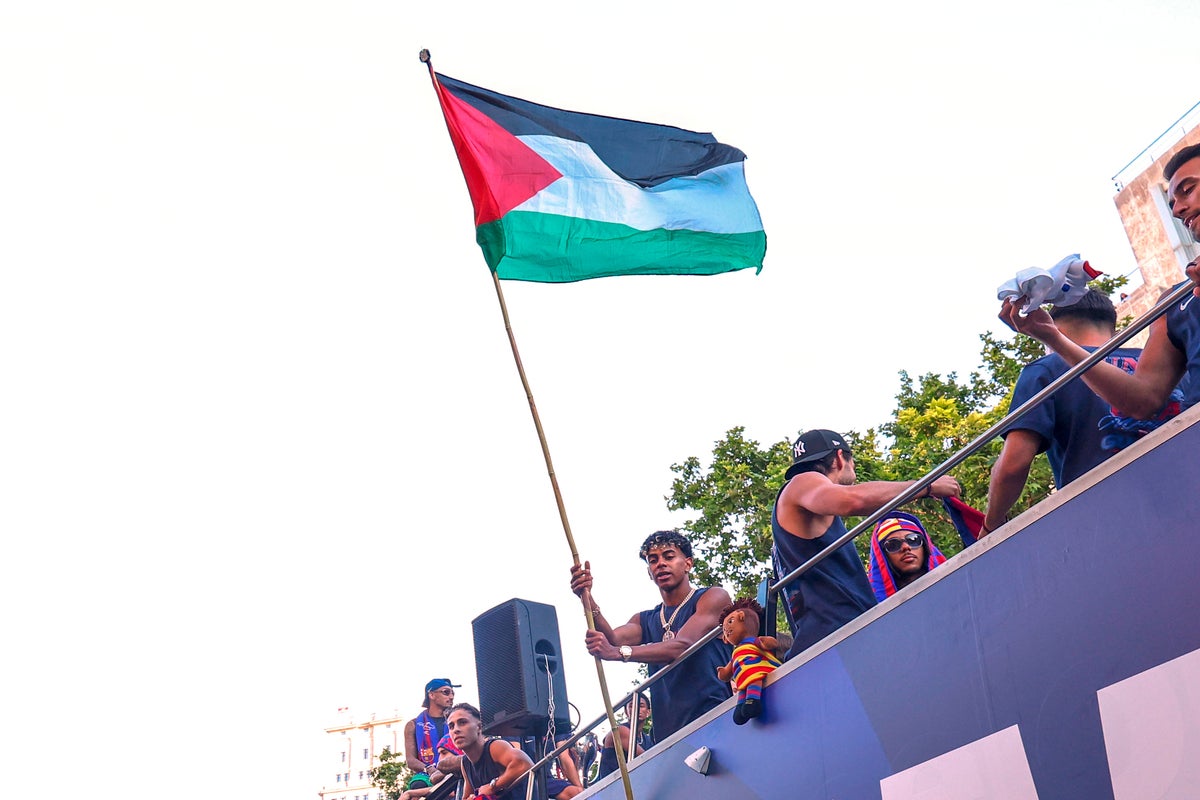
The intersection of elite athletic performance and geopolitical signaling creates a high-velocity feedback loop where a single gesture can bypass traditional diplomatic channels to reach hundreds of millions. When Lamine Yamal, a cornerstone of FC Barcelona and the Spanish national team, integrated a Palestinian flag into a victory celebration, he triggered a collision between three distinct systems: private athletic branding, national identity politics, and the volatile regulatory framework of international football. This event functions as a case study in the breakdown of the "neutrality myth" in professional sports.
The Tri-Pillar Framework of Symbolic Friction
To analyze the reaction from Israeli government officials and the subsequent media cycle, we must categorize the conflict into three structural pillars.
1. The Jurisdiction of the Gesture
The primary tension exists between the athlete's personal agency and the institutional regulations of FIFA and UEFA. Under Law 4 of the IFAB Laws of the Game, equipment must not have any political, religious, or personal slogans, statements, or images. However, enforcement is non-linear. The "pitch" is legally defined as a zone of enforced neutrality, yet the "post-match celebration" exists in a regulatory gray area. When a minister from a sovereign state intervenes to "blast" an athlete, they are attempting to exert extraterritorial jurisdiction over a private individual’s expression within a non-governmental sporting body.
2. The Demographic Leverage of Gen Z Icons
Lamine Yamal represents a specific demographic threat to traditional state-led narratives. As a minor—or young adult depending on the specific timing of the footage—possessing a global digital footprint, his actions carry disproportionate weight with a generation that views traditional media with skepticism. For the Israeli ministry, the critique of Yamal is an attempt to mitigate "narrative contagion." The speed at which a visual of a high-value athlete with a Palestinian flag scales on social media exceeds the speed of official government rebuttals.
3. The Cultural Hybridity Variable
Yamal’s background—born in Spain to Moroccan and Equatorial Guinean parents—adds a layer of identity complexity. His visibility makes him a proxy for larger Mediterranean and North African sentiments. A gesture from a player of his profile isn't merely an individual act; it is perceived by state actors as a representative signal from the wider diaspora and the youth of the Global South.
Quantifying the Backlash Mechanism
The "blast" from the Israeli minister was not a random emotional outburst but a calculated move within the framework of Public Diplomacy (Hasbara). This response follows a predictable three-stage sequence designed to create a cost-function for political expression in sports.
- Stage 1: Moral Reframing. The minister’s rhetoric shifts the focus from the flag itself to the "appropriateness" of the setting. By framing the gesture as a violation of sportsmanship or an endorsement of specific political entities, the state seeks to narrow the definition of acceptable conduct.
- Stage 2: Institutional Pressure. By publicly calling out the athlete, the government signals to the club (FC Barcelona) and the league (La Liga) that the athlete is becoming a liability. This targets the commercial interests of the sponsors who fear alienating specific market segments.
- Stage 3: Precedent Setting. The goal is to establish a "chilling effect." If a star of Yamal’s caliber faces high-level diplomatic condemnation, lower-profile athletes are less likely to engage in similar signaling, fearing for their career trajectories or endorsement deals.
The Failure of the Neutrality Doctrine
International sports organizations have long operated under the pretense that sport is a vacuum, isolated from global conflict. This doctrine is failing due to the Hyper-Visibility of the Individual.
In previous decades, a player’s political stance was filtered through team captains or official club statements. Today, the direct-to-consumer nature of an athlete’s brand allows them to bypass these gatekeepers. When Yamal waves a flag, he is utilizing his personal platform, which often has higher engagement metrics than the clubs themselves.
This creates a Governance Vacuum. Organizations like FIFA find themselves in an impossible position:
- Sanction the player: Risks a massive backlash from the player's fanbase and the Middle Eastern market.
- Ignore the gesture: Risks accusations of bias from the Israeli government and Western political allies, leading to potential loss of corporate sponsorships.
The "cost of silence" for the athlete has plummeted, while the "cost of policing" for the organization has skyrocketed.
Strategic Divergence in Communication
The Israeli minister’s critique highlights a fundamental gap in how political communication is received. To the state, the flag is a hard-power symbol associated with specific territorial claims and security threats. To the athlete and a large portion of his audience, the flag is a soft-power symbol of humanitarian solidarity.
This creates a Semantic Disconnect. The minister’s "blast" uses the language of security and violation, while the athlete’s supporters use the language of human rights and identity. Because these two groups are using different dictionaries, the conflict cannot be resolved through dialogue; it can only be "managed" through brand containment or PR pivoting.
The Feedback Loop of Controversy
The outcry often produces the inverse of the intended effect. In the digital economy, high-profile condemnation acts as a Discovery Engine.
- Initial Event: A localized gesture on a pitch.
- Reaction: Diplomatic condemnation.
- Amplification: Global media coverage of the "blast."
- Resolution: The original image of the flag-wave reaches 10x the audience it would have reached had the minister remained silent.
This suggests that the "blasting" of athletes is less about changing the athlete's mind and more about "In-Group Signaling"—demonstrating to a domestic Israeli constituency that the government is actively defending its narrative on the world stage.
The Operational Risk for FC Barcelona
FC Barcelona operates as a "Més que un club" (More than a club) entity, which historically prides itself on political identity (Catalanism). However, the Yamal incident forces a collision between their local political heritage and their global commercial requirements.
The club must now calculate the Asset Depreciation Risk. If Yamal becomes a "political" figure, his marketability in certain regions may fluctuate. Conversely, if the club muzzles him, they risk alienating their core demographic and the player himself, who is the club’s most valuable sporting asset. The management of this tension requires a sophisticated "neutralization strategy" where the club likely advises the player to move his advocacy to social media—where the club has less liability—rather than the field of play.
Predictive Modeling of Athletic Advocacy
The Yamal incident is not an outlier; it is the new baseline for elite sports. We are witnessing the shift from Passive Representation (the player as a symbol of the club) to Active Signaling (the player as a sovereign political actor).
Future conflicts of this nature will likely be governed by:
- Contractual Morality Clauses: Expect a tightening of language in elite contracts that specifically defines "geopolitical signaling" as a breach of conduct.
- AI-Driven Sentiment Monitoring: Real-time analysis of crowd reactions and social media sentiment will allow clubs to "intervene" with PR scripts before a minister even has time to issue a statement.
- The Rise of Sovereignty-as-a-Service: High-net-worth athletes will increasingly hire independent geopolitical consultants to navigate these moments, ensuring their gestures maximize impact while minimizing legal and commercial exposure.
Athletes who successfully navigate this will become more than just icons; they will function as independent nodes in global diplomacy. The Israeli minister’s reaction confirms that the state now views the individual athlete not just as an entertainer, but as a legitimate geopolitical competitor for the hearts and minds of the global public.
Professional sports organizations must move beyond the "no politics" rule, which is functionally dead, and toward a "managed advocacy" model. This involves creating designated spaces for expression that satisfy the athlete’s need for agency while protecting the organization’s commercial interests from state-level interference. Failure to adapt to this reality will result in constant, reactive crisis management that degrades the value of the sporting product.