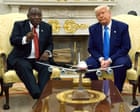
The tension between Pretoria and Washington has reached a boiling point over a proposed American policy to grant refugee status to white South African farmers. President Cyril Ramaphosa has denounced the move as "racist" and a distortion of the ground reality in a country still healing from its fractured past. This is not merely a spat over immigration. It is a fundamental clash over who defines "persecution" in the post-apartheid era and whether the United States is prepared to risk its diplomatic standing in Africa to satisfy a specific domestic political base.
For years, the narrative of "white genocide" in South Africa has simmered in the background of international discourse. It usually lives in the darker corners of social media, but it has now migrated to the highest offices of American power. When a U.S. administration signals that it might open the doors to a specific ethnic group based on the premise that they are being systematically targeted for their skin color, it isn't just a policy change. It is an indictment of the South African state.
The Numbers Behind the Noise
To understand why the South African government is so incensed, one must look at the data that Pretoria uses to defend its record. The Department of Home Affairs and the South African Police Service (SAPS) maintain that crime in South Africa is an equal-opportunity predator. While farm attacks are a brutal reality, the government argues they are motivated by robbery and the remote nature of the properties, rather than a coordinated racial purge.
According to recent SAPS figures, the murder rate in South Africa remains among the highest in the world, with over 27,000 people killed annually. However, the vast majority of these victims are black South Africans living in impoverished townships. In the 2022/2023 reporting period, SAPS recorded 71 murders on farms. While every death is a tragedy, the South African government uses these figures to argue that white farmers are actually statistically safer than many residents of Nyanga or Khayelitsha.
When the U.S. proposes a "refuge" policy, it effectively ignores these broader statistics. It suggests that the threat to one group is so unique and state-sanctioned that it requires international intervention. This is where the "racist" label from Ramaphosa originates. He sees a double standard where the plight of millions of black South Africans living in violent crime hotspots is ignored, while the concerns of a historically privileged minority are elevated to a matter of American national interest.
The Land Question and the Threat of Expropriation
At the heart of this diplomatic rift is the "Expropriation Without Compensation" (EWC) policy. The African National Congress (ANC) has long promised to redistribute land to rectify the imbalances left by the 1913 Land Act and the subsequent decades of apartheid. Progress has been agonizingly slow. Today, roughly 72% of private farmland is still owned by white South Africans, who make up less than 10% of the population.
The American proposal for asylum often cites EWC as evidence of "state-sponsored theft" or a precursor to violence. They point to Zimbabwe’s chaotic land reform in the early 2000s as the inevitable roadmap for South Africa. However, the legal reality in South Africa is far more complex. The constitution remains a formidable barrier to arbitrary seizure. Every attempt to amend Section 25—the property clause—has been met with fierce parliamentary debate and judicial scrutiny.
Critics of the U.S. stance argue that by offering asylum now, Washington is jumping the gun. They are treating a domestic legislative debate as if it were a finished act of ethnic cleansing. For the ANC, this feels like an intervention designed to sabotage their most significant, if controversial, tool for social justice. It creates a feedback loop where the threat of land reform drives the narrative of persecution, which then fuels the call for American refuge.
The Mechanics of Asylum
How would such a policy even work? Under standard U.S. immigration law, a refugee must prove a "well-founded fear of persecution based on race, religion, nationality, membership in a particular social group, or political opinion." Usually, this is an individual assessment. A blanket policy for Afrikaners would be an anomaly in modern American statecraft.
- The Individual vs. The Group: Normally, a farmer would have to prove that the South African government is either actively attacking them or is "unable or unwilling" to protect them.
- The Burden of Proof: Providing evidence of state negligence is difficult when the state is actively prosecuting farm attackers, even if the conviction rates are low.
- The Precedent: If the U.S. grants asylum to Afrikaners based on high crime rates and land reform debates, it opens the door for similar claims from dozens of other countries facing civil unrest or redistributive policies.
The Geopolitical Fallout
South Africa is the most industrialized economy on the continent and a key member of BRICS. It sees itself as a leader of the Global South. When the U.S. takes a position that Pretoria deems offensive, South Africa doesn't just lodge a complaint; it pivots. We have already seen this with South Africa’s stance on the conflict in Ukraine and its legal challenges against Israel at the International Court of Justice.
Every time Washington leans into a policy that can be framed as "Western interference" or "pro-white bias," it loses leverage in Pretoria. China and Russia are more than happy to fill that vacuum. They don't ask about land reform. They don't offer asylum to minorities. They offer infrastructure loans and military exercises.
The U.S. State Department is likely terrified of this asylum proposal. Career diplomats know that the optics of such a move are disastrous for American-African relations. It reinforces the "Fortress Europe" and "White West" stereotypes that Russian propaganda outlets like RT and Sputnik use to alienate African leaders from Washington.
The Reality on the Ground
If you walk the streets of Stellenbosch or the suburbs of Pretoria, you don't see a community in the throes of a refugee crisis. You see a community that is deeply anxious, yes, but also deeply rooted. Many Afrikaners have no interest in moving to rural midwest America or the suburbs of Perth. They have been in Africa for nearly 400 years. Their language, their religion, and their identity are tied to the soil of the Karoo and the Highveld.
The "refuge" offered by the U.S. might appeal to a small, vocal minority, but for many, it is seen as an insult to their commitment to staying and building a "Rainbow Nation" that actually works. There is a sense of "pre-emptive mourning" in the Afrikaner community—a fear that their culture is being erased—but that is a far cry from the legal definition of being a refugee.
The Economic Consequences of the Narrative
Perception is reality in the world of foreign direct investment. When a major world power suggests that a country is no longer safe for a specific group, investors take notice. The mere talk of an asylum policy can trigger capital flight. If farmers believe their land will be seized and they have an "out" in the U.S., they stop investing in their crops. They stop maintaining their equipment.
This leads to a self-fulfilling prophecy. A decline in agricultural productivity leads to food insecurity. Food insecurity leads to social unrest. Social unrest leads to the very violence the asylum policy was supposed to protect people from. The American proposal, intended or not, acts as a destabilizing force on the South African economy.
Strategic Alternatives for Washington
Instead of offering a "racist" escape hatch, the U.S. could exert influence through more traditional diplomatic and economic channels. If Washington is truly concerned about the safety of farmers and the stability of property rights in South Africa, there are better ways to engage.
- Technical Assistance: Provide funding and training for rural safety initiatives that benefit all rural residents, not just white farmers.
- Trade Leverage: Use the African Growth and Opportunity Act (AGOA) as a carrot to ensure that land reform remains within the bounds of the rule of law.
- Bilateral Security Cooperation: Enhance intelligence sharing to combat the organized crime syndicates that often orchestrate farm raids.
By choosing the asylum route, the U.S. is opting for a blunt instrument where a scalpel is required. It is a move that prioritizes a domestic political "win" over long-term strategic stability in the most important country in sub-Saharan Africa.
The South African government’s reaction is not just about hurt feelings. It is a calculated defense of their sovereignty. They are telling the world that South Africa’s problems—as deep and systemic as they are—will be solved in Pretoria and Cape Town, not in Washington D.C. Any attempt to bypass the South African state by categorizing its citizens as refugees will be met with a cold, hard "no."
For the Afrikaner farmer, the choice isn't between staying and fleeing to America. The choice is between isolation and integration. The U.S. policy encourages the former, while the future of South Africa depends entirely on the latter. Washington would do well to remember that in the game of global influence, being a "refuge" for a few is often less valuable than being a partner to many.
Check the current status of the AGOA trade agreement to see how these diplomatic tensions are already impacting South African exports.