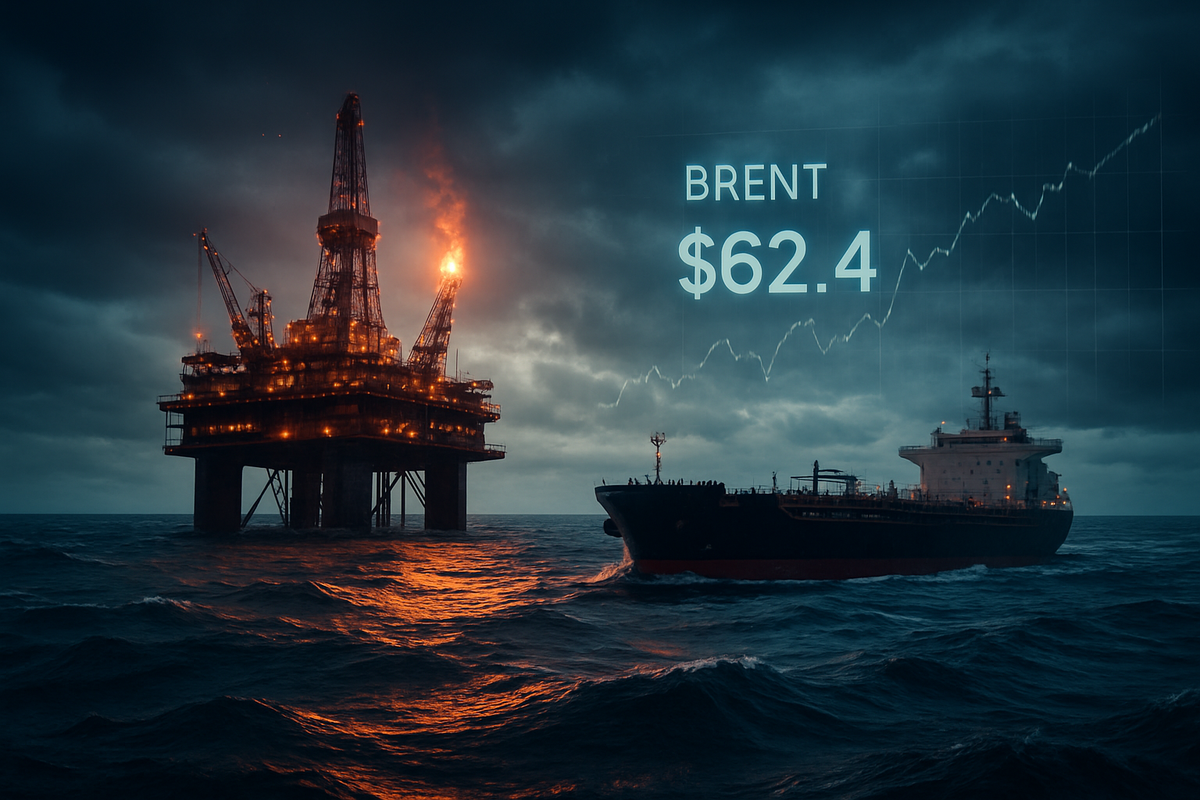
Brent crude has surged past the $114 mark as the White House intensifies its rhetoric against Tehran, signaling a shift from cautious containment to active economic pressure. This price spike reflects more than just a momentary fear of supply disruptions in the Strait of Hormuz. It is the result of a thinning global supply cushion and a series of calculated political gambles that have left the energy market vulnerable to even the slightest hint of conflict. While the headlines focus on the immediate threat of a "new" standoff, the underlying reality is that the global energy infrastructure has been trending toward this volatility for years.
The Fragility of the Global Buffer
Market observers often point to the raw production numbers when explaining price hikes, but the real story lies in spare capacity. Right now, that capacity is dangerously low. When a major player like the United States issues direct threats against one of the world’s largest oil producers, the market doesn't just react to the possibility of lost Iranian barrels. It reacts to the realization that there is no one else capable of making up the difference quickly.
Saudi Arabia and the UAE hold the only meaningful reserves of shut-in production. However, tapping into those reserves is not as simple as turning a faucet. It requires weeks of technical preparation and, more importantly, a political willingness to bail out Western consumers. Currently, that willingness is at an all-time low. Riyadh has shown a clear preference for maintaining higher price floors to fund its domestic diversification projects, meaning the "cavalry" isn't coming to save the $100 barrel anytime soon.
Why Sanctions Alone No Longer Dictate the Price
In previous decades, a threat of sanctions would lead to a predictable drop in Iranian exports. That era is over. Tehran has spent the last ten years perfecting a "ghost fleet" of tankers and a network of clandestine financial channels that allow its oil to reach buyers in Asia, primarily China, regardless of what is said in Washington.
The current rally to $114 is driven by the fear that the next phase of this conflict won't be limited to paper sanctions. If the rhetoric translates into physical interdiction of tankers or strikes on energy infrastructure, the "risk premium" currently baked into the price will look like a rounding error. Traders are now hedging against a total blockage of the Strait of Hormuz, a waterway that handles roughly 20% of the world’s petroleum consumption.
The Refined Product Crunch
While the world watches the price of crude, the real pain for the global economy is felt at the refinery level. We are currently facing a structural shortage of refining capacity. Even if a magical surplus of crude appeared tomorrow, the world lacks the specialized facilities to turn that heavy, sour Iranian-style crude into the diesel and jet fuel that keep modern logistics moving.
- Investment Gap: For the last seven years, capital has fled the traditional oil and gas sector in favor of renewable projects.
- Maintenance Backlogs: Post-pandemic demand surged before refineries could complete essential overhauls, leading to frequent unplanned outages.
- Geographic Shifts: New refining capacity is coming online in the Middle East and Asia, far from the consumption centers in Europe and North America, adding thousands of miles of shipping costs to every gallon.
The China Factor
Beijing remains the silent partner in this escalating tension. As the largest importer of Iranian crude, China has a vested interest in keeping those barrels flowing. Any American attempt to physically stop those shipments would move the conflict from a regional spat to a direct confrontation between the world's two largest economies.
The market is beginning to price in this "Great Power" friction. If the U.S. enforces a total secondary sanction regime on Chinese banks that facilitate Iranian oil trades, the resulting shock to the global financial system would dwarf the direct impact of the oil price itself. This is the "hidden" threat that keeps institutional investors awake at night. They aren't just worried about $5 gasoline; they are worried about the total seizure of global credit markets.
Speculators and the Feedback Loop
We must also look at the role of managed money. Hedge funds and algorithmic trading platforms have piled into long positions, betting that the price will continue to climb. This creates a self-fulfilling prophecy. As the price nears $115, technical triggers force more buying, which pushes the price even higher, regardless of the physical supply-demand balance on the ground.
These algorithms are programmed to respond to keywords in political speeches. When a "threat" is issued, the machines buy. This removes the human element of nuance from the price discovery process. It is no longer about whether Iran will close the Strait; it is about the fact that the possibility was mentioned in a press release.
The Myth of Energy Independence
There is a common misconception that the United States is insulated from these shocks because it is a net exporter of petroleum. This is a fundamental misunderstanding of how a global commodity works. Oil is priced on a global market. A barrel of West Texas Intermediate (WTI) will follow the price of Brent Crude because if Brent is expensive, European and Asian buyers will bid up the price of American oil until they are equal.
American producers are also not in a position to "drill, baby, drill" their way out of this crisis. Wall Street has demanded capital discipline. After a decade of burning through cash to grow production, shale companies are now focused on returning dividends to shareholders and paying down debt. They are not going to ruin their balance sheets by chasing a short-term price spike triggered by a geopolitical event.
The Logistics of a Blockade
If we move beyond rhetoric and into actual kinetic conflict, the numbers become staggering. A full disruption in the Persian Gulf would remove approximately 18 million barrels per day from the market.
To put that in perspective, during the 1973 oil embargo, the world lost about 4 million barrels per day, and prices quadrupled. In today's interconnected, "just-in-time" economy, a loss of 18 million barrels would not just raise prices; it would lead to physical shortages and rationing in many parts of the developing world. The $114 we see today is the market's way of screaming that the margin for error has disappeared.
The Role of Strategic Reserves
The U.S. Strategic Petroleum Reserve (SPR) is currently at its lowest level in decades. While the administration used these reserves effectively to blunt the impact of the Russia-Ukraine conflict, that tool is now largely spent. Refilling the SPR requires buying oil, which adds even more demand to an already tight market.
This leaves the West with very few levers to pull. You cannot tweet your way to a lower oil price when the physical tanks are empty and the diplomatic relationships with producers are frayed.
Inflation and the Central Bank Dilemma
Central banks around the world were already struggling to bring inflation back to their 2% targets. A sustained oil price above $110 makes that goal virtually impossible. Energy costs are the "tax" that affects every other sector. It costs more to grow food, more to ship goods, and more to heat homes.
If energy prices remain at these levels, the Federal Reserve and the ECB will be forced to keep interest rates higher for longer to combat the resulting inflation. This increases the risk of a hard landing—a significant economic recession. We are witnessing a pincer movement where geopolitical tension on one side and monetary tightening on the other are squeezing the global consumer.
The Shift Toward a Permanent Risk Premium
We have entered a period where the "peace dividend" of the 1990s and 2000s has been completely erased. For a long time, the market assumed that global trade was too important for any one actor to disrupt. That assumption is dead.
The current rally is a recognition that energy is being used as a primary weapon of statecraft. Whether it is gas pipelines in Europe or tanker routes in the Middle East, the infrastructure of the old world is now a target. This creates a permanent floor for prices. Even if the current tension with Iran cools tomorrow, the memory of $114 will remain, and investors will demand a higher price to account for the certainty that another crisis is just around the corner.
The volatility is the point. By keeping the West on edge, producers and regional powers gain leverage that they wouldn't have in a stable, $60-a-barrel world. This is the new structural reality of the energy market. It is a world where a single speech can wipe out billions in economic value, and where the "free market" is increasingly a captive of the evening news cycle.
The focus must now shift away from the $114 number itself and toward the durability of the systems that are supposed to prevent it from reaching $150. If the primary response to high prices is more rhetoric and fewer diplomatic channels, the ceiling for crude oil is much higher than anyone is currently willing to admit. High prices are not the problem; they are the symptom of a global order that has lost its ability to manage its most vital resource.