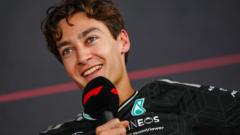
George Russell has spent years playing the long game. He waited three seasons at a struggling Williams team for a seat that felt like his birthright. Then he spent another three years as the "apprentice" to the greatest statistical driver in the history of Formula 1. Now, Lewis Hamilton is heading to Ferrari, and the Silver Arrows are finally showing signs of life. The timing isn't just a coincidence. It’s a shift in the tectonic plates of the paddock. Russell isn't just another fast driver on the grid anymore. He's the undisputed leader of a team that looks like it’s finally figured out the ground-effect era.
If you’ve watched Russell closely, you know he’s rarely lacked pace. What he lacked was a car that didn't try to throw him into a barrier every time he breathed on the throttle. The early W13 and W14 models were nightmares of engineering—bouncing, unpredictable, and frankly, slow compared to the Red Bull rocket ship. But the W15 and its subsequent evolutions have changed the math. Mercedes has transitioned from a team "searching for a direction" to a team that’s actively winning races on merit. For Russell, that means the excuses are gone. The "elite" tag isn't something he’s waiting for. It’s something he’s currently proving.
The Myth of the Number Two Driver
For a long time, the narrative around Russell was that he was merely keeping the seat warm until Hamilton retired or moved on. People pointed to his occasional high-pressure errors—Singapore 2023 comes to mind—as proof that he wasn't ready to carry the weight of a championship-winning organization. That’s a lazy take. Look at the qualifying head-to-head stats. Look at his ability to pull a lap out of nowhere when the car is objectively a handful. Russell has been out-qualifying a seven-time world champion with startling regularity.
Being a "leader" in a team like Mercedes doesn't just mean being the fastest guy on Sunday. It means being the one who spends twelve hours in the simulator on a Tuesday night because the front-end grip felt "vague" in Sector 2. Toto Wolff has been vocal about Russell’s technical feedback. He doesn't just say the car is bad. He explains exactly where the aero map is failing. That’s the difference between a "hot shoe" and a franchise driver. With Hamilton’s exit, the political center of gravity at Brackley has shifted entirely toward Russell’s side of the garage.
Why the W15 Turnaround Changes Everything
Mercedes spent two years in a technical wilderness. They chased a "zero-pod" concept that looked cool in a wind tunnel but felt like a pogo stick on a real track. When they finally ditched it, they didn't just copy Red Bull. They built a platform that actually rewards aggressive driving. Russell is an aggressive driver. He likes a car that he can lean on.
- Front-end Authority: The current Mercedes development path has prioritized a more stable front wing. This allows Russell to carry more speed into the apex without the mid-corner snap that haunted the 2022 and 2023 seasons.
- Ride Quality: They’ve finally mastered the mechanical platform. You don't see the Silver Arrows sparking and vibrating like they're about to shake themselves apart anymore.
- Predictability: Russell’s biggest strength is his precision. When the car does exactly what the telemetry says it should, he’s almost untouchable in clean air.
We saw this peak performance in Canada and Austria. It wasn't just luck. It was the result of a car that finally matched the driver’s ambition. When Russell has a car that can fight for pole, he usually puts it there. The 2026 regulations are on the horizon, but 2025 is shaping up to be his real litmus test. He won't have the "apprentice" shield to hide behind if things go wrong.
Handling the Mental Game of a Title Fight
Let’s be honest about the pressure. Fighting for points is easy. Fighting for a championship against Max Verstappen is a different beast entirely. Verstappen doesn't just beat you; he tries to break you mentally. He takes up space in your mirrors. He forces you into "lose-lose" situations at every corner. Russell has shown he isn't afraid to go wheel-to-wheel with the Dutchman. Sometimes it ends in a shunt, but it shows a lack of intimidation that’s necessary if you want to wear the crown.
The internal dynamics at Mercedes will be fascinating. Kimi Antonelli is the "next big thing," but he’s a teenager. Russell is the veteran now. He’s the one the engineers will look to when the upgrades don't work. He’s the one who has to face the media when the strategy goes sideways. This leadership role isn't gifted; it’s earned through consistency. Russell’s "elite" status depends on his ability to minimize the "bad" weekends. In a title fight, a P5 on a bad day is more important than a win on a good day.
What Russell Needs to Fix Right Now
Nobody is perfect. If Russell wants to beat Verstappen or a rejuvenated Ferrari lineup, he has to stop over-driving when the win is out of reach. There have been moments where he’s pushed a P4 car toward a P2 and ended up in the wall. That’s the "Williams hangover"—the habit of trying to compensate for a car’s deficiencies with pure adrenaline.
He also needs to refine his tire management. Hamilton is still the master of the "long stint," making tires last five laps longer than they have any right to. Russell is getting better, but he still occasionally smokes his rears in the hunt for a faster lap time. It’s a trade-off. Speed is great. Longevity wins championships.
The Road to the 2025 Championship
The hierarchy of F1 is shifting. Red Bull is no longer the untouchable force they were a year ago. McLaren is legitimate. Ferrari is inconsistent but fast. Mercedes is the momentum team. If the development curve continues on its current trajectory, Russell will start next season with a car capable of winning on any Sunday.
Watch the telemetry from the last few races. Russell’s throttle application is smoother. His communication with his race engineer, Marcus Dudley, is more concise and less frantic. These are the markers of a driver who knows he belongs at the front. He’s stopped trying to prove he’s fast and started focusing on being effective.
If you’re betting on the next non-Red Bull champion, Russell is the smartest play. He has the infrastructure of Mercedes behind him, a car that’s finally behaving, and the hunger of a man who’s been told "not yet" for five years. The "not yet" era is over. It’s his team now.
Stop looking at Russell as the guy who replaced Bottas. Start looking at him as the guy who is about to make Mercedes forget they ever lost Hamilton. He’s got the technical mind, the raw qualifying pace, and now, he finally has the machinery. The 2025 season won't just be about who has the fastest car; it’ll be about who can handle the transition of power in a post-Hamilton world. Everything points to George.
Keep an eye on the Friday practice sessions during the next flyaway races. Watch how early Russell can find the limit compared to his teammates. That’s where the "leader" title is actually won—in the quiet moments before the lights go out.