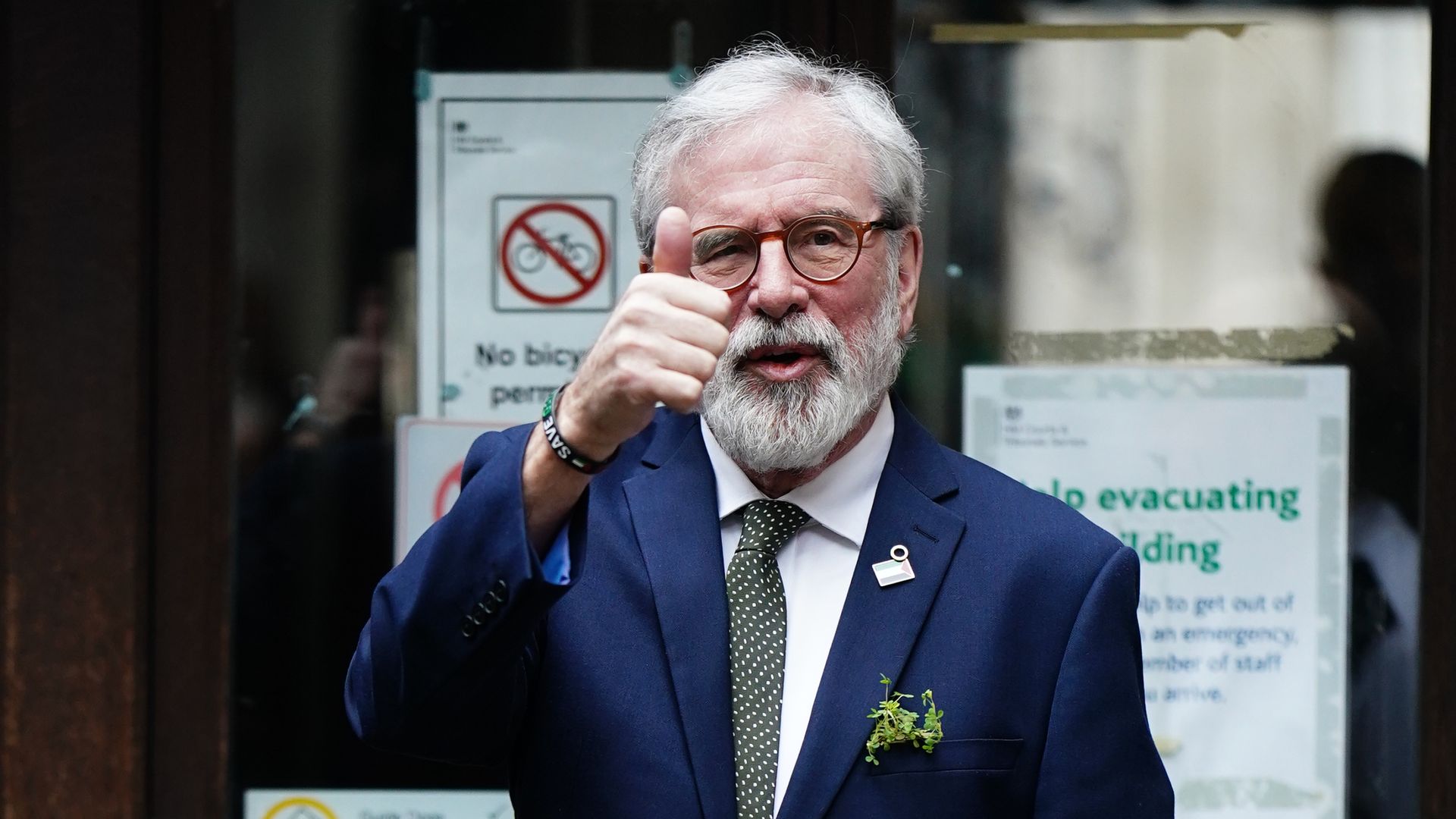
The persistent denial by Gerry Adams regarding his membership in the Provisional Irish Republican Army (IRA) represents more than a personal claim; it is a fundamental case study in strategic political insulation and the divergence between legal evidentiary standards and historical consensus. In the context of the Northern Ireland Peace Process, this denial functions as a necessary structural component of the Good Friday Agreement, allowing a bridge between a paramilitary past and a high-office future without the friction of criminal self-incrimination.
The Architecture of Plausible Deniability
To analyze the veracity of Adams’ claims, one must first define the operational hierarchy of the Republican movement during the "Troubles." The movement functioned as a duplex system: a military wing (IRA) and a political wing (Sinn Féin). While the public-facing narrative suggests a firewall between these two entities, internal organizational logic dictated a high degree of "interlocking directorates."
The "Pillar of Deniability" rests on three distinct mechanisms:
- Cellular Compartmentalization: The IRA’s transition in the late 1970s from a brigade structure to a small-cell system reduced the number of individuals with direct knowledge of specific operations. This created a strategic "knowledge gap" for leadership.
- Verbal Authority: Commands within the IRA’s Army Council were rarely digitized or documented. In an environment where the written word equals a life sentence, the absence of a "paper trail" is not evidence of absence, but evidence of professional tradecraft.
- The Political Proxy: By maintaining a strictly political profile in Sinn Féin, Adams could exert influence over the "Green Book" (the IRA manual) objectives while maintaining legal distance from the tactical execution of those objectives.
The Cost Function of Admission
If we treat the denial as a strategic choice, the "cost" of admission outweighs any perceived "benefit" of historical honesty. An admission of IRA membership, specifically during the period of the 1972 bombings or the 1973 Old Bailey attack, would trigger several immediate cascading failures:
- Legal Liability: Unlike many combatants who received "Royal Prerogatives of Mercy" or early release under the Good Friday Agreement, an admission of leadership in specific atrocities could reopen cold cases under the legacy legislation frameworks.
- Political De-legitimization: The Sinn Féin brand is built on the transition from "ballot box to armalite." However, the modern electoral appeal in both the Republic of Ireland and Northern Ireland relies on the perception of Sinn Féin as a standard social-democratic party. Admission of a direct command role in civilian-targeted bombings would alienate the middle-ground voter base.
- Intra-Movement Cohesion: For many "Old Guard" Republicans, the denial is seen as a necessary lie to protect the movement’s integrity. Conversely, for dissidents, it is viewed as a betrayal of the armed struggle’s legitimacy.
Evaluating the Evidence: The Boston College Tapes and Beyond
The most significant challenge to Adams’ narrative emerged through the Belfast Project, an oral history archive at Boston College. The testimonies of former IRA members Brendan Hughes and Dolours Price provided granular, first-hand accounts of Adams’ role within the Belfast Brigade.
The Hughes-Price Mechanism
Brendan Hughes, a high-ranking Belfast commander, explicitly identified Adams as his superior officer who allegedly sanctioned the "disappearance" of Jean McConville in 1972. The logical weight of this testimony is high because:
- Insider Proximity: Hughes and Adams were roommates and close tactical partners; the probability of Hughes misidentifying his direct supervisor in a rigid military hierarchy is statistically negligible.
- Lack of Incentive: At the time of the recording, Hughes was a disillusioned Republican with no financial or political incentive to fabricate a complex hierarchy that included Adams.
The British Intelligence Perspective
Declassified documents from the 1970s consistently refer to Adams as a key IRA strategist. During the 1972 secret ceasefire talks at Cheyne Walk in London, Adams was flown in by the British government specifically because they viewed him as an individual with the authority to command a cessation of IRA hostilities. If Adams were purely a political figure, his presence at a military negotiation table would have been a tactical redundancy.
The Legal vs. Historical Standard
A critical bottleneck in this discourse is the confusion between historical probability and legal proof.
The legal standard requires "beyond a reasonable doubt" evidence—specifically forensic links or corroborated eyewitness testimony that can survive cross-examination. In the absence of a signed membership card or DNA evidence at a bomb site, the legal system cannot convict Adams of IRA membership.
The historical standard, however, operates on the preponderance of circumstantial overlap. When an individual:
- Is arrested and interned as an IRA suspect (Long Kesh, 1970s).
- Negotiates on behalf of the IRA with the British State.
- Is consistently identified by peers as a commander.
- Exercises the authority to call off military campaigns.
The probability of "non-membership" approaches zero. The divergence here is not a failure of analysis, but a success of legal shielding.
The Strategic Play: Maintaining the Ambiguity
The "Adams Denial" is a stabilized equilibrium. The British and Irish governments, while publicly skeptical, have historically accepted the denial as a price for peace. To force an admission would be to destabilize the political leadership of Sinn Féin, potentially radicalizing the base and ending the power-sharing experiment.
The strategic recommendation for any analyst or policymaker is to view the denial not as a factual claim to be debunked, but as a functional fiction that maintains the current regional stability. The transition of a revolutionary movement into a governing body requires a "purification" phase where the actors distance themselves from the violence that enabled their rise. Adams’ denial is the definitive execution of that phase.
Expect this posture to remain unchanged until the passing of the "Troubles" generation. The ultimate resolution will not come through a courtroom confession, but through the eventual declassification of high-level intelligence files fifty years hence, which will likely confirm the dual-role occupancy that the current political climate cannot afford to acknowledge.
Would you like me to analyze the specific legal implications of the UK's Legacy Act on the ability to prosecute historical paramilitary leadership?