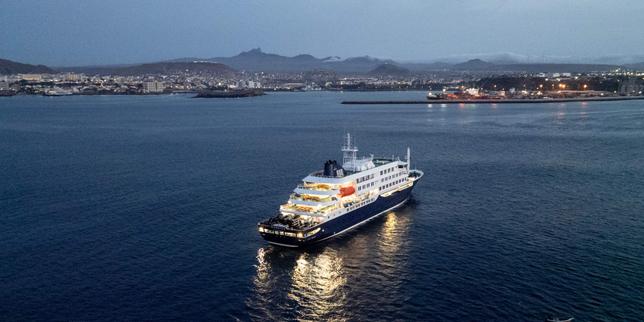
The wood doesn't just sit there. It breathes. If you stand on the deck of the INS Sudarshini when the wind catches the sails, you can hear the teak and mahogany whispering against the strain of 22,000 nautical miles. It is a sound that shouldn't exist in 2026. In an era of nuclear-powered carriers and GPS-guided steel behemoths that ignore the temper of the ocean, the Sudarshini is an anomaly. It is a three-masted sail training ship, a throwback to an age when crossing the sea was a negotiation between man and God.
When the ship pulled into the Grand Harbour of Malta this week, the limestone bastions of Valletta seemed to recognize her. This wasn't just another diplomatic port call. This was the arrival of the "Lokayan-26" expedition, a massive human undertaking that started in the humid docks of Kochi, India, and is currently carving a line across the globe.
To understand why a modern navy would send a wooden sailing ship across 22,000 miles of unpredictable salt water, you have to look past the brass fittings and the crisp white uniforms of the Indian Navy crew. You have to look at the hands of the sailors.
The Mathematics of Survival
Modern navigation is a triumph of screens. You tap a glass surface, a satellite pings, and a blue dot tells you exactly where you are within a few meters. But screens die. Batteries fail. Circuits fry in the corrosive spray of a North Atlantic gale.
The sailors aboard the Sudarshini are learning a different language. They are learning how to read the swell of the water to predict a coming storm. They are learning to calculate their position using a sextant and the stars, a skill that feels like sorcery until you realize it is the only thing that remains when the power goes out.
Consider a young cadet—let’s call him Arjun. He grew up in a landlocked city, used to the steady hum of air conditioning and the reliability of paved roads. Now, he is 30 feet above the deck, clinging to a yardarm as the ship rolls thirty degrees. The wind is screaming. His fingers are numb. In that moment, the 22,000-mile goal of Lokayan-26 isn't a statistic in a press release. It is a physical weight. It is the realization that the ship only moves if he and his crewmates move in perfect, agonizing unison.
This is the "invisible stake" of the expedition. It isn't about reaching Malta; it’s about who these sailors become by the time they see the Mediterranean horizon. The Indian Navy calls it "character building," but that’s a dry term for the radical transformation of a human soul under pressure.
A Bridge Made of Canvas
Malta and India are separated by vast geographical distances, but they are joined by the ghost of the British Empire and a shared seafaring DNA. When the Sudarshini glided past the Breakwater, it carried more than just a crew. It carried a message of "Vasudhaiva Kutumbakam"—the world is one family.
It sounds like a platitude. It feels like a line from a brochure. But then you see the Maltese locals standing on the Upper Barrakka Gardens, watching the sails come down. There is a silence that falls over a crowd when a tall ship enters a harbor. It is a primal recognition of effort.
The voyage is a marathon of diplomacy. Before hitting Malta, the ship had already weathered the Indian Ocean and the Red Sea. Every port is a handshake. Every shared meal between the Indian crew and their Maltese hosts is a brick in a bridge that bypasses the cold, digital channels of modern international relations. We live in a world of instant messaging, yet we have never been more disconnected. There is something about the slow, deliberate pace of a sailing vessel that forces a deeper kind of conversation. You cannot rush a ship that relies on the breeze.
The 22,000-Mile Mirror
Why 22,000 miles? Why not 5,000?
The distance is a deliberate provocation. It is long enough to exhaust a crew. It is long enough for the novelty to wear off and the grinding reality of shipboard life to set in. On a vessel like the Sudarshini, there is no privacy. Your bunk is your only sanctuary, and even that is shared with the smell of damp wool and diesel.
The expedition is a mirror. It reflects the resilience of the human spirit when stripped of modern luxuries. There are no "refresh" buttons on the ocean. If the wind dies, you wait. If the current turns against you, you fight.
The logistical backbone of Lokayan-26 is a feat of quiet engineering. Provisions have to be managed with a discipline that would make a master chef weep. Water is a precious commodity. Every watt of electricity is accounted for. The ship is a closed ecosystem, a tiny planet of wood and canvas floating in a void of blue.
Beyond the Horizon
As the Sudarshini prepares to leave Malta and continue its odyssey, the significance of the journey lingers in the air like salt spray. This isn't just about naval training. It is an act of defiance against the frantic, shallow pace of the 21st century.
We are obsessed with the destination. We want the fastest flight, the quickest download, the most immediate result. But the Lokayan-26 expedition reminds us that the value of a journey is often found in its duration. The sweat on the ropes, the night watches under a canopy of stars that no city dweller will ever see, and the slow, rhythmic creak of the hull are the things that actually matter.
The Sudarshini will eventually return to India. The sails will be furled, the logs will be archived, and the cadets will go on to serve on destroyers and submarines. But they will carry the Mediterranean sun in their skin and the memory of the wind in their bones.
The ship moves on, a sliver of white against the vastness, proving that even in a world of steel and silicon, we are still ultimately at the mercy of the sea—and that is exactly where we belong.
The sun sets over the Grand Harbour, casting long, amber shadows across the deck, and for a brief moment, the distance between Kochi and Valletta ceases to exist. There is only the water, the wind, and the impossible, beautiful endurance of the human heart.